
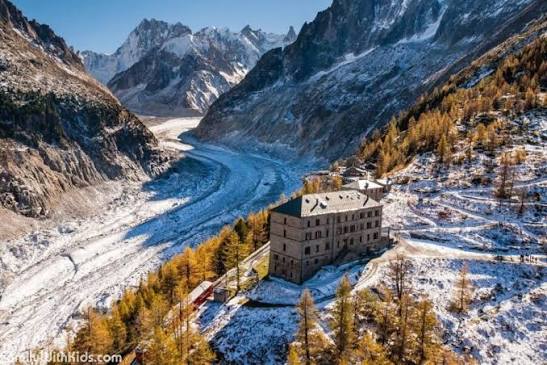
By Suraj Karowa and Richard Fisher/ANW Chamonix, France – November 7, 2025

The Mer de Glace reached all the way down to the Chamonix valley in 1823.
In the shadow of Mont Blanc, the French Alps’ snow-capped sentinel, lies a relic of Romantic awe now reduced to a haunting echo.
The Mer de Glace – France’s largest glacier, once a “sea of ice” that mesmerized poets and painters – has withered dramatically over two centuries.
Shrinking more than 2.5 kilometers (1.6 miles) since the mid-1800s, it’s a stark testament to climate change’s relentless grip.

The Mer de Glace reached all the way down to the Chamonix valley in 1823.
Scientists warn it could retreat another 2 kilometers by 2050, even under aggressive emissions cuts, turning a sublime wonder into a symbol of loss.
This icy expanse, creeping down from the Mont Blanc massif, was no mere backdrop for 19th-century travelers. It birthed literary legends.
In 1816, amid the “Year Without Summer” – a volcanic chill that darkened skies across Europe – 18-year-old Mary Shelley trekked to its edge.

JMW Turner captured the glacier when he visited the region.
Accompanied by her stepsister Claire Clairmont and future husband Percy Bysshe Shelley, she beheld a frozen torrent: waves and whirlpools arrested mid-roar, crevices plunging into azure depths.
“This is the most desolate place in the world,” Mary diary-scribbled, her words laced with dread and wonder.
“Iced mountains surround it – no sign of vegetation except on the place where we view the scene.”

Mer de Glace, painted in 1826 from a similar location as the Ruskin photograph.
Percy, equally entranced, likened it to “frost suddenly binding the waves and whirlpools of a mighty torrent,” its surface etched with 12-to-15-foot ridges and abyssal gaps.
That perilous horseback ascent – complete with a mule’s near-fatal slip – etched itself into Mary’s psyche.
Four years later, it surfaced in Frankenstein; or, The Modern Prometheus (1818).
In Chapter 10, tormented protagonist Victor Frankenstein ascends to the Mer de Glace seeking nature’s balm after his creation’s murderous rampage.

Frankenstein and his creation confront one another on the glacier in Mary Shelley’s story.
“The sea, or rather the vast river of ice, wound among its dependent mountains,” Victor marvels, his heart “swelling with something like joy.”
But solace shatters as the creature bounds across the ice for their fateful confrontation – a scene immortalized in countless adaptations, from John Coulthart’s brooding illustrations to Elsie Russell’s dramatic canvases.

The infamous meeting of the scientist and his monster on the glacier has inspired several paintings.
The glacier’s allure drew more than writers. The Grand Tour era funneled aristocrats and artists through Chamonix en route to Italy.
J.M.W. Turner captured its majesty in 1802 oils, swirling mists and jagged peaks evoking sublime terror.
Swiss painter Samuel Birmann documented its 1823 reach, toes nearly dipping into the valley floor below.
By 1826, from the vantage of today’s Refuge du Montenvers hotel, Birmann rendered it anew: a brooding southeast vista of undulating white.

One hundred years ago, the glacier was still a rugged sea of ice.
Enter photography’s dawn. In the 1850s, John Ruskin’s assistant daguerreotyped the Mer de Glace’s rough, gloomy surface – an early snapshot of compacted snow’s slow crawl.
Charles Dickens, visiting in 1847, raved of Chamonix’s “stupendous or sublime” vistas, impressions too “prodigious” for prose.
Yet these tributes mask tragedy. Remote sensing and ground data chart the Mer de Glace’s retreat – unusual for its dual archive of art and science.

By 2014, the glacier was a shadow of its former self.
In the 1800s, it nearly kissed Chamonix settlements. By 1926, archival photos still showed a rugged sea of crevasses.
The 21st century accelerated the melt: 2002 marked a tipping point, with 2014 images revealing a diminished shadow, dusted in moraine debris.
Artist Emma Stibbon echoed Ruskin’s style in a 2018 cyanotype, her print a ghostly lament for what’s lost. The 2022 heatwave – Alps-wide ice massacre – pushed it further.
Today, from Montenvers, it’s a phantom: the valley barren save for powdery rubble and meltwater rivulets. No roiling ocean; just absence.

A picture taken in a similar style to Ruskin’s daguerreotype shows the glacier in 2018.
A 2024 cable car now ferries visitors down to glimpse remnants, underscoring the irony.
My own 2023 pilgrimage mirrored the Shelleys’. Hiking the forested path – too late for the tourist train – I crested Montenvers breathless, eyes straining for that “dizzying wonder.”
Instead: void. The glacier hunkers behind mountain bends, recoiled like a wounded beast.
Hiking two hours uphill, past glacial fountains, only amplified the desolation Mary evoked.

The view of the glacier in 2014 from a similar position as Ruskin’s daguerreotype .
Models by glaciologist Vincent Peyaud paint grim futures. Optimistic blue lines project a 2050 toe 2 kilometers higher; pessimistic reds foretell near-erasure by 2099 – though that high-emissions path grows improbable amid global pledges.
Still, the math chills: the next half-century’s loss could mirror the 1800s-to-2000s toll.
The Mer de Glace’s saga transcends ice. It’s a canvas of human ambition – Romantic exaltation clashing with industrial folly.
Shelley’s “hideous progeny” – her self-dubbed Frankenstein – warned of unchecked creation.
Now, as Guillermo del Toro preps his film adaptation, the glacier itself embodies that monster: birthed by nature, slain by us.
Percy’s Mont Blanc (1816) pondered the peak’s “unremitting interchange” of power and silence. Today, that silence screams. Artists persist: Stibbon’s echoes, satellite snaps.
But without emissions halts, Mary’s desolate sea risks oblivion – a Frankenstein finale where creator and created both perish in the melt.
As Chamonix buzzes with skiers oblivious to the thaw, the Mer de Glace whispers urgency. Visit now; tomorrow’s view may be gravel and ghosts. In an era of tipping points, this French jewel urges: heed the ice, before it heeds us no more.
Discover more from AMERICA NEWS WORLD
Subscribe to get the latest posts sent to your email.










Leave a Reply