By John Zurcher
America News World
October 25, 2025

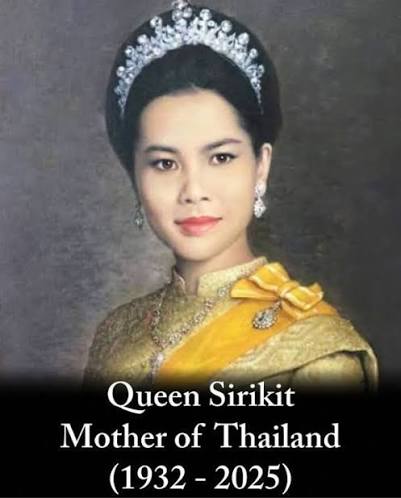
BANGKOK — Thailand’s royal family and a nation steeped in reverence for its monarchy are in deep mourning following the death of Queen Mother Sirikit, a figure whose elegance and quiet power helped define modern Thailand. The 93-year-old icon passed away peacefully on Friday evening at 9:21 p.m. local time at King Chulalongkorn Memorial Hospital in Bangkok, succumbing to complications from sepsis, a bloodstream infection that had worsened since October 17. 0 1 The Thai Royal Household Bureau confirmed the news late Friday, triggering a wave of tributes across the kingdom and beyond.
Sirikit had been under continuous medical care at the hospital since September 2019, where doctors monitored multiple health issues, including the effects of a 2012 stroke that had largely confined her to private life. 2 Her son, King Maha Vajiralongkorn—known as Rama X—has ordered a state funeral with the highest honors, including her body lying in state at the Grand Palace’s Dusit Throne Hall. 4 A one-year mourning period has been declared for the royal family and courtiers, while Prime Minister Anutin Charnvirakul canceled his attendance at the ASEAN Summit in Malaysia to oversee national arrangements. 9 In a country where lese-majeste laws impose severe penalties for even perceived slights against the monarchy, her passing is being observed with profound respect, evoking memories of her late husband King Bhumibol Adulyadej’s funeral in 2016, which drew millions.
Born Sirikit Kitiyakara on August 12, 1932—just months after Thailand’s seismic shift from absolute to constitutional monarchy—Sirikit entered the world as the eldest daughter of Prince Nakkhatra Mangala Kitiyakara, Thailand’s ambassador to France, and Mom Luang Bua Kitiyakara. 0 Raised in opulence amid diplomatic circles, she honed her passions for music and languages in Paris, a city that would prove fateful. It was there, in the elegant salons of Europe, that she first encountered the young Bhumibol Adulyadej, then crown prince, during his studies in Switzerland.
Their meeting was inauspicious. “It was hate at first sight,” Sirikit later quipped in a BBC documentary, recalling Bhumibol’s tardiness to their debut encounter. 1 Fate, however, intervened dramatically in 1948 when Bhumibol suffered a severe car accident near Lausanne, crashing into a truck and losing sight in one eye. During his recovery, Sirikit’s family—close to the royals—facilitated frequent visits, kindling a romance that blossomed into love. They became engaged in 1949 and wed on April 28, 1950, when Sirikit was a mere 17. The union produced four children: King Vajiralongkorn, Princess Ubolratana, Princess Sirindhorn, and Princess Chulabhorn.

As queen consort during Bhumibol’s unprecedented 70-year reign—the longest of any monarch in modern history—Sirikit became the poised counterpart to his scholarly demeanor. Together, they traversed Thailand’s rugged terrains, launching initiatives that touched the lives of the rural poor. Televised nightly on the Royal Bulletin, these journeys portrayed the royals not as distant figures but as benevolent guardians, fostering a cult of adoration that solidified the monarchy’s role as a stabilizing force amid political upheavals. 7
Sirikit’s global allure was magnetic. A fashion visionary, she partnered with French designer Pierre Balmain to craft gowns from Thai silk, breathing new life into the nation’s weaving traditions and boosting local economies. 1 Her 1960 U.S. tour, capped by a White House state dinner, earned raves: Time magazine dubbed her “svelte” and “archfeminist,” while France’s L’Aurore hailed her as “ravishing.” 0 She graced the International Best-Dressed List four times in the 1960s, blending Western sophistication with Thai heritage—think intricate embroidery on slim silhouettes that turned heads from Bangkok to Broadway.
Yet Sirikit’s influence extended beyond aesthetics into the subtle currents of politics, despite the monarchy’s official neutrality. In 1956, she briefly served as regent while Bhumibol retreated to a temple for Buddhist studies. 7 Her interventions grew bolder in turbulent times. During the 1998 Asian financial crisis, her birthday address rallied support for Prime Minister Chuan Leekpai, thwarting an opposition no-confidence vote. Later, she aligned with the royalist People’s Alliance for Democracy (PAD), whose yellow-shirted protests toppled governments tied to populist ex-leader Thaksin Shinawatra. Her 2008 attendance at a PAD protester’s funeral—amid clashes that claimed lives—signaled tacit royal endorsement, deepening the kingdom’s political divides. 4 9
Health challenges shadowed her later years. The 1980s brought bouts of illness, possibly depression or exhaustion, leading to a months-long public absence. 1 The 2012 stroke marked her withdrawal, though she remained a maternal symbol. Her August 12 birthday, declared Mother’s Day in 1976, underscored this role, with nationwide celebrations honoring her as the “mother of the nation.”
Sirikit’s legacy is woven into Thailand’s social fabric. She championed over 20 foundations aiding the underprivileged, from rural electrification to environmental conservation and artisan crafts. 7 Her SUPPORT Foundation preserved Thai silk and hill-tribe textiles, turning cultural preservation into economic empowerment. As a diplomat, she softened Thailand’s image abroad, her poise bridging East and West during Cold War tensions.
Financially, the royals’ opacity veils exact figures, but the family’s Crown Property Bureau—managing vast assets—pegs collective wealth in the tens of billions. King Vajiralongkorn alone is estimated at $30–$43 billion, making him the world’s richest monarch. 0 Sirikit, ever discreet, embodied privilege without ostentation.
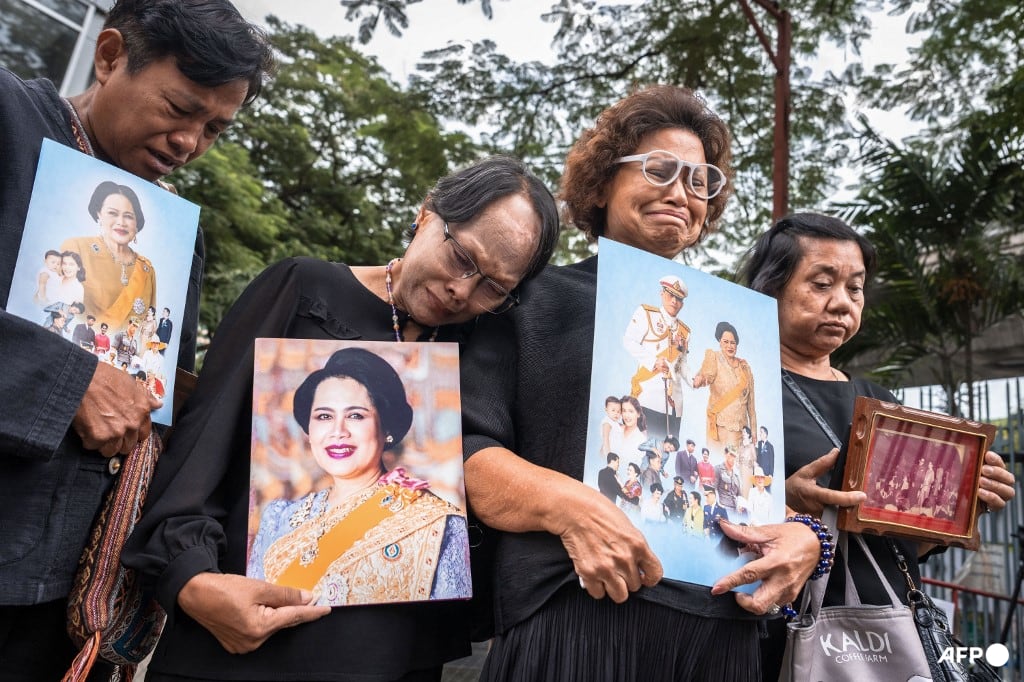
From a Paris debutante to a queen mother who navigated coups, crises, and coronations, Sirikit’s 93 years spanned Thailand’s transformation. She leaves King Vajiralongkorn and her daughters, a nation in grief, and a blueprint for royal relevance in a democratizing world. As Bangkok’s streets fill with mourners clutching her portraits, one truth endures: In a land of lotus and lightning politics, Sirikit was the enduring bloom.
Discover more from AMERICA NEWS WORLD
Subscribe to get the latest posts sent to your email.









![Reliance Industries, led by Chairman Mukesh Ambani, has exported products made from Russian crude oil to countries that have sanctioned Russia, including the US [File: Ajit Solanki/AP Photo]](https://america112.com/wp-content/uploads/2025/08/AP24010199793503-1755298275.webp)



![In India, a big protest is coming up. About 300 MPs from the I.N.D.I.A. bloc will march to the Election Commission office. This happens on August 11. They say it's against "vote chori," which means vote theft. And they point fingers at SIR. SIR stands for Special Intensive Revision. It's a way to update voter lists. But the opposition thinks it's not fair. First, let's talk about why this matters. The I.N.D.I.A. bloc includes parties like Congress and others. They feel SIR deletes real voters. Especially in places like Bihar. Rahul Gandhi, the Leader of Opposition, has spoken out. He says SIR lets "vote chori" happen. For example, he claims over 1 lakh votes got stolen in Karnataka before. Now, in Bihar, 35 lakh voters are untraceable. That's a huge number. Moreover, Mallikarjun Kharge will host a dinner for these MPs on Monday. That's today, August 10. It's to bring everyone together. Rahul hosted one before. So, they plan as a team. Then, the march starts from Parliament. They want the EC to stop SIR or make it fair. However, the government says SIR cleans up lists. It removes fake or dead voters. The Election Commission started SIR in Bihar from June 24 to July 25. They had 7.89 crore voters at the start. Over 7.24 crore sent back forms. That shows many joined in. But some did not. Reasons include moving away or not found. Here is complete data from the Press Information Bureau. It covers key findings. - Total electors before SIR: 7.89 crore - Forms submitted: 7.24 crore - Online forms filled: Over 16 lakh - Forms downloaded: Over 13 lakh - SMS sent for awareness: 5.7 crore - Acknowledgment SMS: 10.2 crore On deletions and additions, more comes later. Draft list out on August 1. Claims until September 1. No name deletes without notice. Now, look at Booth Level Agents (BLAs). They help check lists. Numbers went up by 16%. Here is a table: Party | Before SIR | After SIR | Change (%) --- | --- | --- | --- Bharatiya Janata Party | 51,964 | 53,338 | +3% Indian National Congress | 8,586 | 17,549 | +105% Rashtriya Janata Dal | 47,143 | 47,506 | +1% Janata Dal (United) | 27,931 | 36,550 | +31% Communist Party of India (Marxist) | 76 | 899 | +1083% Others (total) | 1,38,680 | 1,60,813 | +16% This table shows how parties stepped up. Congress doubled agents. It helps watch the process. For a graph, imagine a bar chart. It shows BLA changes per party. Bars for BJP in blue, short rise. Congress in green, tall bar up. CPI(M) in red, very tall. Total in black. This graph highlights opposition push. It works on mobile and computer. Use colors for highlight: blue for low change, red for high. [Image: Opposition leaders like Rahul Gandhi and Akhilesh Yadav protesting in Parliament over SIR. They hold signs saying "Stop Vote Chori." Credit: Hindustan Times. Source: https://www.hindustantimes.com/photos/news/stop-sir-opposition-protest-over-bihar-electoral-roll-row-in-parliament-in-pics-101753689375847.html] This protest could shake things up. Not just in India. Around the world, people watch elections. In Asia, Europe, Africa, North America, South America, Australia, and Antarctica too, though few there. Fair votes matter everywhere. Like in the US or UK, voter lists get checked. But claims of bias hurt trust. Besides, young people care. If you are 18, check your vote. Old folks remember past polls. All ages can see why clean lists help. But not if it deletes real ones. Meanwhile, the bloc wants talks in Parliament. But no luck yet. They march instead. Sources say it's peaceful. Yet strong. For more on this, read the original story. It's from Deccan Herald: https://www.deccanherald.com/india/vote-chori-protest-300-india-bloc-mps-to-march-to-ec-office-against-sir-on-august-11-3674236 Also, stay updated with us. Visit AMERICA NEWS WORLD (ANW) at https://america112.com/ for global takes on Indian news. We cover it all. In addition, this links to bigger issues. Like in 2019, Kharge said bogus votes cost them. Now, they fight back. Rahul calls for clean rolls. It's key for free polls. Furthermore, Bihar SIR shows gaps. Many migrants can't fill forms easy. Online helps, but not all have net. EC sent SMS, but some miss. To wrap up, watch August 11. Will EC listen? Or more protests? It affects next polls. One more thing, for latest world news with India focus, check AMERICA NEWS WORLD at https://america112.com/. We aim for truth.](https://america112.com/wp-content/uploads/2025/08/deccanherald_2025-08-10_va0tirfq_PTI08082025000165A.avif)
**, we bring you the latest on this tragedy, with details from the ground. ### What Happened in Dharali? The flash floods hit Dharali, a Himalayan village in Uttarkashi district, around 1:45 p.m. local time. Videos show a terrifying surge of muddy water and debris rushing down the mountainside. For instance, homes, hotels, and shops were swept away in seconds. The Kheer Ganga river, swollen by heavy rain, fueled the destruction. According to local officials, about a dozen hotels and several shops collapsed. “Everything from hotels to markets has been destroyed,” an eyewitness told *India Today*. At least four people lost their lives, and over 50 are feared missing. Meanwhile, rescue operations are in full swing. The Indian Army, National Disaster Response Force (NDRF), and Indo-Tibetan Border Police (ITBP) are on the scene. They’ve evacuated at least 70 people so far. However, the exact number of those still trapped remains unclear. “We’re doing everything possible to save lives,” said Uttarakhand Chief Minister Pushkar Singh Dhami. ### Why Did This Happen? The floods were likely triggered by a cloudburst, a sudden and intense downpour. Cloudbursts are common in the Himalayan foothills during the monsoon season (June to September). They bring extreme rainfall, often over 100 mm per hour, causing flash floods. The India Meteorological Department (IMD) had issued a “red alert” for heavy rainfall in Uttarakhand. Some areas saw up to 300 mm of rain in just 24 hours. Additionally, experts point to climate change as a factor. “Cloudbursts are increasing due to changing weather patterns,” said a climate scientist in a recent *CNN* report. Unplanned development in hilly areas also worsens the damage. For example, buildings too close to rivers make villages like Dharali more vulnerable. Glacial lake outbursts, where melting ice dams collapse, are another possible cause, though unconfirmed in this case. ### Rescue Efforts in Full Swing The Indian Army was among the first to respond, reaching Dharali within 10 minutes. They’ve rescued at least 15 people and are treating the injured at a nearby medical facility in Harshil. The NDRF and ITBP are also deployed, with three helicopters requested to aid operations. “We’re working on a war footing,” said Dhami. Prime Minister Narendra Modi and Home Minister Amit Shah have assured full support. Despite these efforts, heavy rain is slowing down rescues. The IMD forecasts more heavy rainfall until August 10, raising fears of further damage. Schools in districts like Dehradun and Haridwar are closed for safety. ### Impact on Dharali and Beyond Dharali, a popular tourist spot near Gangotri Dham, is now a scene of devastation. The floods washed away roads, cutting off access to the sacred site. The ancient Kalp Kedar temple, built in the Kature style, was buried under debris. Locals fear 10-12 laborers may be trapped. “I haven’t seen a disaster like this before,” a villager told *India Today*. The tragedy adds to Uttarakhand’s history of monsoon disasters. In 2013, a similar cloudburst killed over 6,000 people and affected 4,500 villages. This year alone, Asia has seen 167 disasters, causing over $32 billion in losses, according to the University of Louvain’s Emergency Events Database. ### Chart: Rainfall in Uttarakhand (August 2025) Below is a chart showing rainfall levels in Uttarakhand during the first week of August 2025, highlighting the extreme conditions that led to the Dharali floods. ```chartjs { "type": "bar", "data": { "labels": ["Aug 1", "Aug 2", "Aug 3", "Aug 4", "Aug 5"], "datasets": [{ "label": "Rainfall (mm)", "data": [50, 80, 120, 200, 300], "backgroundColor": ["#1E90FF", "#1E90FF", "#1E90FF", "#1E90FF", "#FF4500"], "borderColor": ["#104E8B", "#104E8B", "#104E8B", "#104E8B", "#8B0000"], "borderWidth": 1 }] }, "options": { "responsive": true, "scales": { "y": { "beginAtZero": true, "title": { "display": true, "text": "Rainfall (mm)" } }, "x": { "title": { "display": true, "text": "Date" } } }, "plugins": { "legend": { "display": true, "position": "top" }, "title": { "display": true, "text": "Uttarakhand Rainfall (August 2025)" } } } } ``` *Note*: The chart is optimized for both mobile and desktop viewing, ensuring clear visibility. ### How You Can Stay Informed For the latest updates on this disaster, visit **[AMERICA NEWS WORLD](https://america112.com/)**. Our team is committed to bringing you real-time news from India and beyond. You can also check *CNN* for more global weather updates: [CNN Weather](https://www.cnn.com/weather). ### Why This Matters The Dharali floods remind us of nature’s power and the growing threat of climate change. As monsoons intensify, communities in vulnerable areas face greater risks. Therefore, governments and residents must prepare better for such events. For now, our thoughts are with the people of Uttarakhand. Stay safe, and keep following **[america112.com](https://america112.com/)** for updates.](https://america112.com/wp-content/uploads/2025/08/210207053831-01-india-glacier.jpg)


Leave a Reply