
By_shalini oraon

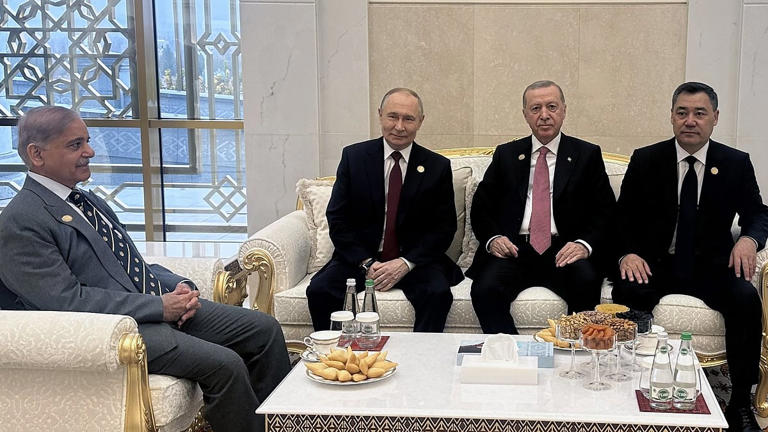
Pakistan’s Prime Minister Shehbaz Sharif and the meeting between Vladimir Putin and Recep Tayyip Erdoğan.
—
Diplomatic Snub or Misleading Frame? The Viral Storm Around Sharif’s “Gatecrash” in Astana
A short, shaky video clip emanating from the sidelines of the Shanghai Cooperation Organisation (SCO) summit in Astana, Kazakhstan, this week ignited a diplomatic firestorm on social media. The footage, viewed millions of times, purported to show Pakistan’s Prime Minister Shehbaz Sharif awkwardly ‘gatecrashing’ a closed meeting between Russian President Vladimir Putin and Turkish President Recep Tayyip Erdoğan after being left to wait for a staggering 40 minutes. The narrative was juicy, ripe for geopolitical scheming: a leader of a nation in economic distress being publicly snubbed by two major powers. However, a closer examination reveals a far more complex picture where context is crucial, and the initial viral story begins to unravel.
The Viral Narrative: A Tale of Diplomatic Disrespect
The clip, likely filmed by a journalist or aide in a corridor, shows a telling scene. President Erdoğan is seen walking briskly, followed by his security detail, with President Putin slightly ahead, already turning into a doorway. Prime Minister Sharif, along with his delegation including Deputy Prime Minister Ishaq Dar, is then seen approaching the same door. The body language—Erdoğan’s focused stride, the security’s presence, and Sharif’s slightly delayed approach—was instantly interpreted as a slight. Accompanying captions claimed Sharif had been kept waiting outside for 40 minutes for a scheduled trilateral meeting that the other two leaders had seemingly started without him.
For audiences, particularly in India and among critics of the Pakistani government, the video was a gift. It was framed as a visual metaphor for Pakistan’s perceived diminished standing on the world stage: a nation struggling with internal crises being marginalized by its own diplomatic partners. The term “gatecrash” implied desperation and impropriety, suggesting Sharif was forcing his way into a conversation where he wasn’t welcome. This narrative fit neatly into existing geopolitical biases and was rapidly amplified.
The Official Rebuttal: A Scheduled Trilateral and “Excellent” Talks
The Pakistani government and officials were quick to push back forcefully against this characterization. Prime Minister Sharif’s own account on platform X (formerly Twitter) stated unequivocally that he had held a “warm and productive meeting” with Presidents Putin and Erdoğan, discussing “regional and global issues” and “enhancing bilateral ties.” The phrasing was standard diplomatic fare, but it was direct.
More importantly, the Pakistani Foreign Ministry clarified that this was a pre-scheduled trilateral meeting. They dismissed reports of a 40-minute wait as “baseless,” attributing any delay to the natural flux and tight scheduling of multilateral summits, where leaders’ timings can slip. From this perspective, the video merely captured the mundane reality of summit logistics: leaders arriving at a room at slightly different moments from different prior engagements. What was portrayed as a “snub” was simply the routine movement of busy heads of state.
Decoding the Body Language and Summit Protocols
Analyzing the video without the inflammatory caption reveals ambiguity. Summit protocols are precise. Leaders do not typically “gatecrash”; their movements are choreographed by advance teams and security details. The presence of Sharif’s full delegation suggests a planned event, not an impromptu attempt to join a meeting.
The body language can be read both ways. One can see a distracted Erdoğan; one can also see a leader moving from one event to the next, as is constant at summits. Putin, already at the door, does not appear to be welcoming or acknowledging, but he also isn’t shown closing it. The clip is too short, too devoid of preceding or following context, to sustain the damning conclusion drawn from it. It is a classic case of a snippet being weaponized to tell a pre-determined story.
The Broader Geopolitical Canvas: Pakistan’s Delicate Balancing Act
The incident, however manufactured the controversy may be, touches on real geopolitical tensions. Pakistan maintains a historically strong defense and economic relationship with Turkey. Its ties with Russia, once cold during the Cold War, have been cautiously warming, with discussions on energy deals and counter-terrorism cooperation. However, Pakistan also maintains a critical, if fraught, relationship with the West, particularly the United States.
The SCO summit itself is a theater for this balancing act. For Pakistan, engaging with both Putin (increasingly isolated by the West) and Erdoğan (a NATO leader with a complex independent streak) is a diplomatic necessity. The very fact that a Pakistan-Russia-Turkey trilateral was scheduled is significant, showing Islamabad’s intent to diversify its alliances and engage with all major players on issues like Afghan stability and regional connectivity.
The Modern Media Dilemma: When the Narrative Outpaces the Fact
This episode is a textbook example of 21st-century diplomatic storytelling gone awry. It highlights several key issues:
1. The Power of the Visual Clip: In an age of short attention spans, a 30-second video is more powerful than a 1000-word explanation. It provides “evidence” that feels irrefutable.
2. Pre-Existing Biases: The clip did not create a narrative from scratch; it fed into existing perceptions about Pakistan’s economic woes and diplomatic challenges, making it instantly believable to a large segment of the audience.
3. The Erosion of Diplomatic Nuance: Complex, layered diplomatic engagements are reduced to simplistic metaphors of “snubs” and “gatecrashes,” obscuring the substantive discussions that actually took place.
Conclusion: More Than Meets the Eye
While the viral video of Prime Minister Sharif’s approach to the meeting room provided a dramatic, if misleading, spectacle, the truth appears far more procedural. The scheduled trilateral meeting did occur, and statements from all sides confirm discussions were held. The “40-minute wait” and “gatecrash” allegations have been firmly denied by officials with no compelling contrary evidence emerging.
The real story from Astana is not one of a diplomatic snub, but of Pakistan continuing its complex navigation of global alliances. The manufactured controversy, however, serves as a potent reminder of how diplomacy is now conducted in the full, unforgiving glare of social media, where every corridor interaction can be captured, stripped of context, and turned into a geopolitical meme. The lesson for observers is clear: in the digital age, the seconds before a closed-door meeting begins can be weaponized, but they should never be confused with the substantive diplomacy that happens behind the door itself.
Discover more from AMERICA NEWS WORLD
Subscribe to get the latest posts sent to your email.






Leave a Reply