
By_shalini oraon

From Tea Shop to Trauma Ward: Myanmar’s Junta Escalates War on Civilians
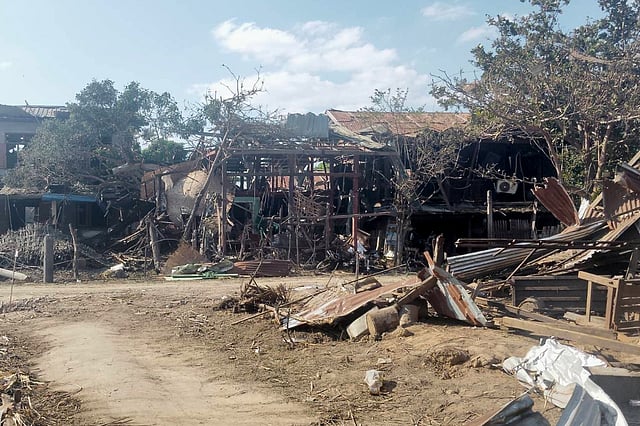
In a horrific escalation of its campaign of terror against the civilian population, the Myanmar military junta has once again committed an atrocity that shocks the conscience of the world. Barely a month after a deadly airstrike on a crowded tea shop in Sagaing Region killed at least 20 people, including children, the same brutal machinery has turned its sights on a place of sanctuary and healing. A military jet reportedly bombed a hospital in the Karenni State (Kayah), killing at least 31 people, including patients, medical staff, and civilians seeking shelter. This attack is not an anomaly but a deliberate pattern, marking a sinister new phase in the junta’s desperate struggle to crush widespread resistance.
The Anatomy of an Atrocity
The attack occurred in an area controlled by anti-junta People’s Defense Forces (PDFs), a fact that forms the core of the military’s callous justification. Junta spokesman Zaw Min Tun, in a now-familiar refrain, claimed the facility was being used by “terrorists” as a base, framing the bombardment as a legitimate military operation. This narrative is systematically used to greenlight the indiscriminate targeting of civilian infrastructure.
However, survivors, humanitarian organizations, and defecting medical personnel tell a different story. They describe a functional medical facility, a trauma ward overwhelmed with the casualties of the junta’s ongoing war. Hospitals in these conflict zones are lifelines, treating not only combatants but also the countless civilians injured in crossfire, artillery shelling, and previous airstrikes. By bombing a hospital, the junta does more than kill those inside; it obliterates the entire region’s capacity to respond to trauma, ensuring that even those who survive future attacks may die from lack of care. This constitutes a catastrophic violation of the foundational principles of international humanitarian law, specifically the Geneva Conventions, which mandate the protection of medical facilities and personnel in conflict zones.
The Tea Shop Precedent: A Pattern of Terror
To understand the hospital bombing, one must view it through the lens of the tea shop massacre that preceded it by just 31 days. That strike, on a clearly civilian gathering place in the village of Let Yet Kone, was a statement of intent. It demonstrated the junta’s willingness to use its overwhelming air power—largely supplied by Russia and China—against any gathering, any space where community life persists in areas it does not control. The tea shop is the heart of a Burmese village, a place of gossip, commerce, and respite. Its destruction was an attack on social cohesion itself.
The hospital bombing is the logical, if more grotesque, next step. If the tea shop strike targeted the social lifeline of the community, the hospital strike targets the physical lifeline. Together, they form a deliberate two-pronged strategy: first, terrorize the population by showing that no social space is safe; second, cripple their ability to recover from the terror you inflict. It is a strategy of collective punishment designed to break the will of the people supporting the resistance.
The International Response: A Failure of Consequences
The global reaction has followed a depressingly predictable cycle: condemnation, calls for restraint, and diplomatic deadlock. The UN Security Council remains hamstrung by the vested interests of permanent members. While Western nations impose targeted sanctions on junta officials and military conglomerates, these measures have done little to slow the violence or curb the flow of arms, particularly from Russia, which has become the junta’s chief weapons supplier and diplomatic shield. China, while expressing concern, continues to engage with the junta and block more robust multilateral action. ASEAN’s “Five-Point Consensus” is in tatters, ignored outright by the generals.
This consistent failure to impose meaningful consequences has created a permissive environment for the junta. When a military faces no tangible cost for bombing a tea shop, it learns it can bomb a hospital. The absence of a referral to the International Criminal Court (ICC), or the establishment of a dedicated international tribunal, means accountability remains a distant dream for victims. The junta operates with the grim assurance of impunity.
The Human Cost and the Resilience of a People
Behind the numbers—31 killed, 20 killed—are stories of unimaginable loss. A midwife killed while delivering a child. A doctor incinerated at a patient’s bedside. Elderly patients who could not flee. These are not collateral damage; in the junta’s calculus, they are the target. The aim is to make life in resistance-held areas untenable.
Yet, the resilience of the Myanmar people continues to defy this brutality. Civilian-led humanitarian groups, often operating at great personal risk, are rebuilding healthcare systems underground, setting up mobile clinics in jungles, and smuggling medicines across borders. The National Unity Government (NUG) and ethnic resistance organizations are desperately seeking ways to acquire air defense systems to counter the junta’s unchallenged dominance of the skies—a dominance that is the direct cause of atrocities like the tea shop and hospital bombings.
Conclusion: A Threshold Crossed
The bombing of a hospital 31 days after the bombing of a tea shop is more than a tragic coincidence. It is a deliberate escalation, a crossing of a moral and legal threshold that reveals the true nature of the Myanmar junta’s war: a war against the people themselves. It is a strategy that leverages terror as a primary tool, viewing civilian suffering not as a byproduct of conflict, but as its central engine.
The international community’s tepid response now carries a heavier burden of blood. Every day without effective action—an arms embargo, coordinated sanctions on jet fuel suppliers, or a legitimate process for justice—is a day that grants the junta permission to choose its next target. Will it be a school? A monastery? A camp for the displaced? The pattern is set. The world’s inaction has become a form of complicity, and until that changes, the people of Myanmar will continue to pay the price in tea shops and trauma wards, waiting for a sanctuary that no longer exists.
Discover more from AMERICA NEWS WORLD
Subscribe to get the latest posts sent to your email.


























Leave a Reply