
By Elena Vargas, Sam jones and Suraj Karowa/ANW International Correspondent Madrid, Spain – December 1, 2025

Pressure grows on Pedro Sánchez amid series of claims involving his family, party and administration.
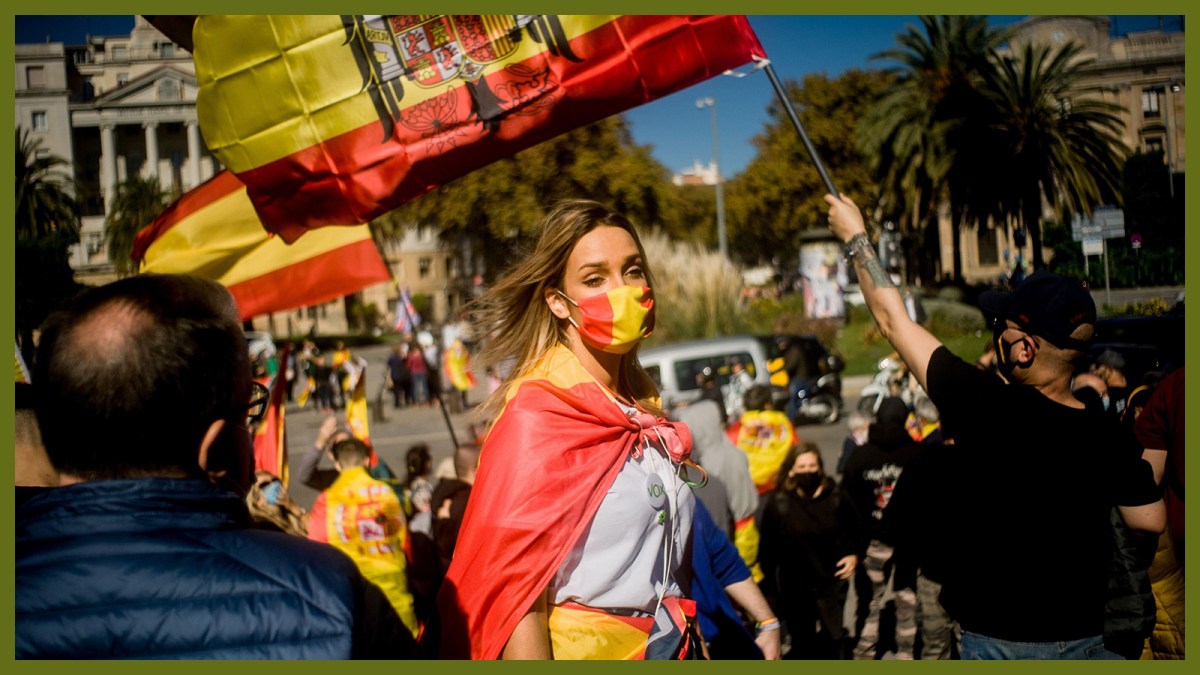
In a thunderous display of public fury, tens of thousands of Spaniards flooded the heart of Madrid on Sunday, their voices a cacophony of chants and placards demanding the immediate resignation of Prime Minister Pedro Sánchez and a snap general election.
Organized by the conservative People’s Party (PP), the rally at the iconic Temple of Debod transformed the Egyptian inspired monument into a sea of blue-and-yellow Spanish flags, fervent slogans, and palpable outrage.
Under the rallying cry “This is it: mafia or democracy?”, protesters decried what they see as a government mired in scandal, betrayal, and moral decay.
The demonstration, which drew an estimated 40,000 to 80,000 attendees depending on the source—PP organizers claimed the higher figure, while government officials pegged it at half—came at a precarious moment for Sánchez’s socialist administration.

People wave Spanish flags and hold placards during the protest called by the People’s party in central Madrid.
Just days earlier, on Thursday, former Transport Minister José Luis Ábalos, once a pillar of Sánchez’s inner circle, was remanded in custody without bail.
A judge in Valencia is probing an explosive kickbacks-for-contracts scheme allegedly orchestrated during the COVID-19 pandemic, involving millions in public funds siphoned through bogus deals for medical supplies.
Ábalos’s arrest has ignited a firestorm, amplifying a cascade of allegations that have ensnared Sánchez’s family, allies, and party apparatus.
“Sanchismo”—the term coined by critics to encapsulate the prime minister’s combative, coalition-dependent style of governance—has become synonymous with corruption in the eyes of the opposition.
PP leader Alberto Núñez Feijóo, addressing the throng from a makeshift stage flanked by massive banners, didn’t mince words.
“This legislature is absurd, rotten to its core,” he bellowed, his voice booming over the crowd’s roars.

The leader of the People’s party, Alberto Núñez Feijóo, speaks during the rally in Madrid.
“Ábalos is in prison, and sanchismo must follow him out of power. It’s not just political or economic corruption—it’s institutional, social, and moral rot.”
Feijóo’s speech was a masterclass in populist rhetoric, painting Sánchez as a puppet master presiding over a web of deceit.
He invoked the ghosts of past scandals that toppled previous governments, drawing parallels to the 2018 no-confidence vote that catapulted Sánchez to power by ousting then-PM Mariano Rajoy’s corruption-plagued administration.
“He came in on a broom of anti-corruption promises,” Feijóo quipped, eliciting cheers.
“Now, it’s time for the people to sweep him out.”
Adding fuel to the flames was Isabel Díaz Ayuso, the firebrand president of the Madrid region and PP standard-bearer.
Known for her unapologetic conservatism and sharp-tongued oratory, Ayuso escalated the drama by invoking the specter of ETA, the Basque separatist group that terrorized Spain for decades before disbanding in 2018.
“While ETA licks its wounds and plots its return to the Basque Country and Navarra, Pedro Sánchez props them up with his unholy alliances,” she thundered, her words met with a mix of gasps and applause.
Ayuso accused Sánchez of betraying Spain’s unity by cozying up to nationalist parties that once sympathized with the terrorists.
Her own personal entanglements—a boyfriend facing trial for tax fraud and document falsification—did little to dampen her fervor; if anything, they lent a veneer of shared victimhood to the narrative.
Yet, the rally wasn’t without its ironies. The far-right Vox party, often PP’s ideological bedfellow, conspicuously boycotted the event, citing tactical differences.
Government spokespeople were quick to pounce. Félix Bolaños, Sánchez’s Minister for the Presidency, Justice, and Relations with the Cortes, dismissed the protest as a “circus orchestrated by twins in outrage: PP and Vox, racing to see who can sling the muddiest barbs.”
In a pointed jab, Bolaños highlighted the judiciary’s independence, noting that investigations proceed apace regardless of political theater.
Sánchez, 53, has weathered storms before. Elected in 2018 amid the Rajoy debacle, he navigated minority governments through labyrinthine coalitions with leftists, regional nationalists, and even former ETA sympathizers.
But the past year has been a deluge. In June, Sánchez’s organizational secretary, Santos Cerdán—his right-hand man—stepped down after a Supreme Court judge uncovered “firm evidence” of his role in the same pandemic procurement racket implicating Ábalos and aide Koldo García.
All three vehemently deny wrongdoing, framing the probes as vendettas by a weaponized judiciary.The scandals have metastasized.
Investigations loom over Sánchez’s wife, Begoña Gómez, accused of influence peddling in university contracts, and his brother, David Sánchez, probed for nepotistic job placements in Badajoz.
Dismissed by the PM as “lawfare” orchestrated by the right, these claims have eroded his Teflon coating.
Compounding the misery, on November 20, Attorney General Álvaro García Ortiz resigned in disgrace after the Supreme Court convicted him of leaking confidential details in the tax fraud case against Ayuso’s partner.
The verdict has supercharged debates over judicial politicization, with leftists decrying a conservative-leaning bench and rightists cheering it as accountability.
As dusk fell on Madrid’s protest, the air hummed with unresolved tension. Elderly retirees clutched faded PP scarves from the Aznar era; young families hoisted signs reading “Democracy or Bust.”
One demonstrator, Maria López, a 62-year-old nurse from Toledo, summed up the sentiment: “We’ve endured pandemics, economic woes, and now this mafia in suits. Sánchez promised hope; he delivered hypocrisy.”
For Sánchez, the path forward is treacherous. Polls show his PSOE party trailing PP by double digits, with snap elections a growing inevitability.
Allies like Sumar, the leftist coalition, urge resilience, while nationalists in Catalonia and the Basque Country—key to his parliamentary arithmetic—grow restive.
International eyes, from Brussels to Washington, watch warily; Spain’s stability underpins EU cohesion amid global upheavals.
In a defiant address from Moncloa Palace late Sunday, Sánchez vowed endurance. “These attacks are not about justice; they’re about power,” he said, eyes steely.
“Spain’s democracy is resilient, and so are we.” But as Ábalos cools his heels in a Valencia cell and fresh leaks hint at more revelations, the question lingers: How long can resilience hold against a tide of fury?
The rally’s echoes reverberate beyond Madrid’s boulevards, a stark reminder that in Europe’s fractious body politic, corruption isn’t just a scandal—it’s a spark that could ignite regime change.
As Spain hurtles toward 2026, the ballot box beckons, and the people, it seems, are ready to vote with their feet.
Discover more from AMERICA NEWS WORLD
Subscribe to get the latest posts sent to your email.














Leave a Reply