
By Kelly Grovier , Suraj Karowa/ Arts Correspondent/ ANW New York, November 18, 2025

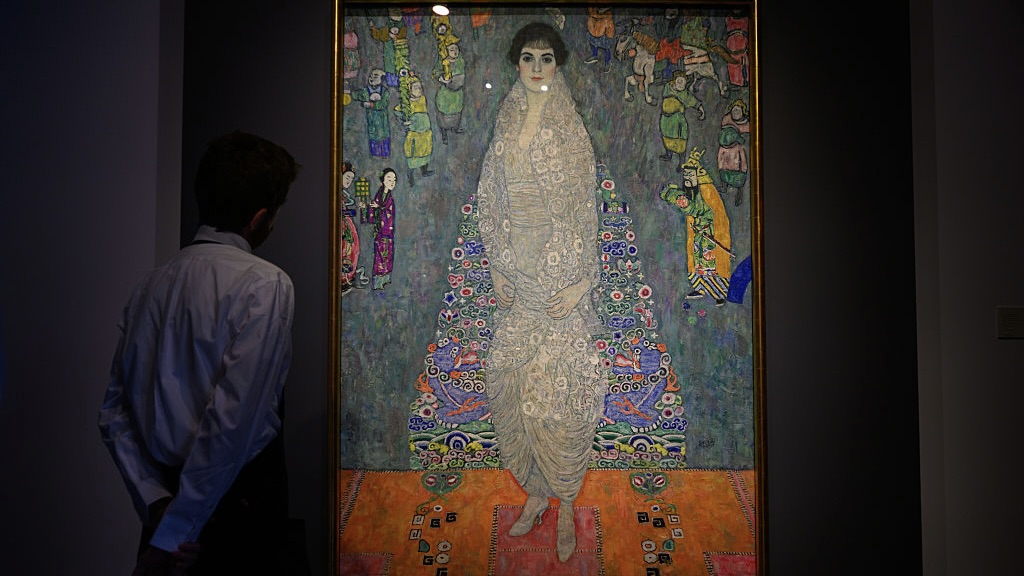
– In a sale that redefined the boundaries of modern art valuation, Gustav Klimt’s long-concealed Portrait of Elisabeth Lederer (1914-16) commanded a staggering $236.4 million at Sotheby’s in New York, eclipsing previous benchmarks and cementing its status as the priciest modern artwork ever auctioned.
The nearly two-meter-tall canvas, depicting the 20-year-old daughter of Klimt’s most devoted patrons, outstripped the $108 million paid for the artist’s Lady with a Fan (1917-18) in London just two years prior – a European record at the time.
It now trails only Leonardo da Vinci’s Salvator Mundi ($450.3 million in 2017) in the pantheon of auction highs, surpassing Andy Warhol’s Shot Sage Blue Marilyn ($195 million, 2022).
This triumph for Klimt, the Viennese Secessionist maestro who died in 1918 at 55, underscores a resurgent appetite for his late-period works amid global economic flux.

Klimt’s Portrait of Elisabeth Lederer,1914-16, is now the most expensive painting by the artist
Bidding, which opened at $80 million, escalated into a frenzy among anonymous phone lines and institutional heavyweights, closing after 10 minutes of heated exchanges.
The buyer remains undisclosed, but whispers in the saleroom point to a Middle Eastern consortium with designs on bolstering its contemporary holdings.
What elevates this portrait beyond mere financial spectacle? At first blush, Bildnis Elisabeth Lederer eschews the ostentatious gold leaf of Klimt’s “Golden Phase” – think Portrait of Adele Bloch-Bauer I (1907) or The Kiss (1907-08), bedazzled icons of Vienna’s fin-de-siècle splendor.
Instead, this wartime creation (begun amid World War I’s opening salvos) simmers with introspective depth, its subject swathed in a diaphanous white silk gown that evokes a chrysalis mid-unfurling.
Elisabeth’s elongated silhouette, framed against a cosmic azure backdrop, gazes with haunting poise, her dark eyes pooling quiet defiance.
The painting’s provenance is as layered as its symbolism. Commissioned by August and Serena Lederer, scions of Vienna’s Jewish industrial elite, it was one of many Klimts in their trove – until Nazi annexation in 1938 stripped them bare.

The portrait contains symbols drawn from East Asian art and the world of microscopic medical imagery
The portrait vanished into the Reich’s looting machinery, resurfacing in the early 1980s via discreet Swiss channels.
It then entered the vaulted collection of Leonard A. Lauder, the Estée Lauder heir whose June 2025 passing at 92 prompted this estate dispersal.
For four decades, it slumbered from public gaze, a ghost in the machine of art restitution debates.
Sotheby’s catalogeers hailed it as “Klimt’s late masterpiece,” a bridge from Secessionist glamour to Expressionist edge.
Absent the alchemical gold, Klimt alchemizes color into raw emotion: silvers and indigos pulse like veins under skin, while Elisabeth’s robe unfurls in a tapestry of motifs pilfered from disparate realms.
East Asian echoes abound – sinuous dragons coiling up her thighs, drawn from Qing Dynasty silks symbolizing imperial dominion and elemental mastery.
These beasts, emerging from stylized waves, crown her not as fragile debutante but as mythic sovereign, taming chaos in a nod to Botticelli’s Birth of Venus rebooted for the atomic age.
Yet Klimt’s sleight-of-hand runs deeper. Interwoven amid the flora are biomorphic whispers: ovoid cells, concentric rings, amorphous loops that nod to his 1903 immersion in Vienna’s scientific salons.
Friend to anatomist Emil Zuckerkandl, Klimt devoured lectures on cell theory, embryology, and hematology – fascinations that seeded his oeuvre. These “microscopic” flourishes, echoed in Danaë (1907) and The Kiss, forge a lexicon of life’s genesis: bloodlines, origins, the primordial swirl.
Juxtaposed with draconic power symbols, they transmute portraiture into allegory – a meditation on heritage amid Europe’s unraveling.
This subtext sharpens with hindsight’s blade. Decades post-Klimt, as Anschluss shadows lengthened, Elisabeth Lederer – wed by then, mother to a son – confronted Aryan edicts. In a audacious gambit, she alleged Klimt, the philandering gentile, as her sire.
Serena’s notarized affidavit sealed the ruse; officials, swayed, reclassified her, sparing deportation.
Fact blurs into the canvas’s fictive biology: those cellular motifs, once abstract, now pulse as prophetic emblems of fabricated lineage, survival’s sly reinvention.
Visually, Elisabeth’s form evokes metamorphosis – a Klimtian butterfly shedding silk for prismatic wings, her gown’s folds glinting like nascent flight.
This regenerative motif recurs in his canon, from ethereal nudes to allegorical friezes, underscoring art’s endurance against oblivion.
Critics debate its $236 million merit. Detractors decry auction inflation, fueled by low supply (fewer than 300 Klimts exist) and post-pandemic wealth surges.
Proponents counter: rarity breeds revelation. Once dismissed as lesser, the Lederer now dazzles in high-res scans, its “concealed riches” – per Sotheby’s – rewarding scrutiny.
As one bidder confided post-sale, “It’s not just a picture; it’s a portal to Klimt’s psyche, and Vienna’s lost Eden.”
The ripple effects? Sotheby’s modern art haul topped $500 million, signaling robust demand despite geopolitical tremors.
Restitution advocates eye the proceeds: a portion funds Jewish cultural preservation, honoring the Lederers’ pillaged legacy.
For Elisabeth, who died in 1986, this windfall – ironic progeny of her Klimt “father” – affirms art’s immortal gambit.
In an era of AI replicas and fleeting memes, Klimt’s canvas endures as talisman: fragile, fierce, forever transforming.
As it migrates to an unseen vault, one wonders – will it hide again, or finally take wing?
Discover more from AMERICA NEWS WORLD
Subscribe to get the latest posts sent to your email.








































Leave a Reply