
By Suraj Karowa and Ali Halit Diker/ANW , Istanbul, Turkey — December 7, 2025

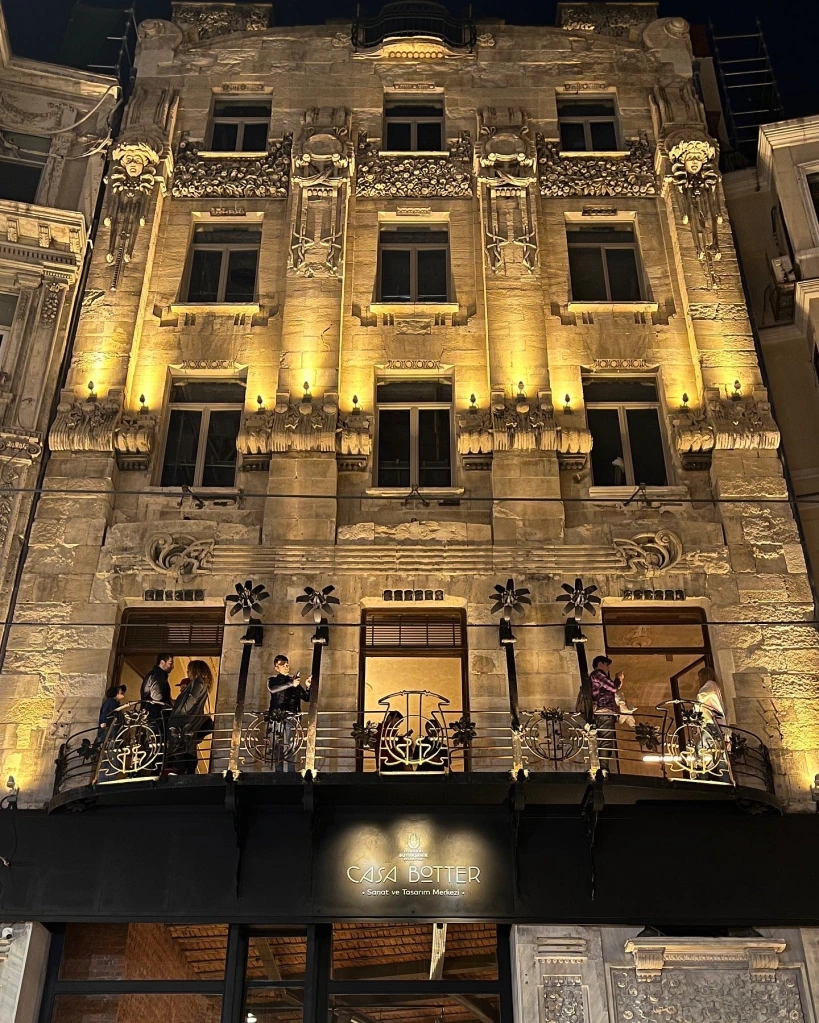
The Botter Apartment: Built in 1901 for a Dutch tailor, Jan Botter, by Ottoman ruler Sultan Abdülhamid II, this was Istanbul’s first Art Nouveau building.
Nestled amid the ceaseless hum of Istanbul’s İstiklal Avenue, where tourists snap selfies with the iconic red tram and locals weave through throngs of street performers and kebab vendors, stands a building that once whispered secrets of Ottoman glamour.
For decades, the Botter Apartment—known affectionately as Casa Botter—languished in obscurity, its ornate façade crumbling like a forgotten love letter.
But now, after a meticulous restoration, this 124-year-old Art Nouveau masterpiece has been resurrected, not as a private relic, but as a vibrant public space blending history, creativity, and community.
Commissioned in 1901 by Sultan Abdülhamid II, the enigmatic ruler who balanced authoritarian grip with a secret passion for European high culture, the Botter Apartment was a bold statement of modernity in a city straddling East and West.

The Casa Botter was the first Art Nouveau-style building in Istanbul.
Abdülhamid, a devotee of Sherlock Holmes novels and lavish operas, gifted the plot to his trusted Dutch tailor, Jean Botter, who crafted bespoke suits for the imperial court.
Botter, a meticulous artisan who fine-tuned Parisian imports for the Sultan’s wardrobe, deserved a home worthy of his craft.
Enter Italian architect Raimondo D’Aronco, the Sultan’s chief designer, who infused the structure with the sinuous lines and floral flourishes of Art Nouveau—the first such building in Istanbul.
Rising six stories on Pera’s cosmopolitan fringe, the apartment was more than aesthetic poetry; it was technological audacity.

For years the house stood empty, decaying almost to the point of collapse.
Turkey’s inaugural steel-framed residential tower, it boasted an elliptical elevator—only the second in the nation after the opulent Pera Palace Hotel.
Whiplash iron railings curled around staircases like frozen vines, while sculpted Medusa heads guarded doorways with mythical ferocity.
The ground floor hummed as Botter’s atelier, a salon for elite fittings and fashion spectacles, drawing Istanbul’s beau monde.
Above, the family resided in airy apartments overlooking the Bosphorus, a microcosm of the empire’s flirtation with Western allure.
Yet glory proved fleeting. The Balkan Wars and World War I shattered Pera’s multicultural idyll, scattering expatriates and dimming its lights.
The Botters fled to Paris in 1917, selling the property amid the republic’s birth pangs.

The restoration work preserved the building’s original features, but retained signs of its age.
Neglect followed: windows shattered, roofs leaked, wooden floors warped into ruin. By the 21st century, the building teetered on collapse, its once-vibrant hues buried under grime and graffiti.
“It was a ghost of itself,” recalls Merve Gedik, architect and heritage projects manager for the Istanbul Metropolitan Municipality. “Water had infiltrated everywhere; the structure screamed for mercy.”
Salvation arrived in 2021, when the municipality greenlit a restoration guided by “minimal intervention.”
Teams peeled away layers of anachronistic paint to unveil original ochres and ivories, conserved weathered metalwork to honor its patina, and reinforced the frame without erasing time’s etchings.
The elevator, a brass-and-glass jewel, was polished to gleam once more, its gears whispering of eras past.
Costing millions in public funds, the project wasn’t mere preservation—it was reinvention.

The house was only the second building in Istanbul to be built with an elevator.
“We wanted to democratize this history,” says journalist Emrah Temizkan, who chronicled the revival. “From palace plaything to people’s palace.”
The grand reopening in April 2023 as the Casa Botter Art and Design Center transformed intent into serendipity.
Envisioned partly for bureaucratic offices, the upper floors instead became a magnet for the creative undercurrent surging through Istanbul’s youth.
Remote workers claim sunlit desks amid potted ferns; artists sketch in alcoves echoing with D’Aronco’s curves; students debate in rooms that once hosted Ottoman soirees.
“The public claimed it organically,” Gedik laughs. “We couldn’t hoard it for filing cabinets.”
Today, it hosts workshops, exhibitions, and pop-up markets, its ground-floor café brewing Turkish coffee laced with tales of tailors and sultans.

The Botter Apartment paved the way for many more European-style buildings in Istanbul.
This rebirth ripples beyond one address. It spotlights Pera’s architectural tapestry, a late-Ottoman love affair with Europe that seeded Turkey’s First National Architectural Movement.
Stroll İstiklal, and you’ll encounter kin: the Mısır Apartment’s subtle concrete curves; Ravouna 1906 Suites’ carved tributes to its designer; Çiçek Pasajı’s Neorenaissance arches, once a floral bazaar for the elite; or the Grand Pera’s Neoclassical grandeur.
These aren’t sterile museums but living veins, pulsing with the city’s hybrid soul—minarets silhouetted against spires, tradition tangoing with innovation.
For visitors, Casa Botter offers an intimate portal. Ascend via that vintage elevator, feel the building breathe.
Gaze from balconies at the avenue’s chaos, a 21st-century echo of 1901’s bustle.
It’s a corrective to Istanbul’s Instagram gloss: beneath the Blue Mosque’s domes and Hagia Sophia’s whispers lie these high-altitude heirlooms, demanding we look up.
In a nation wrestling with its past—Abdülhamid’s shadow looms in debates over authoritarian echoes—the Botter stands as quiet defiance.
It reminds us that heritage isn’t hoarded but shared, decay not destiny but detour. As Turkey’s tourism rebounds post-pandemic, with 50 million visitors projected for 2025, such revivals lure the discerning: not just Hagia Sophia hordes, but seekers of the subtle sublime.
Yet challenges linger. Urban pressures—gentrification, earthquakes—threaten Pera’s fragile fabric. Gedik urges vigilance: “Restoration is a pact with the future.”
For now, though, Casa Botter thrives, a whiplash curve in Istanbul’s endless narrative.
In a city of 15 million stories, this one—tailor’s triumph, sultan’s whim, public’s prize—urges us to pause, peer upward, and rediscover what’s been hiding in plain sight.
Discover more from AMERICA NEWS WORLD
Subscribe to get the latest posts sent to your email.























Leave a Reply