
By Suraj Karowa and Soutik Biswas / ANW New Delhi, December 18, 2025 –

More than two million turkeys have been culled in the US since late August due to avian flu.
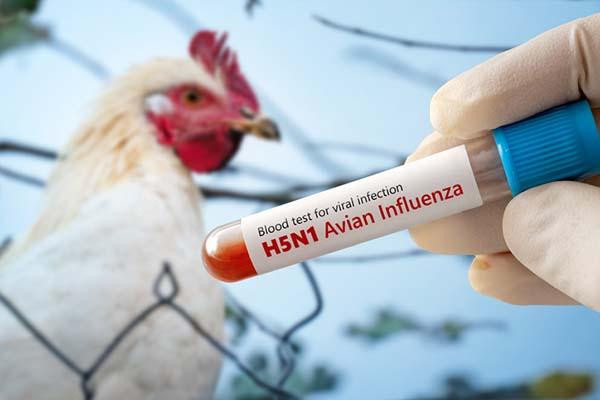
As avian influenza, or H5N1 bird flu, ravages poultry farms and wildlife worldwide, Indian researchers have unveiled a stark simulation revealing just how precariously close humanity teeters on the edge of a potential pandemic.
Their peer-reviewed study, published in BMC Public Health, uses advanced computer modeling to map out the virus’s leap from birds to humans—and the razor-thin timeframe authorities have to slam the door shut before it spirals into uncontrolled human transmission.
For decades, H5N1 has loomed as a global threat, first emerging in China in the late 1990s. It’s entrenched in South and Southeast Asia, sporadically jumping to humans with devastating results.
According to the World Health Organization (WHO), from 2003 to August 2025, the virus claimed 990 human cases across 25 countries, killing 475—a chilling 48% fatality rate.

A bird flu outbreak in a Delhi zoo shut down the facility for a few days in August.
Symptoms in infected people echo a brutal flu: soaring fevers, hacking coughs, throbbing muscles, sore throats, and sometimes pinkeye.
Yet, mercifully, human-to-human spread remains rare, confined mostly to close contacts.
The United States offers a grim snapshot of the virus’s ferocity. Since late August, over two million turkeys have been culled amid outbreaks.
H5N1 has decimated more than 180 million birds, infiltrated over 1,000 dairy herds across 18 states, and sickened at least 70 people—primarily farmworkers—leading to hospitalizations and one fatality.
Even wildlife isn’t spared: In January 2025, three tigers and a leopard succumbed at a rescue center in Nagpur, India.

India’s poultry industry is one of the world’s largest.
It’s this escalating peril that spurred Philip Cherian and Gautam Menon, scientists at Ashoka University, to build their predictive model.
“The threat of an H5N1 pandemic in humans is genuine, but we can hope to forestall it through better surveillance and a nimble public-health response,” Prof. Menon told the BBC.
Their work leverages BharatSim, an open-source platform honed during COVID-19 modeling but adaptable for other pathogens.
By feeding in real-world data—poultry densities, human movement patterns, and transmission variables—the simulation plays out outbreak scenarios in vivid, virtual detail.
At the heart of the study is a synthetic village in Namakkal district, Tamil Nadu—India’s poultry powerhouse.
This region boasts 1,600 farms, 70 million chickens, and daily egg production topping 60 million.
The model crafts a digital twin: 9,667 residents, complete with households, schools, markets, and workplaces, seeded with infected birds to replicate exposure risks.
Transmission kicks off at a farm or wet market, rippling from birds to primary contacts (direct exposures like coworkers), then secondary ones (household members or casual interactions), and beyond.
The findings are unforgiving. The basic reproductive number (R0)—gauging how many people one infected individual contaminates—varies by strain efficiency, but the model tests a spectrum. Crucially, once cases hit two to 10, containment becomes a coin flip.
Quarantine households of primary contacts at just two detections, and the outbreak fizzles—nearly 100% success rate.
Delay to 10 cases, and it’s game over: The virus embeds in the broader population, mirroring unchecked spread.
Interventions matter, but timing is tyrant. Culling birds shines if executed pre-spillover; post-human infection, it’s moot.
Isolating cases and quarantining homes nips it at the secondary stage, but tertiary infections—friends-of-friends—demand draconian steps like lockdowns.
Vaccination bolsters herd immunity, hiking the R0 threshold for sustainability, yet falters in tight-knit homes where proximity trumps shots.
A thorny dilemma emerges: Early quarantine glues families in virus incubators, spiking household transmissions.
Late action? It barely dents the wave. The model assumes fixed networks—no migratory bird swarms or supply-chain jumps—and overlooks behavioral pivots like masking.
It also presumes uniform transmission efficiency, a simplification critiqued by virologist Seema Lakdawala of Emory University.
“This simulation assumes very efficient transmission of influenza viruses,” Dr. Lakdawala cautioned.
“Transmission is complex; not every strain behaves the same, and emerging research shows only a subset of flu-positive individuals shed infectious virus into the air.”
Echoing COVID’s superspreaders, this variability could turbocharge or throttle outbreaks, a blind spot in flu modeling.
Should H5N1 conquer human hosts? Dr. Lakdawala likens it to the 2009 swine flu—disruptive but containable—thanks to stockpiled antivirals like oseltamivir and H5 vaccines.
“We’re more prepared for influenza than for novel coronaviruses,” she said. Yet, underestimating it invites catastrophe: Reassortment with seasonal strains could birth hybrid horrors, spawning erratic epidemics.
India’s context amplifies the urgency. As one of the world’s top poultry producers, the nation balances a $15 billion industry with dense rural markets ripe for zoonotic leaps.
A Delhi zoo shuttered briefly in August 2025 after bird flu infiltrated its aviaries, underscoring vulnerabilities even in urban enclaves.
Globally, as winter grips the Northern Hemisphere, flu surges strain health systems—from the UK’s “last-chance” child jab clinics to U.S. hospital pleas for symptomatic visitors to stay away.
The researchers tout BharatSim’s real-time adaptability: Plug in fresh data—asymptomatic rates, reporting lags—and it recalibrates, arming officials with actionable intel in outbreak infancy.
“This isn’t prophecy; it’s preparation,” Prof. Cherian emphasized. For policymakers, the message is clear: Surveillance must be surgical, responses swift.
Discover more from AMERICA NEWS WORLD
Subscribe to get the latest posts sent to your email.
























Leave a Reply