
By Suraj Karowa and Dana O’Neil/ ANW
December 23, 2025 HARRISONBURG, Va.

James Madison head coach Bob Chesney speaks to his players on the field before the Sun Belt Championship Game on December 5.
— In the shadow of Virginia’s Blue Ridge Mountains, where the air is crisp and ambitions once seemed as modest as the campus itself, James Madison University has scripted one of college football’s most improbable sagas.
What began as a fledgling program in 1972 — a ploy by a forward-thinking president to lure male students to a former women’s teachers college — has evolved into a national title contender.
As the Dukes prepare to face Oregon in the College Football Playoff’s opening round this weekend, their story isn’t just about gridiron grit.

James Madison quarterback Alonza Barnett III has led the Dukes’ offense this season with 35 touchdowns — 21 passing and 14 rushing.
It’s a testament to patience in an era of instant gratification, where programs chase NIL deals and transfer portal stars like hares in a mad dash.
Jeff Bourne, the visionary athletic director who retired in May 2024 after 25 years at the helm, still marvels at the journey.
Arriving in 1999, he gazed at Bridgeforth Stadium — a 12,500-seat relic for a team that had scraped just three wins the prior season — and envisioned glory.

Mickey Matthews addresses his James Madison team before the Division I-AA championship game in 2004.
“I saw potential,” Bourne told CNN Sports. “But college athletics rewards the impatient. We chose to be the tortoise.”
That deliberate pace paid dividends. JMU, which didn’t admit men until 1966 and played its inaugural game as a 6-0 shutout loss to a junior varsity squad from Shepherd College, methodically climbed the ranks.
By 1980, they’d ascended to I-AA (now FCS), tasting NCAA playoffs in the late 1990s. The breakthrough arrived with coach Mickey Matthews, hired alongside Bourne.
Matthews delivered the 2004 I-AA national title, igniting a fervor that justified massive investments: the $62 million stadium expansion to 25,000 seats and the Plecker Athletic Performance Center.

Wide receiver D.D. Boxley celebrates JMU’s title win in 2004.
Yet success bred restlessness. Matthews, the program’s winningest coach, was ousted in 2013 amid waning results, his big stadium echoing with unfulfilled promise.
What followed was the “Harrisonburg coaching cradle” — a revolving door of triumphs and departures.
Everett Withers bolted after two years for Texas State; Mike Houston, after three seasons and another title, to East Carolina.
JMU had become FCS royalty: multiple championships, $10 million annual football budgets dwarfing peers, and even an ESPN GameDay visit.
Enrollment swelled from 16,000 in 2004 to over 21,000 by 2016, fueled by football’s allure.

A look at JMU’s Bridgeforth Stadium before it hosted a FCS playoff game in 2021.
Students footed much of the bill — fees comprising 84% of athletic revenue by 2010, rising to $55.5 million last year — but they embraced it, packing stands with a third of attendees from campus.
Still, JMU waited to leap to FBS.
While 16 schools jumped starting in 2008 for bigger paydays and spotlights, Bourne observed from afar.
Appalachian State’s Sun Belt success inspired; Old Dominion’s stumbles cautioned. “Pressure mounted,” Bourne recalled, “but we calculated: Do we have the resources to sustain it?”
Conferences courted them, yet the Dukes held firm until 2022, joining the Sun Belt with infrastructure primed but finances modest — $10 million on football that year, a pittance against Power Five giants.

Then-JMU head coach Curt Cignetti watches his team play Appalachian State in 2022.
Enter Curt Cignetti, Bourne’s 2019 hire: a grizzled head coach from blue-collar Pennsylvania roots, undaunted by the transition’s perils.
Cignetti, who helmed JMU’s FBS debut win over Middle Tennessee, built a juggernaut.
The 2023 season exploded: 11-1 record, AP Top 25 ranking, and a loophole victory for Armed Forces Bowl eligibility.
But lightning struck twice. Cignetti decamped to Indiana, where he’s now prepping a Heisman-led Hoosiers squad for the Rose Bowl.
Bourne’s checklist yielded Bob Chesney — another Pennsylvania-bred grinder, fresh off Holy Cross success — who elevated the blueprint.

James Madison head coach Bob Chesney speaks with Jacob Thomas during the Dukes’ home win against Washington State in November.
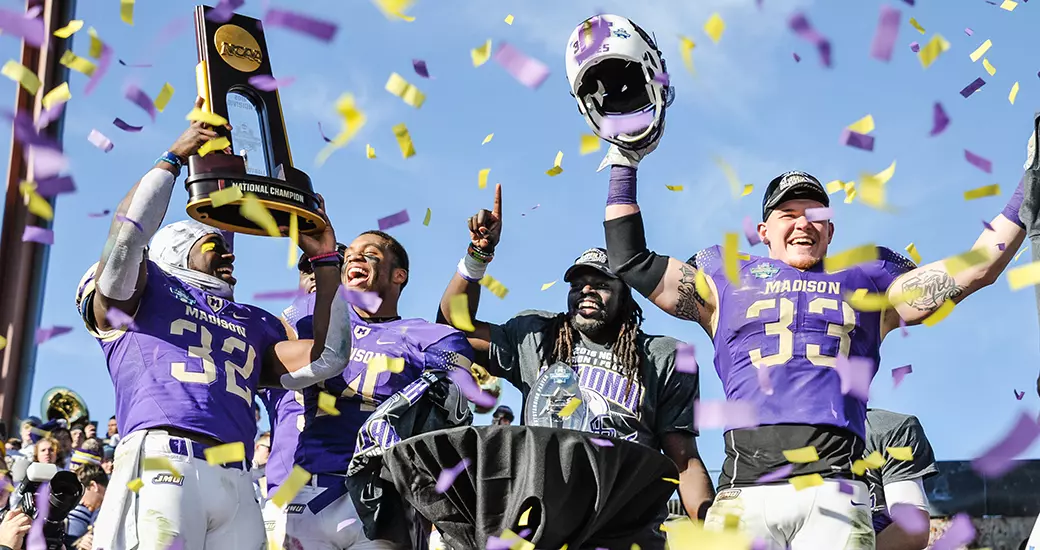
Chesney’s 2025 Dukes went 12-1, claimed the Sun Belt crown on December 5, and secured a playoff bid, quarterback Alonza Barnett III torching defenses for 35 touchdowns (21 passing, 14 rushing).
Chesney’s impending UCLA move — announced December 6 — underscores JMU’s bittersweet cradle status: the fifth coaching vacancy in 11 years.
Athletic director Matt Roan, Bourne’s successor, allowed Chesney to finish the playoff run, prioritizing program stability.
“It’s awkward, but it models integrity,” Roan said. Breaking from tradition, Roan tabbed Billy Napier as replacement — the ex-Florida coach with SEC pedigree from Clemson and Alabama.
“This isn’t flash-in-the-pan,” Roan insisted. “We aim for perennial relevance.”

James Madison celebrates its Sun Belt title on December 5.
Challenges loom. Virginia’s new law caps student fees at 55% for athletics by 2029; JMU nears the limit. Ticket innovations — $10 lotteries for season passes, premium tiers — aim to bridge gaps.
Football spending hit $15.8 million in 2024, while Oregon alone dropped $21 million on coaches.
NIL and revenue-sharing widen chasms, but JMU’s Group of Five slot guarantees playoff access under current rules.
Bourne, watching from Autzen Stadium’s stands, embodies the ethos. “Fans tire of ‘patience,’ peers mock the wait,” he said.
“But we rode the tide backward — and look where it landed us.” As Barnett and the Dukes stare down Nike-fueled Oregon, JMU isn’t just contending; they’re redefining ascent.
In a sport of hare-brained schemes, the mountain tortoise roars.
Discover more from AMERICA NEWS WORLD
Subscribe to get the latest posts sent to your email.









Leave a Reply