
By Manisha Sahu | America News World
December 06,2025
Frank Gehry, the world-renowned architectural icon celebrated for reshaping skylines with his unconventional, sculptural designs, remains one of the most influential creative minds of the modern era. Over the decades, Gehry has won countless accolades, including the Pritzker Prize—often described as the Nobel Prize of architecture—and his native country’s highest civilian honour, the Companion of the Order of Canada. But behind the global acclaim and gravity-defying masterpieces lies the remarkable story of an architect whose career began with hesitance, struggle, and an unexpected spark of boldness that changed everything.

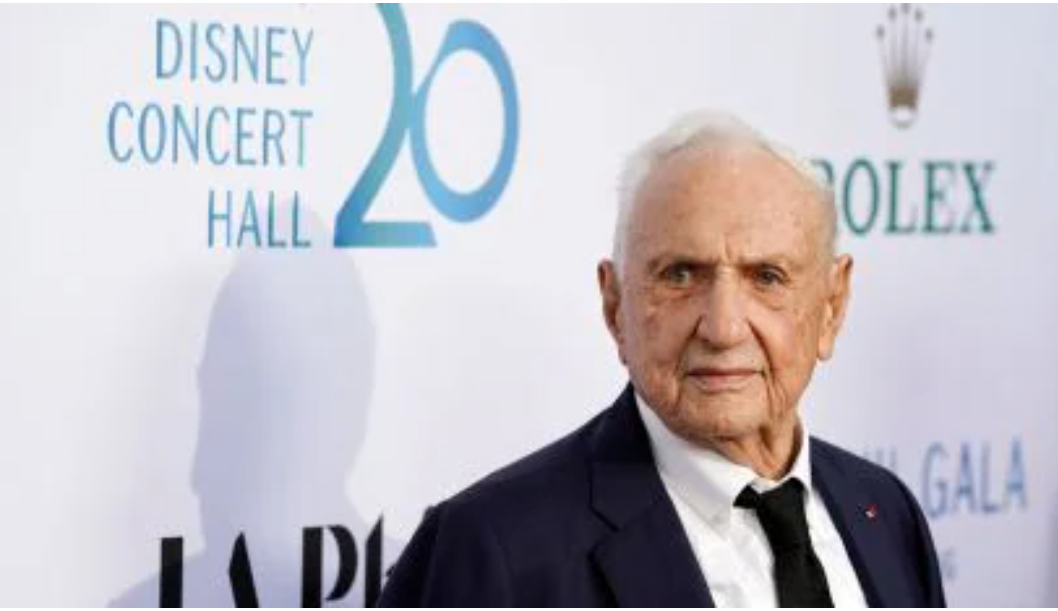
Frank Gehry, the honoree and architect of the Walt Disney Concert Hall, poses for a photo during the 2023 Los Angeles Philharmonic Gala on Thursday, October 5, 2023, at the Walt Disney Concert Hall in Los Angeles. (Photo: AP/PTI)
A Modest Beginning and an Uncertain Start
Frank Gehry’s path toward architectural greatness did not begin with instant success. Born to a humble family and relocating to the United States in his youth, Gehry nurtured a fascination with shapes, materials, and structures from an early age. This passion eventually led him to the University of Southern California, where he earned his degree in architecture in 1954.
Soon after graduating, Gehry served in the U.S. Army before pursuing further studies in urban planning at Harvard University. Yet, despite this promising educational foundation, the early years of Gehry’s professional life were far from glamorous. He grappled with slow business, financial uncertainty, and limited opportunities. For several years, he took on whatever work he could find—designing public housing projects, developing commercial spaces, and even working as a delivery truck driver just to support his family.
This period of struggle was instrumental. It honed his understanding of materials, sharpened his perspective on the everyday built environment, and pushed him to think creatively about how ordinary structures might become extraordinary.
A Breakthrough Hiding in Plain Sight
The turning point in Gehry’s career came during the 1980s, when he was commissioned to design a modern shopping mall near the Santa Monica Pier. Recognizing the financial stakes, Gehry avoided risks and submitted conventional mall designs that resembled other commercial centres across the United States.
However, fate intervened in an unexpected way.
When the mall’s developer visited Gehry’s home to mark the completion of the project, he was stunned by what he saw. Gehry had transformed a modest 1920s bungalow into a striking, innovative residence. Using chain-link fencing, corrugated metal, exposed wood, and unconventional lines, he had created a structure unlike anything typical of suburban American homes.
Surprised, the developer asked why Gehry had played it safe with the mall instead of embracing the creativity evident in his own residence.
Gehry’s answer was simple and honest:
“Because I have to make a living.”
The developer’s response became a defining moment. If Gehry genuinely wanted to express his vision and establish himself as a bold architectural voice, he was told, he needed to stop playing safe and trust his instincts.
That conversation proved transformative. Gehry abandoned hesitation and embraced the daring, imaginative storytelling that would later define his global legacy.
Redefining Architecture Through Audacity and Art
From that point forward, Gehry devoted himself to creating structures that blended architectural function with artistic expression. His career soon soared, and the distinctive Gehry style—characterized by sweeping curves, fragmented forms, reflective surfaces, and unexpected materials—captured the world’s attention.
Gehry Partners LLP, founded in 1962, grew rapidly as demand for Gehry’s visionary designs increased. At its peak, the firm employed more than 130 architects, designers, and engineers. Despite the expansion, Gehry maintained a deeply personal approach to his work. He insisted on being directly involved in each project, from concept sketches to technical refinements, ensuring his vision remained intact.
Over the following decades, Gehry produced some of the most recognizable and admired buildings of the 20th and 21st centuries.
IAC Building: A Shimmering Landmark in New York
Completed in 2007, the InterActiveCorp Headquarters—better known as the IAC Building—became Gehry’s first major New York City commission. Located in Chelsea, the structure resembles a billowing, translucent beehive. Its glass façade captures and reflects light in constantly shifting tones, making the building appear to change forms throughout the day.
The IAC Building became an instant architectural icon, demonstrating Gehry’s mastery of form, light, and movement.
New York By Gehry: Transforming the Lower Manhattan Skyline
In 2011, Gehry completed one of his most ambitious projects: the 76-story residential tower known as “New York By Gehry.” For years it stood among the tallest residential buildings in the world. Its flowing, stainless-steel exterior created rippling waves across the façade, altering the Manhattan skyline with a sense of elegance and dynamism.
The building remains one of Gehry’s most structurally daring works to date.
Shaping Future Generations of Architects
Gehry’s impact extends far beyond the structures he designed. In 2011, he joined the faculty at the University of Southern California, returning to his alma mater as a professor of architecture. He also served as a visiting professor at Yale University and Columbia University, where he inspired young architects to embrace creativity, push boundaries, and rethink conventional architectural norms.
By sharing his experience, philosophies, and personal journey, Gehry helped shape a new generation of designers who view architecture not merely as construction, but as a form of storytelling.
A Legacy Built on Courage and Creativity
Frank Gehry’s story is not just one of artistic triumph—it is a narrative of courage, resilience, and self-belief. From a struggling young architect trying to make ends meet to a global icon who redefined the possibilities of modern design, his journey reflects the transformative power of creativity when paired with conviction.
Gehry continued working well into his 90s, pushing boundaries and reshaping expectations of what architecture can be. His legacy lives on not only in the iconic buildings that adorn skylines around the world but also in the countless architects inspired by his fearless approach.
In a world that often rewards conformity, Frank Gehry proved that the boldest path is sometimes the most rewarding—one that dares to envision structures not just as buildings, but as living, breathing works of art.
Discover more from AMERICA NEWS WORLD
Subscribe to get the latest posts sent to your email.























Leave a Reply