
By Katie Hunt , Suraj Karowa, Science Correspondent/ANW
November 27, 2025 –

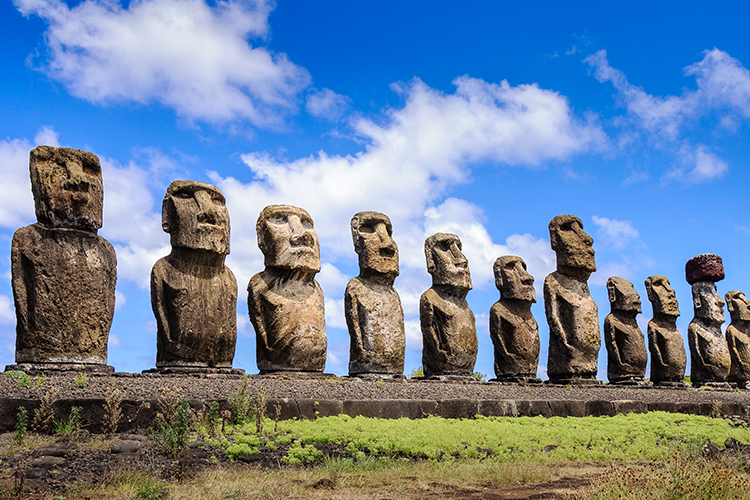
The largest unfinished statue on Easter Island is known as Te Tokanga. It would have weighed around 270 tons if completed.
On the windswept shores of Rapa Nui, better known as Easter Island, the colossal stone moai statues have long captivated the world, symbolizing human ingenuity and mystery.
But new research using cutting-edge 3D modeling has peeled back layers of rock and myth, revealing how these enigmatic monuments were crafted not by a monolithic empire, but by decentralized clans of Polynesian artisans.
The findings, published Wednesday in PLOS One, challenge long-held assumptions about the island’s society and underscore its resilience against ecological collapse narratives.

The model of the quarry revealed 426 moai in various stages of completion.
At the heart of this discovery is Rano Raraku, a volcanic crater that served as the primary quarry for the moai.
Here, embedded in the tuff—a soft volcanic rock—lie hundreds of unfinished statues, frozen in time like ghostly sentinels.
The largest, dubbed Te Tokanga, stretches 21 meters (69 feet) long and could have tipped the scales at 270 tons if completed.
Yet it, like so many others, was abandoned mid-creation, leaving archaeologists to ponder: What drove this monumental labor, and why did it halt?

Moai statues dot a hillside at Rano Raraku stone quarry on Easter Island.
Led by Carl Lipo, a professor of anthropology at Binghamton University, the research team employed photogrammetry—a technique stitching together 11,000 drone-captured images into a hyper-detailed 3D model of the quarry.
This digital reconstruction, the first of its kind for the site, exposed 426 moai in varying states of completion, alongside 341 carving trenches, 133 extraction voids, and even five ancient bollards used as anchors for lowering statues down slopes.
“The sheer scale seemed to demand centralized coordination,” Lipo explained in an email interview.
“But our model shows something far more nuanced: independent work zones suggesting clan-based efforts, not a top-down hierarchy.”

The average statue was 4 meters (13 feet) tall and weighed 12.5 tons.
The implications ripple far beyond the quarry’s craggy walls. For centuries, scholars envisioned Rapa Nui’s moai production as the work of a unified workforce under powerful chiefs, a narrative popularized in Jared Diamond’s 2005 book Collapse, which painted the island as a cautionary tale of resource overexploitation leading to societal downfall.
Deforestation for statue transport, soil erosion, and inter-clan warfare were blamed for a supposed population crash.
Yet Lipo’s team argues the evidence points to a patchwork of small, autonomous family groups, each staking out quarrying “territories” within Rano Raraku.
The 3D model delineated 30 distinct activity zones, each with unique extraction methods—some statues carved top-down in supine positions, others pried from the sides—and finishing styles.
Statues were transported in multiple directions from the quarry, destined for ahu platforms scattered across the island, rather than funneled through a central hub.
“This means the entire production chain—from bedrock incision to final facial details—stayed local,” Lipo said. “No industrial assembly line, just adaptive, community-driven craft.”
These moai weren’t mere decorations; they embodied ancestral power, genealogical pride, and competitive one-upmanship among clans.
The average statue stood 4 meters (13 feet) tall and weighed 12.5 tons, but outliers like Te Tokanga pushed boundaries, perhaps in bids to outdo rivals.
“Some exceeded practical transport limits,” Lipo noted, hinting at “competitive escalation” where communities tested engineering feats, only to confront physical constraints.
Far from signs of abandonment or catastrophe, the unfinished works reflect routine operations, with production likely persisting until European contact in 1722 introduced diseases that decimated the population.
This decentralized model reframes Rapa Nui’s history. Settled around 1200 CE by Polynesian voyagers navigating 2,500 miles of open ocean, the island—today a Chilean territory—sustained up to 15,000 people on just 163 square kilometers (63 square miles) of land.
Recent studies, including isotopic analysis of soils and rat-gnawed bones, debunk the “ecocide” myth, showing sustainable practices like rock mulching for agriculture and no evidence of widespread famine before outsiders arrived.
“If monument-building was autonomous, there was no central authority to drive the island over an ecological cliff,” Lipo emphasized.
Instead, clans made pragmatic choices, erecting about 1,000 moai from the 13th to 17th centuries before shifting priorities amid external pressures.
Not all experts are fully convinced. Helene Martinsson-Wallin, an archaeology professor at Uppsala University in Sweden, praised the photogrammetry as innovative but noted it echoes century-old observations by Katherine Routledge, who documented clan-based systems in the 1910s.
“Rapa Nui was an ‘open society’ without a paramount chief,” she said via email. “Megalithic building doesn’t require rigid hierarchies—it’s compatible with flexible structures.”
Christopher Stevenson, an archaeologist at Virginia Commonwealth University, called the decentralized hypothesis “important” but critiqued the study for overlooking potential elite dwellings near the quarry, which might indicate subtle social distinctions.
As climate change amplifies isolation’s perils—from rising seas to resource strains—Rapa Nui’s story offers hope.
Its people, the Rapa Nui, endured slave raids, pandemics, and colonial erasure, yet revived their language and traditions.
Today, the moai—887 standing, hundreds more buried or toppled—draw 100,000 tourists annually, funding conservation.
The quarry model, accessible via open-source platforms, invites global collaboration, potentially guiding preservation amid erosion threats.
In the end, Te Tokanga and its brethren aren’t relics of ruin but testaments to ingenuity: Polynesians who sculpted not just stone, but a society that thrived on the edge of the world.
As Lipo reflects, “These weren’t monuments to hubris, but to community—and survival.”
Discover more from AMERICA NEWS WORLD
Subscribe to get the latest posts sent to your email.



























Leave a Reply