
By Brad Lendon and Suraj Karowa/ANW,
November 27, 2025

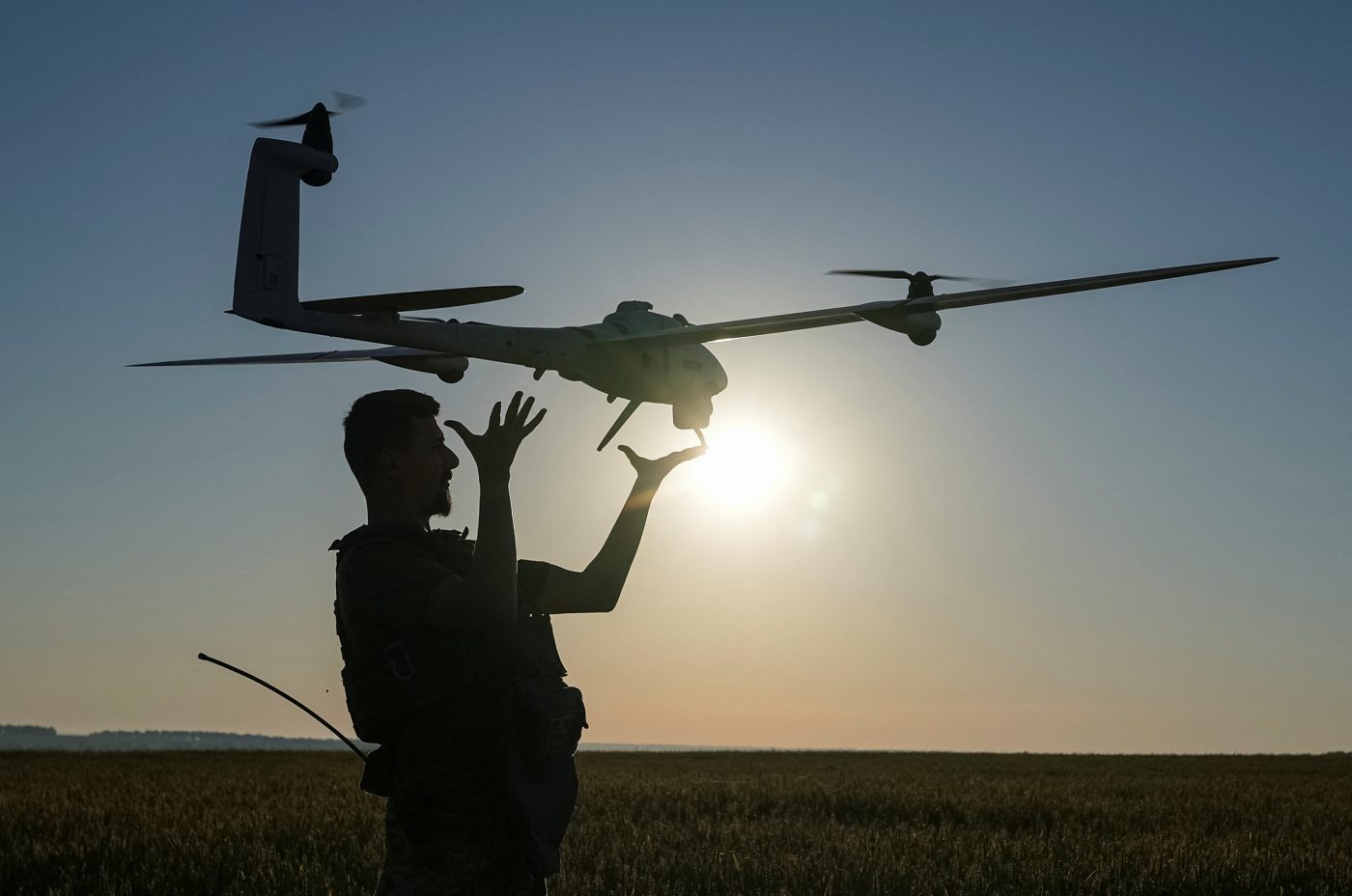
A pilot practices with a drone on a training ground in Kyiv region on February 29, 2024, amid the Russian invasion of Ukraine.
In the chaos of modern war, where superpowers clash with insurgents and underdogs defy odds, drones have emerged as the great leveler.
Cheaper than tanks, deadlier than rifles, and increasingly smarter thanks to artificial intelligence, these unmanned machines are not just reshaping conflicts—they’re prolonging them, turning swift victories into grinding stalemates.

Britain’s Prime Minister Keir Starmer and Ukraine’s President Volodymyr Zelensky speak to members of the media after attending a presentation of Ukrainian military drones in Kyiv, Ukraine on January 16, 2025.
From Ukraine’s Black Sea triumphs to Myanmar’s rebel strongholds, drones signal a new era of asymmetric warfare, one where innovation born of desperation outpaces even the mightiest militaries.
The story begins in the trenches of history. Britain and the U.S. toyed with radio-controlled aircraft in World War I, dubbing them “drones” after the buzzing De Havilland Queen Bee of the 1930s. By Vietnam, hundreds flew reconnaissance and psy-ops missions.

An officer of the Security Service of Ukraine operates the next-generation multipurpose Sea Baby unmanned surface vehicle in Ukraine, on October 17, 2025.
The 1991 Gulf War marked their combat debut, with Tomahawk missiles—essentially smart drones—blasting Iraqi targets.
But it was the post-9/11 “war on terror” that elevated behemoths like the Predator and Reaper, stealthily hunting militants from afar.
The true revolution ignited in 2020’s Nagorno-Karabakh clash. Azerbaijan, outgunned by Armenia, deployed cheap agricultural drones as decoys to expose air defenses, then swarmed with Turkish Bayraktar UCAVs.
The result? Baku seized the skies, proving low-cost tech could topple conventional might. “UCAVs point to a new trend for resource-strapped nations,” wrote UK RAF officer Chris Whelan.

A member of the Mandalay People’s Defense Forces preparing to release a drone near the front line amid clashes with Myanmar’s military in northern Shan State.
Ukraine amplified this script in Russia’s 2022 invasion. Facing a Goliath with tanks and jets, Kyiv’s forces unleashed a drone blitz: aerial FPV kamikazes shredding T-90s, sea drones like the Sea Baby sinking Black Sea Fleet warships, and ground bots ambushing infantry through windows.
One viral clip showed a wounded soldier pedaled to safety on a drone-delivered e-bike. “Drones turned expected weeks-long rout into three-plus years of attrition,” says Kateryna Bondar of the Center for Strategic and International Studies (CSIS).

Harvard’s famous robotics project, the RoboBee, has finally been turned into an applied technology that has led to a startup company.
Ukraine’s edge? Rapid iteration. From 800,000 units in 2023 to 2 million last year—and 5 million projected for 2026—Kyiv’s workshops, often mobile and frontline-adjacent, tweak frequencies, sensors, and flight paths in weeks, not months.
When Russia jammed radio signals, Ukraine pivoted to fiber-optic tethers, enabling 30-mile strikes. Britain’s MoD, in a June deal, hailed Kyiv as the “world leader in drone design.” Even U.S. President Donald Trump quipped, “They make a very good drone.”
Russia countered fiercely, churning out 4 million annually, including Iranian-inspired Shaheds and jamming-proof fiber-optics from its secretive Rubicon Center.

A RoboBee rests at a work station in the lab.
Yet losses mount: over a million casualties, per Western tallies. Drones haven’t ended the war but entrenched it, echoing Mary Shelley’s chaos-born invention and Pierce Brown’s tech-amplified fear.
This asymmetry ripples globally. In Africa’s 36 drone-adopting nations—spiking post-2020—import powerhouses like Turkey and China arm governments and rebels alike.
Libya’s 2014-20 civil war was the “preeminent drone theater,” per Nate Allen of the U.S. Defense Department’s Africa Center, leaving it fragmented.
Sudan’s Rapid Support Forces nearly assassinated the army chief with a drone last July; non-state actors in Burkina Faso, Mali, and Somalia wield them too, “reshaping battlespaces.”
Asia’s Myanmar rebels, since 2023, swapped artillery for commercial quadcopters, bombarding junta bases and reclaiming borderlands.
“A major power shift,” says IISS’s Morgan Michaels. In Gaza, Hamas drones blinded Israeli posts before October 7, 2023, igniting a war that’s claimed 60,000 Palestinian lives.

Drones manufactured by Korean Air are on display at the Seoul ADEX 2025 defense exhibition in October, 2025.
Drones evolving from tools to thinkers. Auterion’s $50 million U.S. deal delivers 33,000 “strike kits” to Ukraine—AI that spots targets a kilometer out, dodges jams, and strikes autonomously.
CEO Lorenz Meier likens it to precision artillery: one drone equals 6 shells, slashing ammo from 60 to 6 per kill. Cost? $1,500 vs. $3,000 per round.
“It’s gunpowder-level disruption,” says ex-U.S. Army officer Patrick Shepherd.
The spectrum spans extremes.

Ukrainian serviceman of the 28th brigade Maksym, 20, conducts a training flight with an FPV drone in Donetsk region on April 29, 2024, amid the Russian invasion of Ukraine.
China’s mosquito-sized nano-drones scout silently; Harvard’s RoboBee, half a paperclip, flaps on “artificial muscles.”
Norway’s Black Hornet, pigeon-sized, reconnoiters 3 km for 45 militaries. At sea, DARPA’s 180-foot USX-1 Defiant sails crewless; Australia’s Ghost Shark AUV, container-sized, nets a $1.1 billion fleet.
China’s XLUUV torpedo-subs parade as the world’s largest undersea drone armada. Even Singapore’s 8,500-ton drone mothership launches swarms.
This boom births Silicon Valley-style defense disruptors. Anduril’s Palmer Luckey builds end-to-end systems in a $1 billion Ohio mega-factory, slashing timelines.
Auterion’s software swarms any drone, like Microsoft’s OS on varied hardware. Kratos, Shield AI, and Korean Air join the fray, crashing Defense News’ top 100 list alongside Palantir.
China leads production, dominating commercial drones and counter-tech: 3,000+ anti-drone firms, microwave “oven storms” frying swarms at 3 km.
The U.S., warns Heritage Foundation, lags—fragmented, underfunded. Ex-Joint Chiefs chair Gen. Mark Milley: Future wars favor algorithms; America isn’t ready.
Trump’s June executive order and Army Secretary Daniel Driscoll’s million-drone buy signal catch-up, eyeing Amazon-like commercial partners.
Yet Britain’s Adm. Tony Radakin cautions: Don’t go “drone-tastic.” Tech dazzles, but strategy lags. Drones excel in “micro-engagements”—one-vs-one zaps—but can’t hold soil.
Ukraine’s “Spiderweb” bomber raid? Spectacular, yet strategically null, per Arizona State’s Amos Fox. They prolong “forever wars,” per Vision of Humanity: 59 conflicts raging, victories down to 9% from 49% in the 1970s.
Drones democratize death, empowering Davids against Goliaths—from narco-cartels to African insurgents. But in chaos, they breed endless attrition.
As Shelley noted, invention thrives in disorder. The question: Will it end wars faster, or just make them eternal?
Discover more from AMERICA NEWS WORLD
Subscribe to get the latest posts sent to your email.




































Leave a Reply