
By John Liu and Suraj Karowa/ANW
Hong Kong, November 27, 2025

Dozens are confirmed dead, with hundreds more missing, after fire broke out and spread quickly via bamboo scaffolding
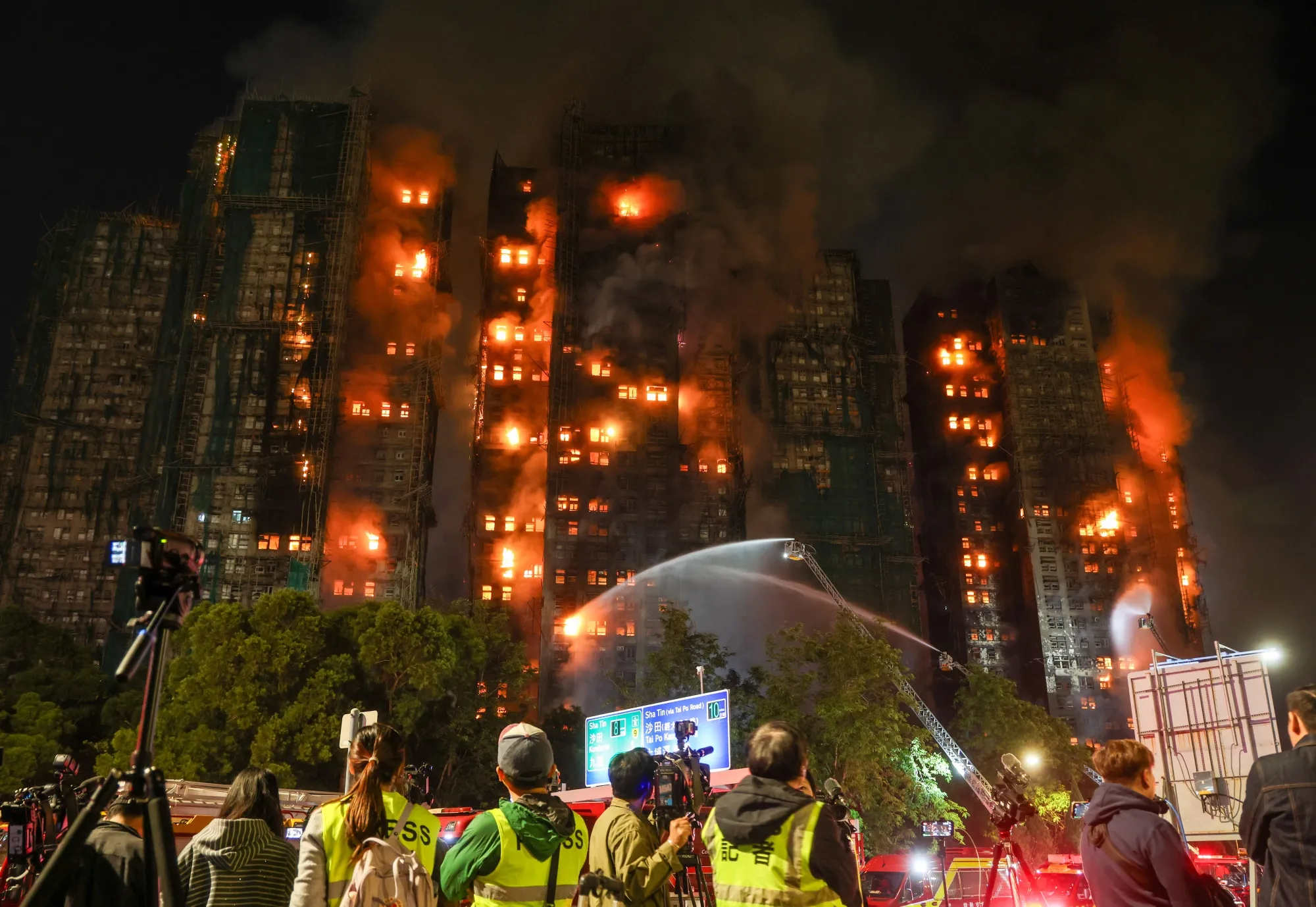
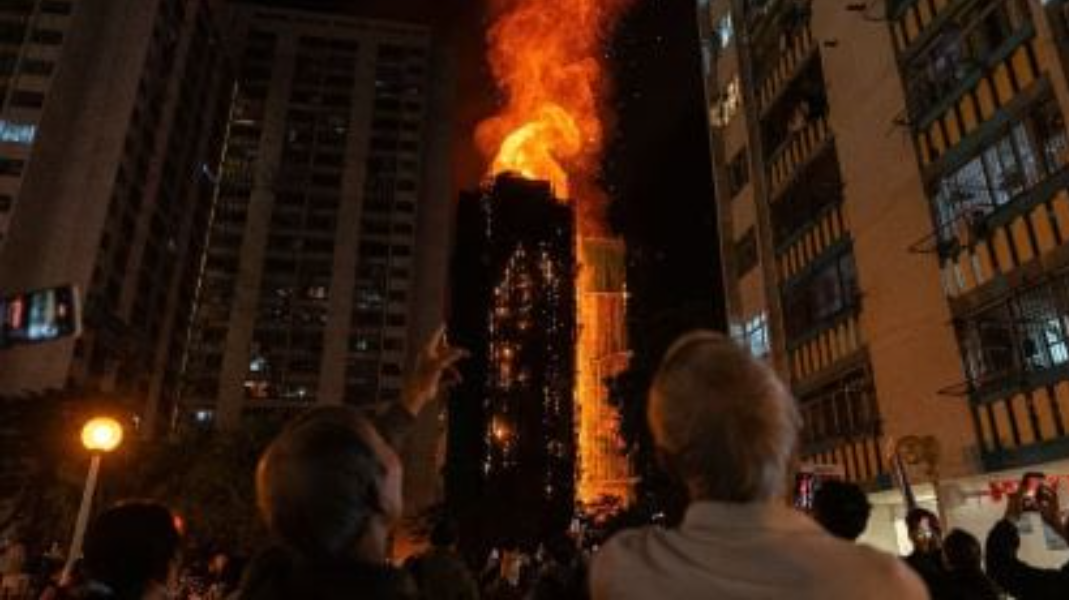
A catastrophic fire that erupted Wednesday afternoon in Hong Kong’s densely packed Wang Fuk Court residential complex has claimed at least 44 lives, with rescuers still scouring the charred ruins for hundreds of missing residents.
The inferno, which raged through multiple high-rise towers in the Tai Po district of the New Territories, marks the deadliest blaze in the city since World War II, evoking grim parallels to global tragedies like London’s Grenfell Tower fire.
The flames broke out around 3 p.m. local time in Block 6 of the eight-tower estate, home to over 4,000 people—many of them elderly pensioners.

A man who said his wife was caught in the fire reacts outside Wang Fuk Court as flames engulf the building, in Hong Kong, China
According to government data from 2021, about 36% of Wang Fuk Court’s residents are aged 65 or older, underscoring the vulnerability of those trapped as the fire leaped to adjacent blocks within minutes.
By early Thursday, the death toll had climbed from an initial 36 to 44, with 40 fatalities at the scene and four more in hospitals.
At least 279 people remain unaccounted for, their fates hanging in the balance amid ongoing searches hampered by extreme heat and structural instability.
Firefighters battled the blaze for over 16 hours, with isolated flames still flickering in several units as dawn broke over Tai Po.

Firefighters work to extinguish a blaze that engulfed multiple buildings at the Wang Fuk Court housing estate in Tai Po, Hong Kong.
Hong Kong Fire Department Deputy Director Derek Armstrong Chan described the conditions as hellish: “Extremely high temperatures” inside the towers, coupled with falling debris and scaffolding, posed lethal risks to responders.
Tragically, one firefighter, 35-year-old Ho Wai-ho, lost his life during the operation.
Secretary for Security Tang Ping-keung paid tribute to Ho, calling his sacrifice a stark reminder of the dangers faced by first responders.

Fire engines line the streets as Hong Kong residents line a nearby overhead bridge to take a look at the Wang Fuk Court residential estate, in Tai Po, Hong Kong
The complex, undergoing refurbishment, was shrouded in bamboo scaffolding—a ubiquitous fixture in Hong Kong’s skyline, dating back to the Han dynasty
This ancient construction method, prized for its flexibility in the city’s vertical urban jungle, has long been a double-edged sword.
While celebrated as cultural heritage, bamboo’s combustibility has drawn scrutiny, especially after a similar mid-October blaze at Chinachem Tower in the Central business district, sparked by a cigarette butt and contained without casualties.
In Wednesday’s disaster, the scaffolding appeared to act as a fuse.

Residents rest at a temporary shelter after a fire broke out at Wang Fuk Court, a residential estate in the Tai Po district of Hong Kong’s New Territories
Director of Fire Services Andy Yeung reported that crews discovered inflammable polystyrene boards blocking apartment windows—materials linked to a construction firm working on the site.
“These boards are extremely inflammable, and the fire spread very rapidly,” Yeung said, noting their unusual presence.
Protective nets, canvas, and plastic covers also allegedly failed safety standards, fueling the blaze’s unchecked ascent.
The flames turned the exteriors into infernos, reminiscent of the 2017 Grenfell Tower disaster, where cladding accelerated the spread, killing 72.
By Thursday morning, efforts had brought four of the seven affected blocks under control, but three remained focal points for firefighting teams.
Drones hovered overhead, illuminating the wreckage, while hoses doused smoldering facades.
Hospital admissions stood at 66, with 17 in critical condition and 24 serious. Chief Executive John Lee, addressing reporters in the pre-dawn hours, labeled the event “a major disaster” and vowed accountability.
“We will hold those responsible in accordance with the laws,” he said, announcing probes into fireproofing compliance and scaffolding safety.
Police moved swiftly, arresting three men—two directors and a consultant from the implicated construction company—on suspicion of manslaughter due to “gross negligence.”
The firm’s name was etched on the polystyrene boards, and investigators suspect substandard materials exacerbated the tragedy.
A dedicated task force will dissect the fire’s origins, with housing authorities scrutinizing refurbishment protocols.
Amid the chaos, human stories emerged from the ashes.
Resident Mr. Ho, 65, fled his 11th-floor apartment in Block 1 with nothing but the clothes on his back.
Watching from behind police tape, wrapped in a donated towel, he gazed at his ruined home and lamented: “I don’t doubt many elderly, cats and dogs are still in there.”
The death toll, he feared, would rise. Nearby, in the “desert zone” devoid of shops, 45-year-old Mr. Ho from Fanling distributed community-donated water and tea to exhausted firefighters.
“This has rarely ever happened in Hong Kong history,” he said, his voice heavy with disbelief. “We’re doing what we can to help.”
Over 700 evacuees, dazed and blanket-clad, were bused to makeshift shelters like a Tai Po sports center.
There, volunteers sorted donations—cup noodles, bread, bottled water—while survivors slept on floor mats in hushed halls.
Some lingered on streets into the early morning, elderly figures shuffling with volunteer aid, their faces etched with loss.
The estate’s 31-story towers, offering nearly 2,000 affordable units, symbolize Hong Kong’s public housing lifeline for low-income families, but also its aging infrastructure strains.
Global echoes of sympathy poured in. Taiwan President Lai Ching-te, posting on X early Thursday, extended “deepest condolences” and prayers for the bereaved.
“At this moment, let us pray for Hong Kong together,” he wrote, wishing safe returns for the missing.
Experts weighed in on the structural perils. Dave Downey, former chief of Florida’s Miami-Dade Fire Rescue, told ANW the intense heat had likely assaulted the concrete frames like “an oven,” raising collapse risks.
“This fire has been attacking the structure itself,” he warned, advising trapped residents to seal doors with tape and wet cloths—a futile shield against smoke and 1,000-degree infernos.
As the city mourns, the blaze reignites debates over modernization. Hong Kong’s Development Bureau recently mandated 50% metal scaffolding for new public projects from March onward, citing worker safety.
Yet, backlash from heritage advocates persists. Structural engineer Goman Ho of Arup suggested epoxy coatings for bamboo to balance tradition and resilience.
“We need to find ways to overcome it,” he urged. Wang Fuk Court, once a quiet haven miles from mainland China, now stands as a scar on Hong Kong’s safety record.
The 1996 Garley Building fire, which killed 41, had held the grim peacetime title—until now.
With investigations unfolding and acrid smoke lingering in Tai Po’s air, questions loom: How did negligence turn routine renovations into apocalypse? And can Hong Kong’s bamboo-wrapped legacy evolve without forsaking its roots?
Recovery will be arduous.
Shelters brim with the displaced, communities rally with aid, and a city of 7.5 million grapples with grief. For the 279 unaccounted souls, hope flickers faintly against the dawn.
As Lee pledged full assistance, one thing is clear: This “major disaster” demands not just condolences, but systemic reckoning.
Discover more from AMERICA NEWS WORLD
Subscribe to get the latest posts sent to your email.
















Leave a Reply