By Suraj Karowa and Ella Nilsen/ANW
December 6, 2025

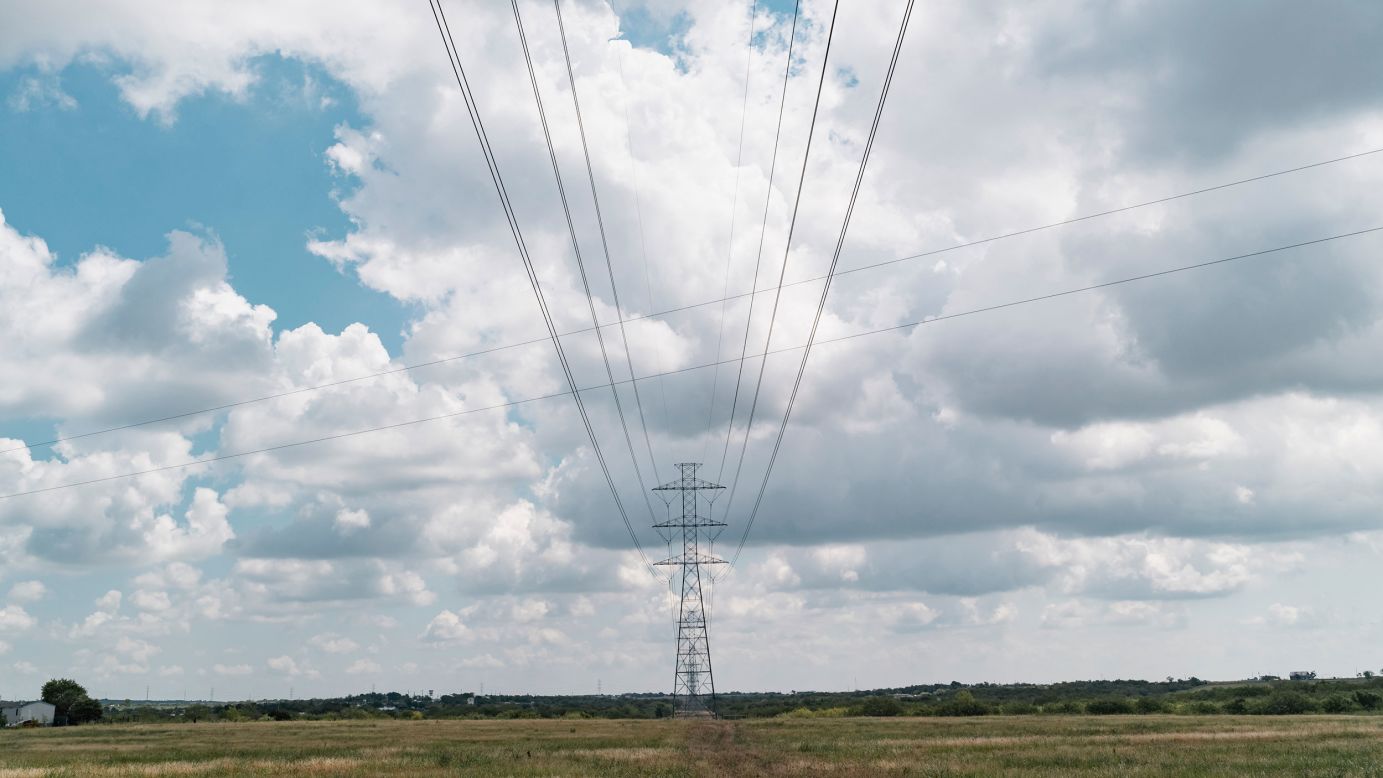
Power transmission lines near Austin, Texas, in June 2024
Power lines stretch across the dusty plains near Austin, Texas, humming under the relentless June 2024 sun.
These towering veins of America’s energy system—once reliable workhorses—now symbolize a deeper strain: a national grid buckling under the weight of age, climate chaos, and exploding demand.
For homeowners like Stephanie Tate in Illinois, the fallout is personal and painful. Her winter heating bills last year ballooned to $400 a month, despite a perfectly functioning furnace, fresh insulation, and energy-sipping windows.
“It still didn’t make a dent,” Tate recalls, bundling up in a home chilled below 68 degrees.
Summer brought no relief. Air conditioning costs pushed her bills higher still, forcing her to tolerate 75-degree indoor swelter.

Linemen work on large transmission structures that are part of Xcel Energy’s Power Pathway project south of Brush, Colorado, in January 2024.
Digging into the numbers, Tate uncovered the real villain: “delivery fees”—charges for maintaining poles, wires, and substations—rivaled the price of the electricity itself.
“You’re paying more for everything right now,” she says, “and the electrical costs increase so exponentially and so quickly.”
Tate’s sticker shock echoes nationwide. Since September 2024, U.S. residential electricity rates have climbed 7.4%, per the Energy Information Administration.
Illinois saw the third-steepest surge at 20.6%, trailing only Washington, D.C., and New Jersey.
But supply charges alone don’t tell the story; delivery fees, tied to infrastructure upkeep, are the silent escalator.
In Illinois, Ameren—the utility serving Tate—blames volatile wholesale power prices from third-party generators, especially during peak summer demand.
Yet the company, like peers across the U.S., is also ramping up grid investments. “We’re investing in strengthening and modernizing the grid,” a spokesperson explained.
These upgrades, essential as they are, are landing squarely on customer bills.
America’s electric infrastructure, much of it built in the mid-20th century, is fraying at the edges.
Over the past five years, utilities have poured $5 billion into high-voltage transmission lines—those massive towers shuttling power across regions—and $16 billion into local distribution networks of poles and substations.
“Essential investments,” calls Drew Maloney, CEO of the Edison Electric Institute, the industry’s trade group.
“Our electric grid is America’s most important machine—and we have to make sure it works reliably every day for families, businesses, and local communities.”
The urgency stems from dual threats: surging demand and eroding resilience. For decades, U.S. electricity use flatlined. Now, it’s exploding.
Data centers, the digital backbone of AI and cloud computing, could devour 106 gigawatts by 2035—equivalent to powering Japan—according to Bloomberg NEF.
Add in reshored manufacturing, electric vehicles, and heat pumps electrifying homes, and the grid faces unprecedented pressure.
“We’ve been able to get by with the grid that we have,” says Ryan Hledik, a principal at the Brattle Group, who co-authored a recent study on rising prices.
“The unfortunate thing is, we’ve been needing to make those investments to basically tread water.”
Pandemic-disrupted supply chains have supercharged costs: Transformers and other gear now outpace inflation.
Extreme weather—floods in California, hurricanes in the Southeast, wildfires in Colorado—has battered systems, demanding resilience retrofits.
Take Xcel Energy’s Power Pathway project in Colorado: Linemen in January 2024 scaled colossal towers south of Brush, fortifying lines against blazes that have scorched the West.
“The grid is being updated, but it’s definitely still old,” Hledik notes. “We’re continuing to confront the reality of more volatile weather conditions.
So, it’s not my expectation that the need for this investment is going to be finished anytime soon.”
Natural gas networks fare no better. In Baltimore, winter 2025 heating bills topped $1,000 for some, sparking outrage.
Baltimore Gas and Electric (BGE) operates the nation’s oldest gas system, riddled with iron and steel pipes from the Grant era—some installed in the 1870s. “Our hundreds of miles of century-old gas main is far past the end of its useful life,” says BGE’s Nick Alexopulos.
Crews have swapped 600 miles for modern plastic, with 800 more to go. On April 3, 2025, workers unearthed a corroded 4-inch cast-iron relic from the early 1900s along East Monument Street, replacing it with a gleaming 30-inch conduit.
For Tate, exhaustion with Ameren bills prompted action: This year, she installed solar panels and a battery system, eyeing thousands in annual savings. State and federal incentives will offset half the cost; she’ll pay off the rest in a year.
“I’m extraordinarily excited,” she says, gazing at sunny skies. “Every day it’s sunny outside, I’m like, ‘oh gosh, I missed this day with solar.’”
Come summer, her home stays cooler; during Illinois’ brutal spring storms, batteries ensure lights stay on when the grid falters. “Those batteries will run even when Ameren is offline.”
Yet even solar won’t erase delivery fees—utilities demand connection payments. “I’m just incredibly frustrated,” Tate admits.
“It doesn’t seem logical that they should be this high, this quick.” Her leap feels like “a leap of faith,” but one buoyed by rebates and reliability.
As America electrifies, the grid’s overhaul can’t wait. Utilities warn of blackouts without it; consumers balk at the tab.
Policymakers face a tightrope: Subsidize upgrades? Accelerate renewables? For now, families like Tate’s hunker down, bills mounting like storm clouds on the horizon.
In Kensington, Maryland, on July 3, 2025, installer KJ Williams hauled panels to a rooftop, part of a solar boom. But without a nimbler grid, the promise of clean, cheap power remains just that—a promise deferred.
Discover more from AMERICA NEWS WORLD
Subscribe to get the latest posts sent to your email.