By ANW Staff/ANW , November 24, 2025
Peshawar, Pakistan

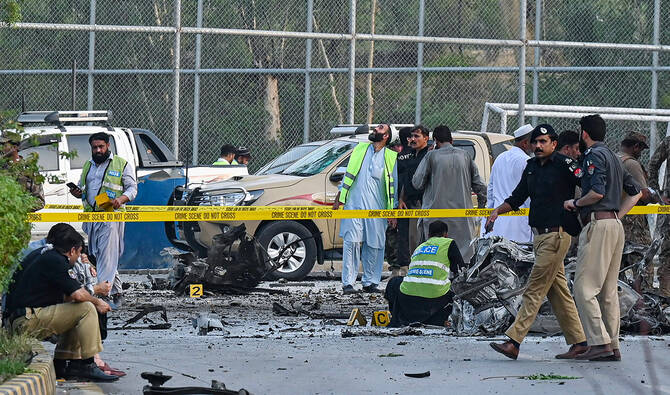
Rescue personnel examine the site of the suicide attack in Peshawar
– November 24, 2025 – In a brazen early-morning assault that shattered the fragile calm of this volatile border city, three suicide bombers targeted the headquarters of Pakistan’s Federal Constabulary (FC) paramilitary force, killing at least three security personnel and injuring several civilians.
The attack, which unfolded amid routine morning drills, underscores the escalating threat posed by militant groups in Khyber Pakhtunkhwa province, where the Tehrik-e-Taliban Pakistan (TTP) has intensified operations in recent months.
Eyewitnesses described a scene of chaos as the first bomber detonated his explosives-laden vest at the main gate of the sprawling FC complex around 6:30 a.m. local time.

Security officials at the scene of the attack in Peshawa
The blast ripped through the entrance, sending shrapnel and debris flying into the densely populated neighborhood surrounding the facility.
Two additional attackers, armed and attempting to breach the perimeter, were swiftly neutralized by FC guards in a fierce exchange of gunfire.
“They came on foot, screaming jihadist slogans,” recounted one survivor, a local shopkeeper whose stall was partially destroyed.
“The explosion was like thunder – it shook the ground, and then the shooting started.”

Three suicide bombers have attacked the headquarters of a paramilitary force in the Pakistani city of Peshawar
Peshawar Capital City Police Officer Mian Saeed Ahmad provided a stark timeline to reporters. “One bomber blew himself up at the gate, killing the three FC officers stationed there.
The other two tried to force entry but were gunned down before they could advance further,” he said.
The slain personnel were identified as gate sentries caught in the initial detonation.
Ahmad emphasized the role of heightened alertness: “Our forces’ timely response prevented the attackers from reaching the parade ground, where dozens of personnel were assembled. It could have been a massacre.”
The FC headquarters, a fortified bastion in Peshawar’s bustling Hayatabad area, serves as a nerve center for counterinsurgency operations along the Afghan border.
Its location in a teeming urban zone amplified the attack’s ripple effects.
Rescue teams, including ambulances from Lady Reading Hospital and Khyber Teaching Hospital, rushed to the site, where an emergency was declared.
Hospital spokespersons confirmed treating six civilians for shrapnel wounds and blast injuries – all reported stable by midday.
“We received calls for everything from cuts to concussions,” said Dr. Ayesha Khan, an emergency physician at Lady Reading. “The wounded include women and children who were just starting their day.”
No group immediately claimed responsibility, but fingers pointed squarely at the TTP, the Pakistan-based faction of the Taliban allied with but distinct from Afghanistan’s ruling regime.
The TTP has orchestrated a wave of high-profile strikes since the Afghan Taliban’s 2021 takeover, exploiting porous borders to stage cross-border incursions.
Analysts link the uptick to safe havens in Afghanistan, where Islamabad accuses Kabul of turning a blind eye.
“This is textbook TTP: symbolic targets to erode state authority,” said security expert Imtiaz Gul. “Peshawar remains their focal point – it’s the gateway to the tribal belt.”
The assault comes amid a spasm of violence that has strained Pakistan-Afghanistan relations to the breaking point.
Just 13 days prior, on November 11, a suicide bomber struck outside Islamabad’s district court, killing 12 in an explosion next to a police vehicle.
Authorities arrested four suspects tied to a TTP splinter cell in connection with that bombing, fueling demands for Afghan extraditions.
On November 20, Pakistani forces reported killing 23 militants in cross-border raids, retaliating against alleged TTP staging grounds.
“The cycle is vicious,” noted a Western diplomat speaking anonymously. “Each attack begets retaliation, pushing both sides toward confrontation.”
Prime Minister Shehbaz Sharif, addressing the nation from Islamabad, decried the “cowardly” strike and vowed retribution.
“We honor our fallen heroes and will hunt down these terrorists without mercy,” he declared in a televised statement.
“Their evil designs against Pakistan’s sovereignty will be crushed.” President Asif Ali Zardari echoed the sentiment on X (formerly Twitter), offering condolences to the families and lauding the FC’s “unwavering valor.”
“In the face of terror, our security forces stand as an unbreakable shield,” he posted, attaching a photo of the cordoned site.
The human toll extends beyond the immediate casualties. Families of the deceased FC officers – hailing from rural villages in Khyber Pakhtunkhwa – gathered at the hospital, their grief compounded by economic hardship.
“My brother joined the FC to feed us; now who’s left?” wept Fatima Bibi, sister of one victim.
Community leaders called for enhanced urban defenses, pointing to Peshawar’s history as a militant flashpoint.
The city, scarred by bombings since the post-9/11 era, has seen over 1,200 militant deaths in 2025 alone, per government tallies.
Broader context reveals a nation grappling with resurgence.
Pakistan’s military campaign against TTP strongholds has displaced thousands, while economic woes – inflation at 25%, floods ravaging the south – hamstring counterterrorism funding.
Recent incidents compound the narrative: A November 21 gas explosion at a glue factory in eastern Punjab killed 16, highlighting industrial neglect; a November 20 police raid on the Kashmir Times office in Jammu sparked cries of press suppression amid India-Pakistan border flares.
Even aviation suffered a blow with an Indian Tejas jet crash at the Dubai Airshow on November 22, killing the pilot.
Internationally, the attack draws muted concern. The U.S. State Department condemned the violence, urging Afghan cooperation, while China – a key Pakistani ally – reiterated support for stability.
Yet, as winter sets in along the Durand Line, fears mount of a Taliban-inspired insurgency spilling over.
“Without diplomatic breakthroughs, Peshawar’s gates will keep bleeding,” warned Gul.
As investigators comb the blast site – a cratered maw ringed by bullet-pocked walls – Peshawar resumes its defiant rhythm.
Street vendors hawk chai amid checkpoints; children navigate rubble-strewn alleys.
For now, the city mourns, but its resolve hardens. In Sharif’s words: “Terror may strike, but it will not break us.”
Discover more from AMERICA NEWS WORLD
Subscribe to get the latest posts sent to your email.