
By Manisha Sahu, America News World
September 19, 2025
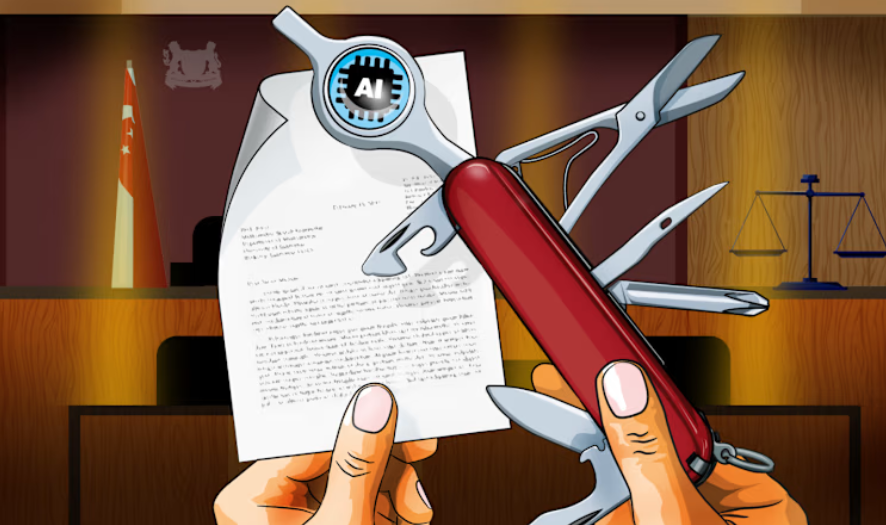
Artificial intelligence (AI) is quietly reshaping the legal landscape in Singapore, where law firms of all sizes are experimenting with generative AI tools to enhance efficiency. From drafting initial submissions to summarising lengthy case documents, AI is increasingly seen as a powerful assistant. Yet, lawyers are quick to stress one critical point: human oversight remains essential, as responsibility for accuracy ultimately rests with the lawyer who signs off.
The shift comes as the Singapore judiciary itself takes the lead in technological innovation, having introduced AI tools in the Small Claims Tribunal. A year earlier, in October 2024, the courts issued guidelines on AI use in legal practice, paving the way for firms to adopt the technology more systematically.
A New Era of Legal Workflows
Large law firms are leading the charge, adopting sector-specific AI platforms like HarveyAI, designed for legal drafting and research, and Microsoft Copilot, which automates administrative tasks. These tools are used for a variety of functions: generating chronologies of events, drafting submissions, translating documents, and even brainstorming alternative legal arguments.
At Rajah & Tann Singapore, one of the country’s largest practices, dispute resolution head Adrian Wong said the firm relies on Harvey for drafting and knowledge management. “Harvey is also used as a knowhow repository for our in-house template pleadings and precedents, enabling our disputes lawyers to efficiently locate and retrieve relevant materials,” he explained. The firm also uses RelativityOne, an AI-powered e-discovery tool, for analyzing large datasets in litigation.
Lawyers and support staff at Rajah & Tann complement these efforts with Microsoft Copilot, particularly for drafting meeting notes, summarising project updates, and adjusting the tone of client communications.
Early Adopters and Expanding Partnerships
WongPartnership, another major player, has been investing in AI since 2017. Managing partner Chou Sean Yu noted that the firm was the first in Singapore to deploy natural language processing for contract review and e-discovery using the platform Luminance. More recently, WongPartnership became one of the earliest Southeast Asian adopters of Harvey.
“Automating routine tasks allows our lawyers to achieve better work-life balance and focus on higher-value strategic work,” Mr. Chou said. “AI enhances efficiency but complements rather than replaces the personalised attention that clients depend on.”
Drew & Napier, home to 350 lawyers, has also rolled out AI across its workforce. All its lawyers now have access to Copilot, while a selected group uses Harvey for more complex disputes. Rakesh Kirpalani, the firm’s chief technology officer, described Harvey as particularly effective when working with vast document sets. “The lawyer can then narrow down timeframes and keywords before performing a manual review,” he said, underscoring AI’s role as an assistant rather than a replacement.
At Withers KhattarWong, more than 60 percent of lawyers are using Copilot, while department-specific tools such as LegalScape and LexRoom are being piloted for research and drafting. Litigation head Pardeep Khosa said the firm’s phased approach ensures efficiency without compromising professional judgment.
Smaller Firms Testing the Waters
Boutique law firms are also experimenting with AI, albeit more cautiously. At Han & Lu Law Chambers, partner Bozy Lu said her firm uses Copilot for administrative tasks like tabulating medical invoices for personal injury claims. The firm recently tested Google’s Gemini to draft legal submissions in road traffic accident cases, with results “comparable to a first-year associate’s drafts.”
Similarly, Tang Thomas, a new boutique practice, is exploring AI in both backend operations and legal drafting. Partner Simran Toor emphasised that adoption must be intentional, particularly given concerns around legal privilege and confidentiality.
Beyond Law Firms: Prosecutors and Mediators Step In
The adoption of AI is not limited to private practice. Prosecutors at Singapore’s Attorney-General’s Chambers (AGC) are using AI-powered image recognition to handle sensitive evidence, such as classifying digital child sexual abuse material. Solicitor-General Daphne Hong said this reduces the time spent sifting through thousands of files while maintaining human accountability.
At the Singapore International Mediation Centre (SIMC), mediators are using a custom-built AI assistant called MAIA. Launched in 2024 and recently upgraded to MAIA 2.0, the tool helps mediators digest tens of thousands of pages of documents in just days. Feedback has been strong, with one mediator calling the tool “shockingly accurate” and others reporting preparation time reduced by up to 30 percent.
Opportunities and Risks
Despite widespread enthusiasm, lawyers remain cautious about over-reliance on AI. Risks include “hallucinations,” where AI generates plausible but inaccurate outputs, and potential breaches of client confidentiality.
“AI is undeniably powerful, but its limitations are equally real,” said Withers’ Mr. Khosa. “Responsible adoption requires a clear boundary between operational support and professional judgment.”
Ms. Lu from Han & Lu described her relationship with AI as “love-hate,” noting that poorly crafted prompts often produce flawed results. She warned that polished AI drafts could lead to complacency if not checked thoroughly: “If lawyers make submissions based on unchecked AI work, that becomes inherently dangerous in court.”
Firms are therefore embedding safeguards, from internal policies on responsible AI use to client transparency. At Rajah & Tann, Mr. Wong stressed that clients can opt out of AI use entirely, while Drew & Napier ensures all AI outputs are independently verified.
Looking Ahead
Singapore’s legal sector is already planning for the next stage: agentic AI systems capable of automating multi-step workflows with minimal human input. Rajah & Tann aims to embed AI into compliance frameworks and tailor it to its internal precedent libraries. Withers is exploring AI-enabled client interfaces, while Tang Thomas is considering AI-driven client education tools.
The vision, according to industry leaders, is not about replacing lawyers but about raising the standard of service. “Ultimately, the goal is to elevate the quality of the service we provide and be better professionals,” said Mr. Khosa.
For now, AI remains a junior assistant in Singapore’s legal sector—powerful, promising, but always subject to the final signature of a human lawyer.8

Also read : Are US troops returning to Afghanistan? What Donald Trump Said about Reclaiming Bagram
Discover more from AMERICA NEWS WORLD
Subscribe to get the latest posts sent to your email.































**, we dive into why your electric bill is climbing and what can be done. ### Why Are Electricity Prices Rising? Electricity costs are soaring across the United States. According to the U.S. Energy Information Administration (EIA), household electricity prices are expected to jump 13% from 2022 to 2025. In some states, the increase is even steeper. For instance, Maine saw a 36.3% spike, while Connecticut faced an 18.4% rise between May 2024 and May 2025. Nationwide, the average household paid 17.47 cents per kilowatt-hour in May 2025, up from 16.41 cents a year earlier—a 6.5% increase. So, what’s driving these hikes? First, there’s a massive surge in electricity demand. More people are using air conditioners during hotter summers. Electric vehicles and heat pumps are also becoming popular. However, the biggest culprit is the rapid growth of AI-powered data centers. These facilities, run by tech giants like Amazon, Google, and Microsoft, use as much electricity as small cities. A single AI search, like one on ChatGPT, consumes 10 times more power than a regular Google search. Additionally, natural gas prices, a key fuel for power plants, have climbed. The aging US power grid also struggles to keep up. Many transmission lines and power plants date back to the post-World War II era. As a result, utilities are spending billions to upgrade infrastructure, and those costs are passed on to consumers. > **Data Highlight: Electricity Price Trends (2022-2025)** > Source: U.S. Energy Information Administration > - **2022**: 14.96 cents per kWh > - **2023**: 15.87 cents per kWh > - **2024**: 16.41 cents per kWh > - **2025 (May)**: 17.47 cents per kWh > *Note*: Some states like Maine (+36.3%) and Connecticut (+18.4%) saw sharper increases. ```chartjs { "type": "line", "data": { "labels": ["2022", "2023", "2024", "2025 (May)"], "datasets": [{ "label": "Average US Electricity Price (cents per kWh)", "data": [14.96, 15.87, 16.41, 17.47], "borderColor": "#007bff", "backgroundColor": "rgba(0, 123, 255, 0.2)", "fill": true }] }, "options": { "responsive": true, "maintainAspectRatio": false, "scales": { "y": { "beginAtZero": false, "title": { "display": true, "text": "Price (cents per kWh)" } }, "x": { "title": { "display": true, "text": "Year" } } } } } ``` ### The AI Power Problem The AI boom is transforming how we live, work, and search online. But it comes at a cost. Data centers that power AI tools are sprouting up fast. Between 2021 and 2024, the number of US data centers doubled. By 2030, they could consume 5% to 9% of the nation’s electricity, according to the Electric Power Research Institute. This is a big jump from just 4% in 2022. For example, PJM Interconnection, which serves 67 million people across 13 states, reported a massive spike in demand. In 2024, its capacity auction prices jumped 833%, with data centers driving nearly 70% of the increase. This led to higher bills for households in states like Pennsylvania, New Jersey, and Ohio. In Columbus, Ohio, typical electric bills rose by $27 a month in 2025. Moreover, AI tasks are energy hogs. Generating a single high-definition AI image uses as much power as charging a smartphone halfway. As more people use AI for work or fun, the strain on the grid grows. Tech companies are racing to build bigger data centers, but the power supply isn’t keeping up. This mismatch is pushing prices higher. > **Image**: An Amazon Web Services data center in Boardman, Oregon, August 2024. (Source: Jenny Kane/AP) > *Caption*: Data centers like this one are driving up electricity demand across the US. ### Other Factors Behind the Price Surge While AI is a major player, it’s not the only reason for rising bills. Natural gas prices have spiked, making it more expensive to generate electricity. Also, the US power grid is old and needs upgrades. The Department of Energy says 70% of transmission lines are nearing the end of their lifespan. Replacing them costs billions, and consumers foot the bill. Extreme weather is another issue. Heat waves and storms are more frequent, forcing utilities to repair or harden the grid. In California, utilities spent $27 billion from 2019 to 2023 on wildfire prevention and insurance. These costs trickle down to customers. Meanwhile, some states are phasing out coal plants, but new renewable energy projects face delays due to permitting issues. For more insights on how energy costs affect households, check out **[AMERICA NEWS WORLD (ANW)](https://america112.com/)** for the latest updates. ### Solutions to Ease the Burden Thankfully, there are ways to tackle rising electricity costs. First, experts suggest speeding up the permitting process for new power plants, especially solar and wind. The International Energy Agency (IEA) predicts that solar and wind could add 110 terawatt-hours of power for data centers by 2030. Streamlining permits could bring these projects online faster. Next, tech companies are stepping up. Google recently signed deals to reduce AI data center power use during peak grid times. Amazon is investing in small modular nuclear reactors to power its operations cleanly. These efforts could lower costs and emissions in the long run. Additionally, hardening the grid can help. In Florida, utilities are using concrete poles and advanced tech to make power lines hurricane-proof. In California, moving lines underground reduces wildfire risks. These upgrades cost money upfront but save on repairs later. Finally, power purchase agreements (PPAs) let data centers buy renewable energy directly. This reduces reliance on fossil fuels and keeps costs down for consumers. Co-locating data centers with solar or wind farms is another smart move. For more on clean energy solutions, visit **[AMERICA NEWS WORLD (ANW)](https://america112.com/)**. > **Data Highlight: Projected Data Center Power Demand** > Source: Electric Power Research Institute > - **2022**: 4% of US electricity consumption > - **2030 (Projected)**: 5% to 9% of US electricity consumption > - **Growth**: Data center energy use could double by 2030. ```chartjs { "type": "bar", "data": { "labels": ["2022", "2030 (Projected)"], "datasets": [{ "label": "Data Center Electricity Consumption (% of US Total)", "data": [4, 7], "backgroundColor": ["#28a745", "#dc3545"], "borderColor": ["#28a745", "#dc3545"], "borderWidth": 1 }] }, "options": { "responsive": true, "maintainAspectRatio": false, "scales": { "y": { "beginAtZero": true, "title": { "display": true, "text": "% of US Electricity" } }, "x": { "title": { "display": true, "text": "Year" } } } } } ``` ### What’s Next for Consumers? Electricity prices may keep rising if demand outpaces supply. The White House warns that AI data centers could push prices up 9-58% by 2030 without new investments. The US needs $1.4 trillion by 2030 to meet growing power needs, according to the White House Council of Economic Advisors. This includes building new power plants and transmission lines. However, not all hope is lost. Renewable energy is getting cheaper. Solar and wind projects are expanding, and nuclear power is making a comeback. For example, Microsoft is reviving Pennsylvania’s Three Mile Island nuclear plant to power its AI tools. These efforts could stabilize prices over time. Consumers can also take action. Using energy-efficient appliances, sealing home leaks, and switching to LED lights can lower bills. ### Global Impact and Local Action The AI-driven power surge isn’t just a US problem—it’s global. Data centers worldwide could consume 3-4% of global power by 2030, up from 1-2% today, according to Goldman Sachs. In Europe, countries like Ireland and Germany are seeing similar price hikes. In Asia, Malaysia’s data centers could account for one-fifth of power demand growth. Locally, communities near data centers face challenges. Noise, water use, and power outages are common complaints. Some states, like Pennsylvania, are pushing back. Governor Josh Shapiro has threatened to pull the state from PJM if costs don’t drop. For more on local energy issues, ### Looking Ahead The AI revolution is exciting, but it’s putting pressure on power grids and wallets. While tech companies and utilities work on solutions, consumers are stuck with higher bills. By investing in clean energy, upgrading grids, and managing demand, the US can balance innovation with affordability. Stay informed with **[AMERICA NEWS WORLD (ANW)](https://america112.com/)** for the latest energy news. For a deeper dive into how AI is reshaping the energy landscape, check out this [CBS News article](https://www.cbsnews.com/news/ai-data-centers-electricity-demand-power-grid-us/) on the growing strain on US power grids.](https://america112.com/wp-content/uploads/2025/08/1198006_3_0818-NPRICES-lines-lede.jpg_standard-1.jpg)






![Smoke rises after Israeli strikes in Beirut's southern suburbs, on March 2 [Mohamad Azakir/Reuters]](https://america112.com/wp-content/uploads/2026/03/hgh.webp)