By _shalini oraon

—
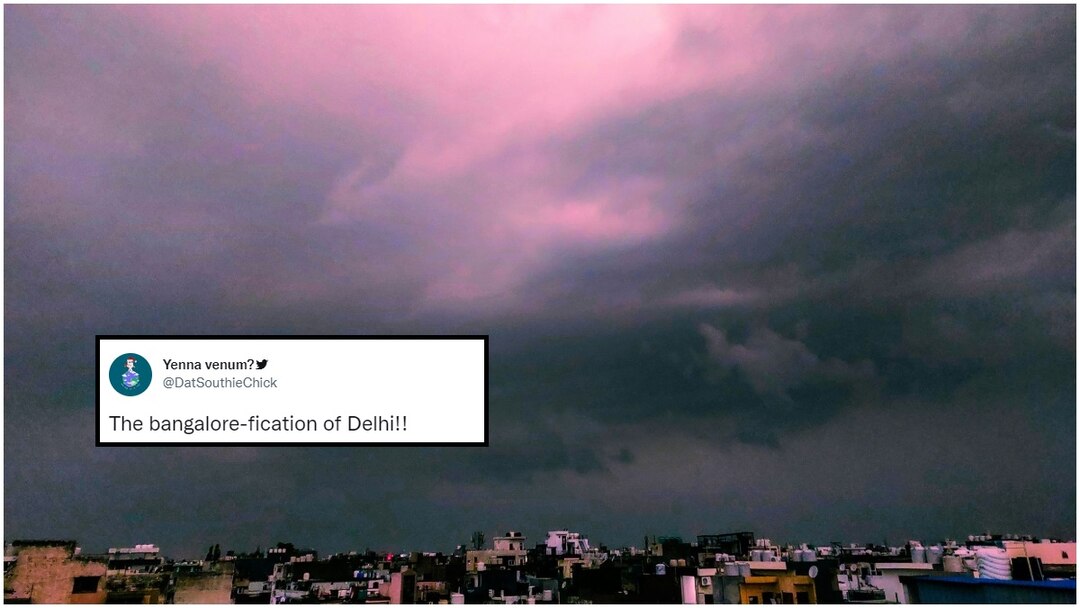
Rain on One Side, Sunshine on the Other: Bengaluru Skies Delight Delhi Boy
For a boy from Delhi, where the sky is a monolithic entity—a relentless, searing blue in summer, a thick, grimy blanket in winter, or a uniform, vengeful grey during the brief monsoon—the sky of Bengaluru presents a spectacle of bewildering, almost theatrical, duality. I am that Delhi boy, and my recent encounter with a Bengaluru sky, where on one side the sun shone with golden-hour benevolence and on the other, a curtain of rain fell in a silver, shimmering sheet, was not just a meteorological observation; it was a philosophical lesson painted on the canvas of the atmosphere.
In Delhi, the weather is an absolutist regime. When it is hot, the entire city bakes in a collective furnace, the heat rising from the asphalt in visible waves, forcing a unity of suffering. When it rains, it does so with a tyrannical force, flooding streets and washing away distinctions, a great equalizer of chaos. The sky there is a single, domed decision. There is no nuance, no debate. You are either under the sun or under the clouds, but never, ever under both simultaneously.
Bengaluru, I discovered, is a city of partitions and possibilities. Its weather is a vibrant democracy, often a chaotic one, where different neighbourhoods live under different governments. The phenomenon I witnessed—a sunshower of such dramatic contrast—is a perfect microcosm of the city’s soul. I was standing on a flyover, the kind that offers a panoramic view of the urban sprawl. To my left, towards Whitefield, the world was drenched in a warm, honeyed light. The glass facades of tech parks glittered, and the green of the trees was vivid and intense, each leaf outlined with cinematic clarity. It was a postcard for a prosperous, sunny future.
But to my right, towards Sarjapur, a different drama unfolded. A deep, purplish-grey cloud had unleashed its payload. The rain was not the hesitant drizzle of a passing cloud but a solid, opaque wall of water. The buildings in that direction were softened into silhouettes, their details blurred by the downpour. The light under that cloud was a cool, bruised twilight, a stark contrast to the golden afternoon just a few hundred meters away. The line of demarcation was not a gentle gradient but a sharp, startling frontier, as if an invisible, giant shield was separating two entirely different worlds.
This was the moment of delight, the moment of pure, unadulterated wonder. It was a delight that went beyond the visual spectacle. It was a cognitive delight. My brain, wired by the monolithic skies of North India, struggled to process the information. How could one reality contain two such opposing truths? It felt like a glitch in the matrix, a beautiful error in the code of nature. I stood there, mesmerized, watching cars drive from brilliant sunshine into a torrential downpour, their windscreen wipers springing to life mid-journey, their occupants experiencing a complete climatic shift in the span of a single traffic light.
This celestial drama is, of course, a product of Bengaluru’s geography. Situated at an altitude of over 3,000 feet, it sits in the realm of cumulonimbus clouds—the great, towering cauliflower-shaped architects of thunderstorms. These clouds are localized and potent, dumping their rain in concentrated bursts over one area while leaving the adjacent one parched. The city’s infamous traffic, which I had been cursing just moments before, became the perfect vantage point to appreciate this phenomenon. The very stagnation that defines Bengaluru’s commute allowed me the time to truly see its sky.
But the significance of this event unfolded slowly, like the clouds themselves. It began to feel like a metaphor for the city I was exploring. Bengaluru is a city of stark, coexisting contrasts. It is the garden city and the silicon valley of India. It is a place where centuries-old temples stand in the shadow of shimmering glass skyscrapers. It is a city where you can be stuck in a traffic jam fueled by the frantic energy of a million startups, while a few streets away, life moves at the leisurely pace of the old cantonment, with its colonial bungalows and quiet, tree-lined avenues.
The sunshine and the rain, existing simultaneously, mirrored the city’s spirit of juxtaposition. The relentless, sunny optimism of its tech industry, always looking forward, always building, exists alongside the nostalgic, sometimes rainy, melancholy for a greener, quieter past. You can have a conversation about machine learning and artificial intelligence in a trendy café, and within minutes, be listening to an old resident lament the loss of the city’s lakes and the cool climate—a sunshine of progress, a rain of memory.
For me, the Delhi boy, it was also a personal allegory. Moving to a new city is always a journey of contrasting weathers within the self. There are days filled with the sunshine of new opportunities, new friendships, and the thrill of independence. And there are moments of sudden, unexpected rain—pangs of homesickness, the frustration of navigating an unfamiliar culture, the grey clouds of doubt. We are all, in a way, living under a Bengaluru sky, capable of holding sunshine and rain within us at the same time. We can feel hopeful about the future while simultaneously mourning the past. We can be confident in our new life while feeling a sudden, sharp loneliness.
The Bengaluru sky taught me that these contradictions are not a sign of instability, but a mark of a rich, complex, and dynamic reality. Life is not about waiting for a uniformly sunny day or resigning oneself to a period of unending rain. It is about appreciating the spectacle of both, often at the same time. It is about recognizing that just because it’s raining on you right now doesn’t mean the sun isn’t shining brightly on the other side of the flyover—and that you can drive towards it.
As the raincloud eventually drifted and the two worlds merged back into a single, damp, and glistening evening, I felt a sense of peace. The Delhi boy had been delightfully schooled. I had learned that the most beautiful skies are not the ones that are uniformly perfect, but the ones that are bravely, brilliantly, and unapologetically divided. Bengaluru, with its dramatic, partitioned heavens, had given me a new lens through which to see not just the weather, but life itself.
Discover more from AMERICA NEWS WORLD
Subscribe to get the latest posts sent to your email.