By_shalini oraon

The Ghosts of George Floyd: Minneapolis Erupts Again as ICE Shooting Ignites Old Wounds
The streets of Minneapolis, still bearing the psychic and physical scars of the George Floyd uprising, erupted in renewed chaos last night. This time, the flashpoint was not a police knee on a neck, but bullets fired by agents from U.S. Immigration and Customs Enforcement (ICE). The shooting of a woman during an enforcement operation has ignited a volatile mix of outrage over immigration practices, deep-seated distrust of law enforcement, and the raw, unhealed trauma of a city that became a global symbol of protest.
According to fragmentary and contested official reports, the incident began as an ICE operation targeting an individual described as a “prior criminal alien.” Details are infuriatingly scarce, but what is known is that during the encounter, ICE agents discharged their weapons, striking a woman present at the scene. Her condition was reported as serious but stable. Authorities have not released her name, immigration status, or crucially, whether she was the intended target or a bystander. ICE stated only that the shooting occurred after an “assault” on an officer, a claim immediately and vehemently disputed by witnesses and community organizers.
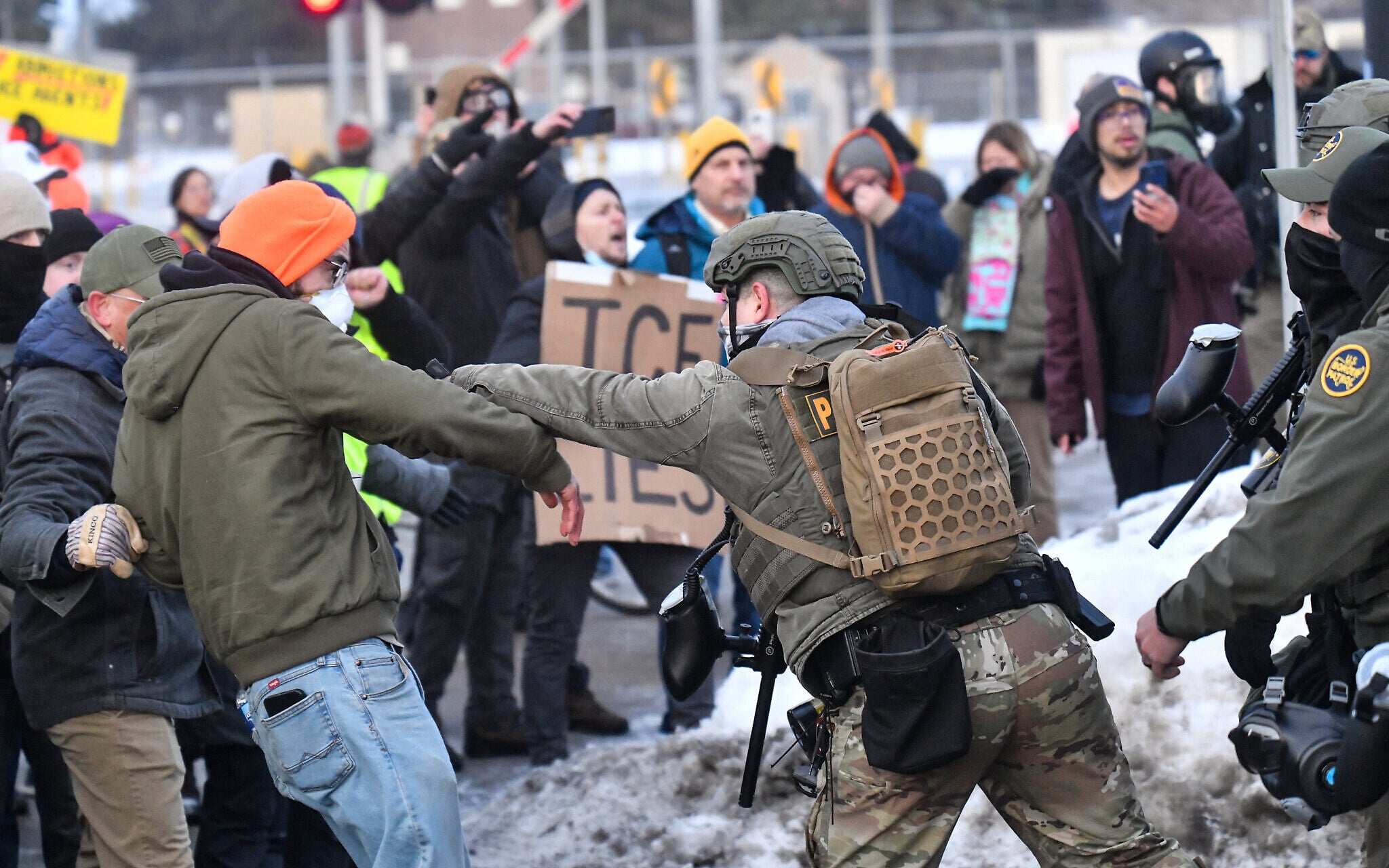
Within hours, the Powderhorn Park neighborhood, not far from the now-iconic 38th and Chicago intersection, transformed into a battlefield. Protesters, carrying signs that read “Abolish ICE” and “Who Did You Shoot?,” faced off against a phalanx of federal agents and Minneapolis Police in riot gear. The air grew thick with the acrid sting of tear gas and the sharp report of flash-bangs, echoing the terrible summer of 2020. Protesters hurled water bottles and shouted accusations of state violence, while lines of officers advanced, making arrests and attempting to clear intersections.
This is not merely a protest about a single shooting. It is the eruption of a dozen festering tensions. For Minneapolis’s large immigrant communities, particularly its East African population, ICE has long represented a specter of fear—a force that conducts raids, separates families, and operates with a perceived lack of transparency and accountability. The shooting transforms that fear into fury. “They come into our community, into our homes, and they think they can do anything,” said Omar Jama, a community advocate, his voice shaking. “They shot a woman. And they won’t even tell us why.”
For the city’s entrenched activist networks, forged in the fires of the movement for racial justice, this incident is a horrifying convergence. It links the systemic issues of police brutality—so painfully examined after George Floyd’s murder—with the parallel system of enforcement embodied by ICE. To them, it is all part of the same carceral state. “MPD, ICE, it’s the same monster with different faces,” one protester, who gave her name as Maya, yelled through a megaphone. “They terrorize Black communities, they terrorize immigrant communities. Minneapolis is under occupation by our own government.”
The city’s political leadership is caught in a near-impossible bind. Mayor Jacob Frey, whose handling of the 2020 protests was widely criticized, faces a fresh nightmare: the authority to police the streets is intertwined with, but separate from, the federal agents who sparked the crisis. He called for a “full, transparent investigation” but has no jurisdiction over ICE. Governor Tim Walz deployed the Minnesota State Patrol, but their presence risks further inflaming the perception of a militarized response.
The federal response, emanating from a Washington D.C. deeply divided on immigration, has been predictably polarized. The Department of Homeland Security, ICE’s parent agency, pledged a standard internal investigation. Congressional Republicans framed the event as a tragic outcome of necessary enforcement, while Democratic legislators from Minnesota demanded immediate answers and a suspension of the agents involved.
On the ground, the dynamic is terrifyingly familiar. Livestreams capture scenes of medics flushing tear gas from protesters’ eyes, young people linking arms before a skirmish line, and the glowing embers of a dumpster fire lighting the smoky night. Yet, there is a new, chilling dimension: the presence of ICE itself as a direct antagonist. Their agents, in distinctly marked uniforms, are not the local police with whom activists have a tortured, familiar relationship. They are a distant, federally empowered force, seen by protesters as an occupying army enforcing unjust laws.
As dawn breaks over Minneapolis, the city is left to survey the damage—to its streets, and to its fragile social fabric. The questions hang heavy in the air, unanswered and urgent: Who is the wounded woman? What exactly transpired in those critical seconds? And will the investigation be one that the community, with its profound and justified skepticism, can ever trust?
The ghosts of George Floyd’s murder have never left Minneapolis. They linger in the gaps in trust, in the readiness to take to the streets, in the collective instinct to resist perceived injustice with immediate, unyielding force. Last night, those ghosts were resurrected by the crack of ICE gunfire. The incident has exposed, once again, the deep fault lines in American society—where issues of race, policing, and immigration collide with explosive force. Minneapolis, the city that sparked a global reckoning, now finds itself at the center of a new and painful chapter, proving that without radical transparency, profound accountability, and a genuine healing of old wounds, the flames of protest are never more than one spark away from reigniting.
Discover more from AMERICA NEWS WORLD
Subscribe to get the latest posts sent to your email.