By_shalini oraon

From Controversy to Collaboration: How Prada Turned a Cultural Flashpoint into a Coveted Kolhapuri Collaboration
In the intricate dance between global luxury and local craftsmanship, missteps are common. Brands often stumble over the fine line between inspiration and appropriation, triggering public backlash and accusations of cultural insensitivity. Yet, it is in the resolution of these conflicts that the most innovative partnerships can be born. This is precisely the story unfolding in India, where the Italian luxury titan Prada has masterfully transformed a controversy over its interpretation of traditional Kolhapuri sandals into a high-profile collaboration, resulting in a new line of India-made luxury footwear with a staggering price tag of ₹84,000 (approximately $1,000) per pair.
The Spark: A Controversy of Form and Credit
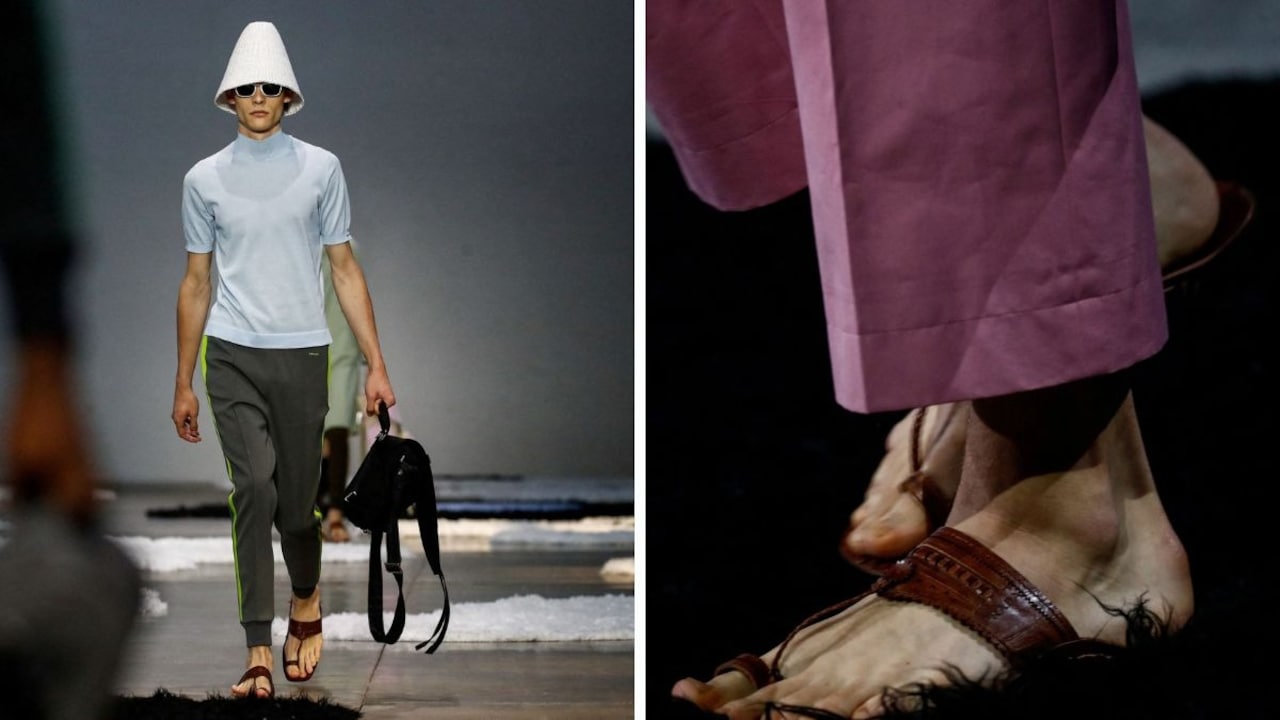
The saga began when Prada’s Spring/Summer 2022 menswear collection featured a flat, leather sandal with a distinctive T-strap and cross-bar design. To the global fashion eye, it was a minimalist, elegant offering. But to the Indian consumer, and particularly to artisans from the Kolhapur region of Maharashtra, it was a familiar silhouette stripped of its identity. Social media erupted with observations that the design was unmistakably a Kolhapuri chappal, a centuries-old craft known for its durable vegetable-tanned leather, intricate tooling, and hand-stitched robustness. The controversy centered not on the use of the design itself, but on the lack of acknowledgment. Prada was accused of cultural appropriation—profiting from a traditional design without crediting its origins or supporting the artisan communities that had preserved it for generations.
Kolhapuri sandals are more than footwear; they are a cultural legacy. Historically worn by both men and women across socio-economic strata in western India, their making is a time-intensive, multi-village process, from tanning the leather to braiding the straps. To see this design rebranded as a luxury Italian item for thousands of dollars, with no nod to its provenance, struck a deep nerve in an era increasingly conscious of ethical sourcing and cultural credit.
The Pivot: From Defense to Dialogue
Where many brands might issue a quiet clarification or simply weather the storm, Prada took a more strategic and ultimately more respectful path. The company engaged in a behind-the-scenes dialogue with stakeholders in India’s craft sector. This wasn’t a mere PR maneuver; it was a recognition of the value and integrity of the original craft. The outcome was a decisive pivot: instead of retreating, Prada announced a collaboration to officially create a line of luxury footwear inspired by and in partnership with Indian craftsmanship.
This move reframed the entire narrative. It shifted the conversation from “appropriation” to “appreciation,” from “extraction” to “empowerment.” By choosing to collaborate and produce the new line within India, Prada addressed two core grievances: it credited the source of inspiration and invested in local manufacturing infrastructure.
The Creation: “Made in India” as a Luxury Proposition
The resulting product, part of Prada’s broader lineup, is a fascinating study in luxury alchemy. It retains the foundational, revered silhouette of the classic Kolhapuri—the broad toe box, the functional T-strap—but transmutes it through the lens of high fashion. The leather is undoubtedly of the highest, supplest quality, finished to Prada’s exacting standards. The minimalist aesthetic is amplified, with a focus on pristine lines and a luxurious, muted color palette.
The most significant detail, however, is the “Made in India” label. At a price point of ₹84,000, this designation carries immense symbolic and economic weight. It challenges the long-held orthodoxy in luxury that the “Made in Italy” or “Made in France” stamp is the sole hallmark of prestige. Prada is betting that its clientele—a globally-minded, culturally-aware luxury consumer—will see value in the narrative of authentic, expert craftsmanship from a specific region, elevated by Italian design sensibility. It’s not just selling a sandal; it’s selling a story of cross-cultural synergy.
The Implications: A New Blueprint for Luxury?
This collaboration has ramifications far beyond a single product line.
1. For Artisan Communities: The direct impact on traditional Kolhapuri artisans is complex. The ₹84,000 sandal is not handcrafted by a single artisan in a small Kolhapur workshop; it is likely manufactured in a premium, ethically-run Indian facility that meets Prada’s global supply chain standards. However, the collaboration legitimizes the traditional design on the world’s highest fashion stage. It can create a “halo effect,” boosting the prestige and perceived value of authentic, handmade Kolhapuri sandals, potentially opening new markets and increasing prices for the original artisans. The hope is that some form of benefit-sharing or craft development initiative is part of the unseen partnership.
2. For the “Made in India” Label: This is a landmark moment. For decades, India has been a powerhouse of leather production and craft, often as a hidden contractor for Western brands. Prada putting its name behind a luxury product manufactured in India is a powerful endorsement. It paves the way for other houses to explore India not just for embroidery or outsourcing, but as a center for finished luxury goods, combining local craft intelligence with global quality control.
3. For the Fashion Industry: Prada has provided a potential blueprint for navigating cultural inspiration. The model is clear: Engage, Credit, Collaborate, and Invest. It shows that controversy can be a catalyst for a more equitable and creative partnership. In an age where consumers demand authenticity and ethics, such collaborations can be more valuable than any traditional marketing campaign.
The Price Tag: A Statement or a Barrier?
The ₹84,000 price point is inevitably provocative. It places these sandals in the realm of ultra-luxury, inaccessible to the vast majority of Indians, including the artisans whose culture inspired them. Critics may argue this is the ultimate commodification, placing a traditional, accessible item behind a velvet rope.
Prada’s defense would be that it is not selling a utility product, but a piece of luxury art. The price reflects the brand’s premium materials, its design input, its retail experience, and the novelty of the collaboration itself. It exists in a different universe from the ₹2,000-₹5,000 authentic handcrafted Kolhapuri. Whether this justifies the cost is a question for the individual consumer, but it undoubtedly makes a statement about the perceived value of cross-cultural fusion in high fashion.
Conclusion: A Step in the Right Direction
The Prada Kolhapuri episode is a modern fashion parable. It begins with a familiar tale of oversight in a globally interconnected world but evolves into a more hopeful narrative of course correction. By choosing collaboration over silence, and investment over extraction, Prada has turned a reputational risk into a pioneering venture.
The ultimate test will be in the longevity and depth of this partnership. Does it represent a one-off collection, or the beginning of a sustained commitment to Indian craftsmanship? Will it funnel real benefits back to the artisan communities of Kolhapur? For now, the collaboration stands as a significant milestone. It proves that in the sensitive intersection of culture and commerce, the most elegant path forward is not to take, but to partner—and to proudly label the result with the name of its origin. The sandal priced at ₹84,000 is, therefore, more than footwear; it is a symbol of a shifting world order in luxury, where respect and collaboration are becoming the ultimate markers of prestige.
Discover more from AMERICA NEWS WORLD
Subscribe to get the latest posts sent to your email.