
By Manisha Sahu | America News World
November 21, 2025
The investigation into the deadly crash of a UPS cargo aircraft in Louisville, Kentucky, earlier this month has taken a critical turn after federal investigators revealed evidence of structural cracks in one of the plane’s key engine components. In a preliminary report released by the National Transportation Safety Board (NTSB), officials confirmed that cracks were found in the engine mount on the aircraft’s left wing—an issue that may have played a central role in the tragic accident that claimed 14 lives and injured 23 others.

The NTSB said investigators recovered the cockpit voice recorder along with the engine and pylon that had detached from the aircraft’s wing.
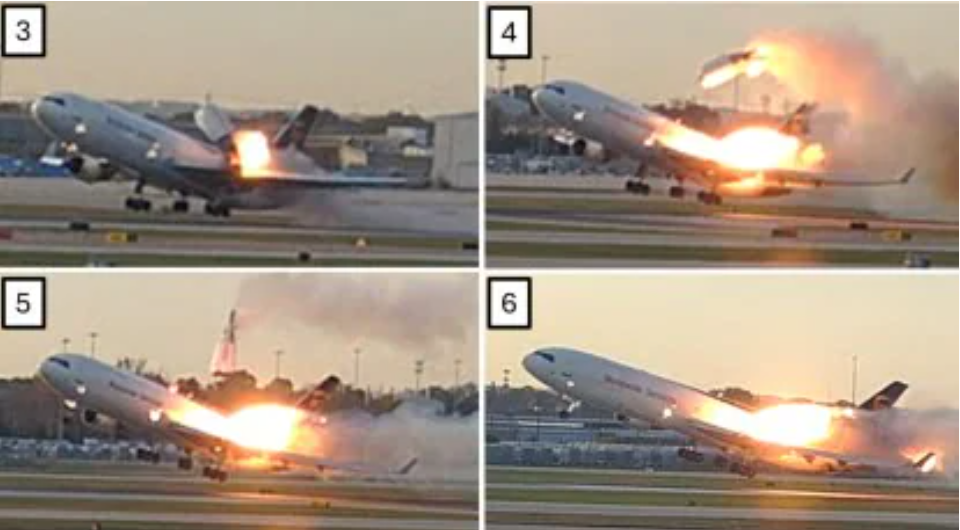
The crash, which occurred on November 4, involved an MD-11 freighter operating under UPS. The aircraft struggled to gain altitude after takeoff, managing to climb only 9.1 meters (approximately 30 feet) before losing control and plunging into an industrial area near the Louisville Muhammad Ali International Airport. The impact killed three crew members on board and 11 people on the ground, turning a routine cargo flight into one of the most devastating aviation accidents the region has witnessed in years.
Critical Findings in the Preliminary Report
According to the NTSB, the early stages of the investigation have yielded significant clues. The most notable discovery involves cracks in the left-wing engine mount, a structural component responsible for securing the engine to the wing. The MD-11’s design places considerable stress on the pylons and mounts during takeoff and landing, making their structural integrity essential for safe operation.
Investigators said they successfully recovered the cockpit voice recorder (CVR) and the detached engine and pylon, which had separated from the wing just moments before the crash. The separation appears to have triggered a catastrophic loss of control, leaving the flight crew with little time or altitude to react.
“Initial examination shows evidence of cracking in the forward portion of the left engine mount,” NTSB engineers noted in the preliminary summary. While the exact age and extent of the cracks have yet to be determined, the early findings raise urgent questions about maintenance procedures, potential material fatigue, and inspection intervals.
A Descent That Lasted Only Seconds
The flight, which was transporting overnight cargo across the Midwest, began like any other UPS operation. Weather conditions were stable, visibility was clear, and no mechanical issues were reported before takeoff. However, shortly after rotation, airport personnel and nearby witnesses observed abnormal movements from the aircraft’s left wing.
Within seconds, the engine separated from the wing, causing the aircraft to roll sharply and lose lift. According to flight data, the MD-11 never climbed higher than 9.1 meters before its nose pitched downward. The entire sequence—from liftoff to impact—lasted less than 15 seconds.
Emergency responders raced to the scene, where flames and smoke engulfed a cluster of warehouses and service buildings. Despite rapid intervention, the accident site suffered extensive damage, and several victims on the ground were caught in the blaze.
The MD-11: A Complex Aircraft with a Challenging History
The MD-11, though widely used in cargo operations, has long been noted for its complex handling characteristics, particularly during takeoff and landing phases. While many airlines have retired the aircraft from passenger service, freighter companies such as UPS and FedEx continue to utilize the model due to its large cargo capacity and long-range capabilities.
However, the aircraft also has a history of structural and stability-related incidents. Aviation experts have often highlighted the MD-11’s susceptibility to hard landings, tail strikes, and uneven weight distribution—factors that place additional stress on engine pylons and mounts. Although it is too early to assign fault or causation, the presence of structural cracks reinforces concerns about aging cargo fleets and the need for rigorous maintenance oversight.
Community Impact and the Human Toll
The crash site, located less than two miles from the airport, sits near a busy industrial corridor filled with warehouses, repair shops, and delivery centers. On the morning of the incident, dozens of workers were present in the area, many beginning routine morning shifts.
Of the 11 victims on the ground, several were employees of a logistics firm whose facility was struck directly by the falling plane. Families of the victims have already begun seeking answers, with some calling for a thorough review of air-traffic routes over populated commercial zones.
The three UPS crew members killed in the crash were highly experienced pilots with years of service. UPS released a statement expressing deep sorrow and pledging full cooperation with federal investigators. “We lost valued members of our UPS family,” the company said. “Their dedication, professionalism, and service will never be forgotten.”
Ongoing Investigation and What Comes Next
The NTSB emphasized that its preliminary report represents only the earliest phase of a detailed investigation expected to span many months. The agency will continue analyzing the recovered components, reviewing maintenance logs, interviewing personnel, and conducting laboratory testing.
Critical areas of focus include:
– Determining the origin and progression of cracks in the engine mount
– Evaluating UPS maintenance records and inspection intervals
– Studying the engine’s detachment sequence and associated stresses
– Analyzing cockpit voice recordings for crew communication and alerts
– Reconstructing the aircraft’s final seconds using flight data simulations
The agency cautioned that no definitive conclusions about the cause of the crash should be drawn until the full investigation is completed.
Broader Implications for Cargo Aviation
The accident has renewed debate about the safety of aging cargo aircraft in the United States. Many major carriers operate fleets that include older models—some over 30 years old—that require stringent maintenance and retrofitting to remain airworthy. Aviation safety analysts warn that as global cargo demand grows, maintenance cycles must keep pace to prevent catastrophic failures.
If the engine mount cracking is confirmed as a contributing factor, regulators may consider issuing airworthiness directives requiring inspections of similar aircraft worldwide.
A Community Still Grieving
As Louisville mourns the loss of 14 lives, memorials have sprung up outside the damaged buildings, honoring both the crew and those on the ground. City officials have pledged support to victims’ families and are reviewing emergency response protocols following the devastating crash.
For now, the community waits for answers. The NTSB’s preliminary findings shed light on the mechanical failures that may have doomed the flight, but the search for a definitive explanation continues—with the hope that future tragedies can be prevented.
Discover more from AMERICA NEWS WORLD
Subscribe to get the latest posts sent to your email.

































![Smoke rises after Israeli strikes in Beirut's southern suburbs, on March 2 [Mohamad Azakir/Reuters]](https://america112.com/wp-content/uploads/2026/03/hgh.webp)