Introduction to the US-China Trade Spat
A new chapter in the ongoing US-China trade war has unfolded, this time taking an unexpected turn into the world of fashion and social media. The controversy centers around White House Press Secretary Karoline Leavitt, who found herself at the heart of an online storm after wearing a lace dress allegedly manufactured in China. The incident, sparked by a pointed remark from a Chinese diplomat, has reignited debates about hypocrisy, global trade policies, and the complexities of “Made in China” labels in a world dominated by interconnected supply chains.
This article delves into the details of the controversy, the reactions it has provoked, and its broader implications for US-China relations, global trade, and the political narrative surrounding protectionism. With insights from social media, expert analysis, and historical context, we explore how a single dress has become a lightning rod for international discourse.
The Spark: Chinese Diplomat’s Viral Post
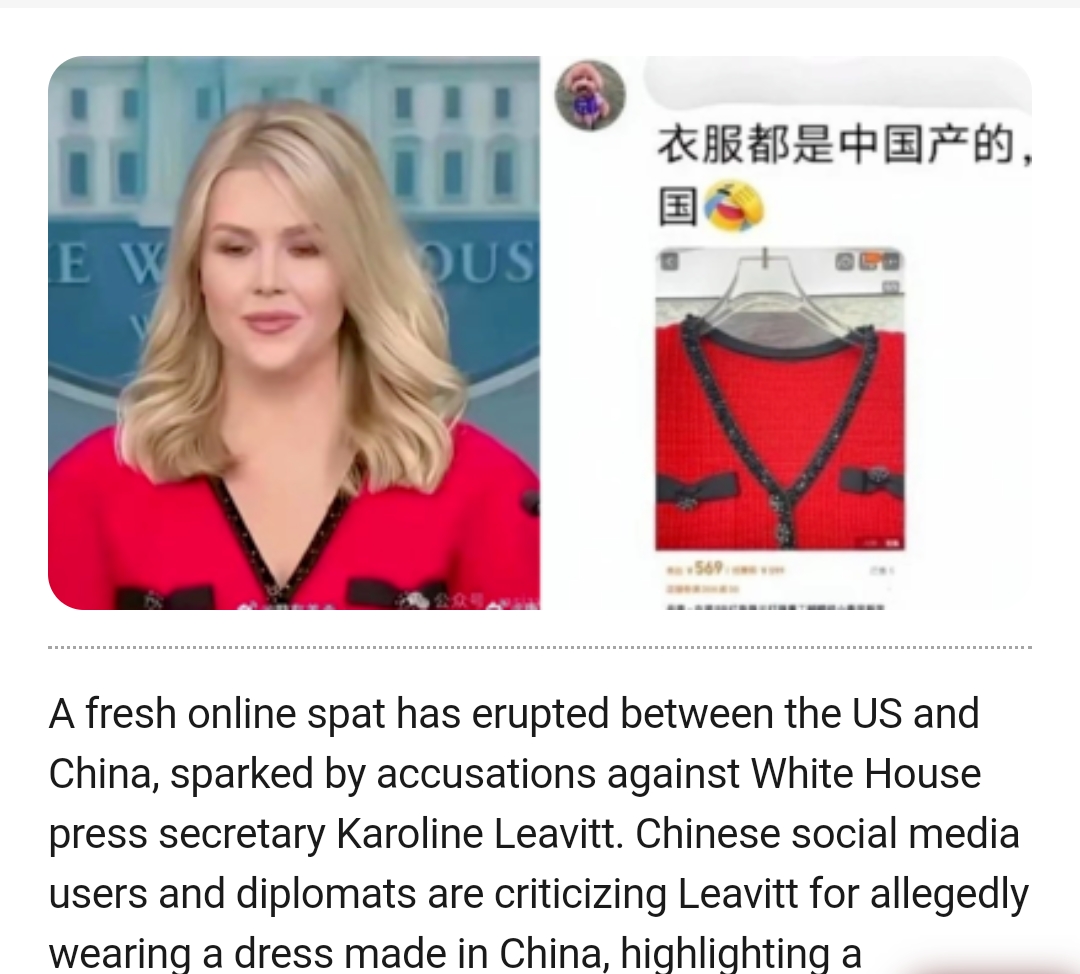
The controversy began when Zhang Zhisheng, the Consul General of the People’s Republic of China in Denpasar, Indonesia, took to X to mock Karoline Leavitt’s choice of attire. Zhang shared an image of Leavitt wearing a lace dress during a White House press briefing and referenced a Weibo user’s claim that the dress’s lace was produced in a factory in Mabu, China.
In his post, Zhang wrote, “Accusing China is business. Buying in China is life. The beautiful lace on the dress was recognized by an employee of a Chinese company as its product.” The comment was a thinly veiled jab at the Trump administration’s aggressive trade policies, which have long emphasized reducing reliance on Chinese manufacturing while promoting American-made goods.
Zhang’s post quickly went viral, amassing thousands of shares and comments across platforms like X, Weibo, and Reddit. The diplomat’s remarks tapped into a broader narrative of perceived hypocrisy, as critics pointed out the contradiction between the administration’s rhetoric and the reality of globalized supply chains.
Social Media Backlash and Support
The online reaction to Zhang’s post was swift and polarized, reflecting the deep divisions in how people view US-China trade dynamics.
Critics Slam Leavitt’s “Hypocrisy”
Many social media users seized on the opportunity to criticize Leavitt and the broader Trump administration. One X user remarked, “Leavitt slams Made in China while rocking a Chinese-made dress, hypocrisy much? Classic politician move: blame China, but keep the cheap goods.” Another user added, “How does Karoline Leavitt manage the crushing irony of slamming ‘Made in China’ while strutting in a gorgeous Chinese-made lace dress at the White House podium?”
The criticism wasn’t limited to Leavitt herself. Some users brought up the long-standing issue of Donald Trump’s “Make America Great Again” (MAGA) merchandise, much of which has been manufactured in China since 2016. “If Trump’s hats are made in China, why are we surprised his press secretary’s dress is too?” one commenter quipped.
Defenders Push Back
Not everyone was quick to jump on the bandwagon. Supporters of Leavitt argued that the claims about the dress’s origin were unverified and potentially misleading. One X user wrote, “Fake news. She’s wearing the French original, whereas the advert shows a Chinese copy. It’s funny indeed, but the spin of the tweet is dishonest.”
Others suggested that the dress could be a victim of China’s well-documented counterfeit goods market. “Chinese factories are notorious for bootleg clothes. It’s more likely they copied a luxury brand’s design than produced the original,” one user speculated.
The debate over the dress’s authenticity highlights a broader issue: the difficulty of tracing the origins of consumer goods in a globalized economy. Even if the lace was made in China, it’s possible the dress was assembled elsewhere or designed by a Western brand, complicating the narrative of “Made in China” hypocrisy.
The Bigger Picture: US-China Trade Tensions
The “Made in China” dress controversy is more than just a social media spat—it’s a microcosm of the broader tensions between the US and China. For years, the US has accused China of unfair trade practices, including currency manipulation, intellectual property theft, and flooding global markets with cheap goods. The Trump administration, in particular, has taken a hardline stance, imposing tariffs on Chinese imports and encouraging companies to bring manufacturing back to the US.
However, the reality is far more complex. China remains a dominant player in global manufacturing, producing everything from electronics to textiles. Many American consumers, including those in the White House, rely on Chinese-made goods for their affordability and availability. This dependency creates a paradox: while politicians may rail against China’s economic influence, their personal choices often reflect the realities of a globalized market.
The dress incident also underscores the role of social media in modern diplomacy. Chinese diplomats, often referred to as “wolf warriors,” have increasingly used platforms like X to push back against Western criticism. Zhang’s post is a textbook example of this strategy, blending humor, nationalism, and pointed critique to score political points.
Historical Context: MAGA Merch and Made in China
The controversy over Leavitt’s dress isn’t the first time the Trump administration has faced scrutiny over its reliance on Chinese manufacturing. Since the 2016 presidential campaign, critics have pointed out that much of Trump’s MAGA merchandise—including hats, T-shirts, and flags—was produced in China. In 2020, reports surfaced that some MAGA hats were being made in factories in Guangdong, despite the campaign’s “Buy American” rhetoric.
This contradiction has been a recurring theme in discussions about protectionism. While the administration has pushed for reshoring manufacturing, the economics of global trade often make it more cost-effective to produce goods in countries like China. The dress controversy simply brings this issue back into the spotlight, with Leavitt as the latest target.
Global Reactions and Implications
The “Made in China” dress saga has resonated far beyond the US and China, drawing attention from audiences across the globe. In India, for example, social media users have drawn parallels to their own country’s “Make in India” initiative, which similarly seeks to boost domestic manufacturing while grappling with reliance on Chinese imports. “Same story here,” one Indian X user wrote. “We talk about self-reliance, but our markets are full of Chinese goods.”
In Europe, the controversy has been framed as a cautionary tale about the challenges of decoupling from China. “The US can’t just snap its fingers and stop buying from China,” a French commentator noted. “It’s not about hypocrisy—it’s about how deeply integrated our economies are.”
The incident also has potential diplomatic ramifications. While Zhang’s post was lighthearted on the surface, it reinforces China’s narrative that the US is unfairly targeting its economy. This could complicate ongoing trade negotiations, especially as both countries navigate issues like rare earth minerals, technology exports, and supply chain security.
Expert Analysis: The Complexity of Global Supply Chains
To understand the dress controversy, it’s essential to consider the intricacies of global supply chains. Dr. Sarah Lin, an expert in international trade at Georgetown University, explains, “Most consumer goods today are the product of multiple countries. The lace in Leavitt’s dress might have been made in China, but the design could be French, the assembly could be in Vietnam, and the brand could be American. Pinning it down to one country oversimplifies the issue.”
Dr. Lin also points out that consumers often have little control over where their goods are made. “Even if Leavitt wanted to buy an American-made dress, the options are limited. The textile industry in the US has been decimated over decades, and China fills that gap.”
This reality poses a challenge for policymakers advocating for protectionism. While tariffs and trade barriers can incentivize domestic production, they also risk raising costs for consumers and disrupting supply chains. The dress controversy, in this sense, is a reminder of the trade-offs involved in reshaping global trade.
Conclusion: A Dress, a Diplomat, and a Divided World
What began as a seemingly trivial remark about a dress has snowballed into a global conversation about trade, hypocrisy, and the power of social media in shaping public perception. For Karoline Leavitt, the controversy is an unwelcome distraction from her role as White House Press Secretary. For Zhang Zhisheng, it’s a diplomatic coup, amplifying China’s voice in the ongoing US-China rivalry.
As the world watches this sartorial saga unfold, one thing is clear: in an era of globalized economies and instant communication, even a single dress can become a symbol of much larger issues. Whether Leavitt’s attire was indeed “Made in China” or not, the debate it has sparked will likely linger, serving as a reminder of the complexities and contradictions at the heart of international trade.
Discover more from AMERICA NEWS WORLD
Subscribe to get the latest posts sent to your email.