By_shalini oraon

_the renewed India-Canada partnership.
—
India, Canada Vow Deeper Ties, Set Ambitious $50-Bn Trade Target by 2030
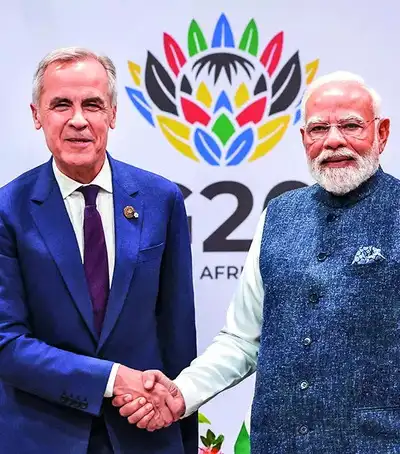
In a powerful signal of a relationship maturing beyond periodic diplomatic friction, India and Canada have jointly pledged to elevate their strategic partnership, setting an ambitious target of $100 billion in bilateral trade by 2030. The announcement, emanating from high-level talks between Prime Ministers Narendra Modi and Justin Trudeau, underscores a mutual recognition of immense untapped potential and a shared desire to build a more resilient, future-oriented economic alliance.
This renewed commitment, which aims to more than double the current trade volume, is not merely a numerical goal. It represents a comprehensive roadmap built on the pillars of trade diversification, clean energy cooperation, strategic mobility, and a mutual alignment in the face of a shifting global order. The “New Roadmap for India-Canada Relations” provides the architectural blueprint for this deepened engagement, focusing on concrete outcomes rather than just diplomatic goodwill.
Moving Beyond the Headlines: A Foundation of Quiet Strength
The India-Canada relationship has often been portrayed in the media as a rollercoaster, subject to the winds of political statements and diaspora-driven controversies. However, this narrative obscures a foundation of remarkably robust and quiet interdependence. The new trade target is ambitious, but it is not built on sand.
Canada is home to one of the largest Indian diasporas in the world, a vibrant community of over 1.8 million people who act as a living bridge between the two nations. This community is not just a cultural asset but an economic powerhouse, driving entrepreneurship, fostering academic exchanges, and creating a natural demand for goods and services from both countries. Beyond people-to-people ties, the current trade relationship is already substantial, spanning from pulses and lentils—a staple in the Indian diet largely supplied by Canada—to potash for fertilizers critical to India’s food security. In the other direction, India supplies Canada with pharmaceuticals, IT services, and a range of manufactured goods.
The new target acknowledges this existing base but pushes both nations to look at the relationship through a new, strategic lens. As a joint statement noted, “Our partnership is based on a shared commitment to democracy, pluralism, and the rule of law, and is poised for significant growth in an era of global transformation.”
The Core Pillars of the $100-Bn Vision
Achieving this exponential growth requires moving beyond traditional trade baskets. The roadmap identifies several key areas of synergy:
1. Critical Minerals and Supply Chain Resilience: This is arguably the centerpiece of the new economic alliance. As the world pivots to clean energy and electric mobility, critical minerals like cobalt, lithium, and nickel have become the new oil. Canada is rich in these resources, while India, with its ambitious green energy goals and massive domestic market, is a voracious future consumer. A Memorandum of Understanding (MoU) on Critical Minerals paves the way for Canadian investment in Indian processing facilities and secure, stable supply chains for Indian manufacturers, reducing dependency on single sources like China. This is a classic case of supplier-nation meeting demand-nation with strategic intent.
2. The Clean Energy Bridge: Aligning with their respective net-zero commitments, India and Canada are positioning themselves as ideal clean energy partners. Canada’s expertise in hydrogen fuel cell technology, hydropower, and small modular reactors (SMRs) complements India’s massive push for green hydrogen and its need for stable, low-carbon baseload power. Collaborative R&D projects and Canadian technology transfer in exchange for access to India’s vast market can create a win-win scenario, accelerating the energy transition for both.
3. The Digital and Innovation Corridor: With India’s formidable tech talent pool and Canada’s strengths in AI, quantum computing, and cybersecurity, there is immense potential for a trans-Pacific innovation corridor. The roadmap emphasizes deepening ties between startups and tech incubators in Bengaluru, Hyderabad, and Toronto and Vancouver. Easier mobility for skilled professionals—facilitated by the recently enhanced “Strategic Mobility” pillar of the relationship—will be crucial to fuel this digital partnership.
4. Education and Skills: Canada is already a top destination for Indian students, who contribute significantly to its economy and academic landscape. The new framework aims to institutionalize this further through more joint degree programs, research collaborations in areas like climate science and public health, and work-sharing opportunities for students. This creates a pipeline of talent with deep cross-cultural understanding, who will go on to become the next generation of business and thought leaders in the bilateral relationship.
Navigating the Challenges: The Elephant in the Room
No analysis of the India-Canada relationship is complete without acknowledging the diplomatic sensitivities, often stemming from the activities of Khalistani separatist elements in Canada. This issue has been a persistent irritant, testing diplomatic patience and trust.
The successful negotiation of this new roadmap suggests that both sides have chosen a path of pragmatic compartmentalization. While the political differences may not be fully resolved, there is a clear understanding in Ottawa and New Delhi that the strategic and economic imperatives are too significant to be held hostage by a single, albeit complex, issue. The joint statements have notably emphasized “respect for sovereignty and territorial integrity” and a “shared commitment to countering terrorism and violent extremism,” indicating that channels of communication on these sensitive matters remain open, even as the economic agenda is aggressively pursued.
The Geopolitical Context: A Multipolar Alignment
The reinvigorated India-Canada partnership also reflects broader global realignments. For Canada, diversifying its economic partnerships beyond an over-reliance on the United States and China is a strategic priority. India, with its stable growth trajectory and democratic credentials, presents an attractive alternative.
For India, partnerships with like-minded, resource-rich democracies like Canada are essential to its strategy of building resilient supply chains and securing the resources needed for its next phase of development. In a world increasingly divided between autocratic and democratic blocs, the India-Canada relationship is a natural alignment of two major, non-authoritarian powers.
Conclusion: A Relationship Coming of Age
The $100 billion trade target is more than just a number; it is a statement of ambition and a testament to a relationship that is finally coming of age. It demonstrates a maturity to acknowledge differences while relentlessly pursuing mutual interests. By focusing on the concrete pillars of critical minerals, clean energy, and digital innovation, India and Canada are building a partnership for the 21st century—one that is pragmatic, forward-looking, and capable of weathering the occasional political storm. The road to 2030 will require sustained political will, bureaucratic streamlining, and active involvement from the private sector. But the foundation is laid, and the map is clear. The journey to a deeper, more consequential partnership has officially begun.
Discover more from AMERICA NEWS WORLD
Subscribe to get the latest posts sent to your email.