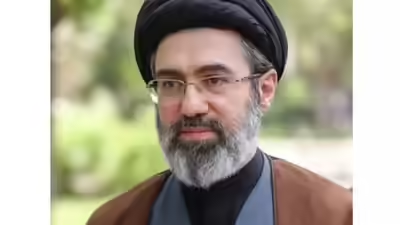
Iran's new supreme leader Mojtaba Khamenei narrowly escaped death on February 28 when Israeli "Blue Sparrow" ballistic missiles tore through his father's compound in Tehran, killing Ayatollah Ali Khamenei along with some of the Islamic Republic's most senior military and government figures. Mojtaba survived only because he had stepped outside for a brief walk in the compound's garden — a matter of minutes that spared his life.
The extraordinary account comes from an audio recording obtained by The Telegraph, capturing a private address by Mazaher Hosseini — head of protocol for Ali Khamenei's office — delivered to senior clerics and Islamic Revolutionary Guard Corps (IRGC) commanders on March 12. The recording provides the first detailed picture of what happened inside the supreme leader's compound at the moment of impact.
"God's will was that Mojtaba had to go out to the yard to do something and then return. He was outside and heading upstairs when they struck the building with a missile. His wife, Ms Haddad, was martyred instantly."
— Mazaher Hosseini, Head of Protocol, Ali Khamenei's OfficeA Compound Struck Simultaneously
Hosseini revealed that the Israeli missiles hit multiple locations inside the compound at the same moment, with some aimed directly at the supreme leader's personal quarters. Mojtaba's wife, Zahra Haddad-Adel, and their son Bagher were both killed in the strike. His brother Mostafa Khamenei and Mostafa's wife survived in a nearby residence — shielded from the blast by falling dust and rubble.
Also killed were IRGC chief Mohammad Pakpour and Iran's Defence Minister Aziz Nasirzadeh, who were gathered for a meeting inside the compound when the missiles struck. The body of Mohammad Shirazi — chief of Khamenei's military bureau — was, according to Hosseini, "blown to pieces." Authorities were able to recover only a few kilograms of remains for identification.
Ayatollah Ali Khamenei — Iran's Supreme Leader, killed in his personal quarters.
Zahra Haddad-Adel & son Bagher — Mojtaba's wife and child, killed instantly.
Mohammad Pakpour — IRGC Chief, killed at a meeting inside the compound.
Aziz Nasirzadeh — Iran's Defence Minister, killed in the same meeting.
Mohammad Shirazi — Head of Khamenei's military bureau, body largely destroyed.
Why Shirazi Was Targeted
Hosseini suggested Israel's decision to target Shirazi was calculated — aimed at disrupting succession planning. Shirazi was described as a critical link between Iran's military command structure and the supreme leader. Killing him, Hosseini argued, was intended to prevent any smooth transfer of authority to new commanders and to create openings for "rioters and infiltrators" to exploit the chaos following the leadership vacuum.
Mojtaba: A Leader Shrouded in Silence
Since the February 28 strike, Mojtaba Khamenei has made no public appearance. His only communication with the Iranian public came through a written message read out on state television. Several media reports have claimed he suffered critical injuries and is in a coma, though these accounts remain unconfirmed. An Iranian official told The Telegraph that even military commanders had no reliable information about his current condition — a striking admission about the opacity surrounding the man now holding the Islamic Republic's highest office.
Mojtaba first entered public consciousness at age 17 when he disappeared for a week during the Iran–Iraq war in March 1985. IRGC commanders at the time regarded him as inexperienced. His selection as supreme leader is, according to the official quoted, potentially against both his own wishes and those of his late father. None of Ali Khamenei's other children have been seen in public since the strikes, deepening uncertainty about Iran's political direction at one of its most turbulent moments.
"Mojtaba was selected, but it is against the will of the supreme leader and maybe against his own will too. We still have not heard anything from him."
— Senior Iranian Official, speaking to The TelegraphAs Iran navigates the aftermath of the deadliest strike on its leadership in the republic's history, the world watches a nation whose new supreme leader remains unseen, unheard — and whose grip on power is as fragile as the garden wall that, by sheer chance, once stood between him and death.