By Suraj Karowa /ANW
Mumbai, November 23, 2025

Architects blended local elements into Art Deco, like the lattice balcony screens on this Mumbai bungalow
In the heart of Mumbai’s bustling chaos, where the Arabian Sea crashes against the curving shoreline of Marine Drive, a quiet revolution in architecture has stood the test of time for exactly 100 years.
Born from the glittering excesses of 1925’s Exposition Internationale des Arts Décoratifs et Industriels Modernes in Paris, Art Deco arrived like a bolt of modernist lightning, illuminating the city’s skyline with ziggurats, sunbursts, and nautical flourishes.

The world’s most iconic cinema halls, including Eros in Mumbai, are built in the Art Deco style
Today, as Mumbai honors this centenary, the Art Deco Mumbai Trust unveils an exhibition that peels back the layers of this “hidden in plain sight” heritage, revealing a style that not only defined an era but continues to pulse through the veins of India’s financial capital.
Picture this: neon-hued jazz lounges, silver-screen sirens striding across celluloid, and the roar of early automobiles slicing through urban fog.

The dim, opulent interiors of Mumbai’s Liberty Cinema captured the glamour of early 20th Century films
Art Deco wasn’t just bricks and mortar; it was a manifesto for the machine age, a exuberant farewell to the ornate Victorian Gothic that had long smothered colonial India.
“It embodied unbridled optimism,” explains Atul Kumar, founder of the Art Deco Mumbai Trust and the exhibition’s curator.
Speaking to this correspondent amid the trust’s meticulously restored archives, Kumar gestures to faded blueprints of bungalows and cinemas.

Shiv Shanti Bhuvan, in Mumbai’s Oval Maidan, is among the first Art Deco buildings developed in the area
“Concrete revolutionized construction—faster, cheaper, bolder. In Mumbai, it fused with local ingenuity, creating something uniquely ours.”
Mumbai’s affair with Art Deco is no fleeting romance. The city boasts the world’s largest documented trove of these buildings—over 1,500, by Kumar’s count—edging out even Miami’s pastel paradise, though some rankings flip the duo.

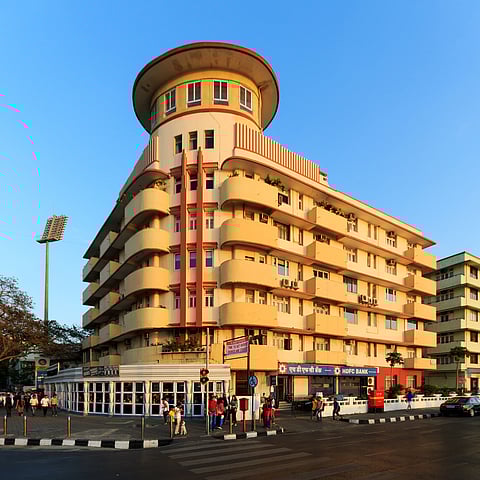
Turreted rooftops are typical of the Art Deco style
Along Marine Drive, a necklace of over 30 apartment blocks rises like frozen ocean waves, their turreted rooftops and geometric facades catching the sunset in a symphony of cream, butter-yellow, and bottle-green.
Shiv Shanti Bhuvan at Oval Maidan, one of the earliest in the neighborhood, gleams with dual-toned elegance, its curves whispering of speed and progress. What sets Mumbai’s Deco apart is its democratic sprawl.

A grand Art Deco foyer featuring polished woods and elegant stones like granite and marble
Unlike Miami’s leisure-focused facades, here the style infiltrated every corner of life: grand cinemas like Eros and Liberty, where Bollywood’s golden age flickered to life; modest petrol pumps etched with streamlined motifs; even schools and banks that served the rising mercantile class.
Liberty Cinema, with its opulent dim-lit interiors and circular Art Deco lamps, once hosted the likes of Charlie Chaplin on tour.

The Art Deco style influenced the design of home objects
Eros, a UNESCO gem topped by a spherical tower in red sandstone, still draws crowds for midnight screenings. “These weren’t elite enclaves,” Kumar notes. “They were the people’s architecture, blending European flair with Indian soul.”
The story begins in the 1920s, as Bombay—then under British Raj—transformed into a throbbing port metropolis.
A cadre of pioneering Indian architects, fresh from London’s Royal Institute of British Architects, returned home armed with Deco blueprints. Names like Chimanlal Master, Laxman Vishnu Sathe, and Gopalji Mulji Bhuta didn’t merely import the style; they indigenized it.

Mumbai’s Marine Drive seafront has more than 30 Art Deco buildings
Drawing from Mumbai’s maritime pulse, they incorporated porthole windows evoking docked ocean liners.
Lattice balcony screens, echoes of Mughal jaali work, softened the rigidity of ziggurat steps on Bandra bungalows like the pink-hued Saudades, built in 1936.
Arthur Lodge in Borivali, a pistachio confection from 1950, sports a circular frontage that’s pure Deco whimsy, adapted for suburban sprawl.
The British sniffed at it as “lesser architecture,” a threat to their Gothic impositions.

Arthur Lodge was built in the Art Deco style in Mumbai’s Borivali suburb in 1950
Yet Deco signaled India’s architectural awakening—a hybrid vigor that merged Indo-Saracenic spires with Deco curves, crowning South Mumbai’s skyline in eclectic harmony.
Inside these structures, the influence rippled deeper: polished granite foyers in the Seksaria building along Marine Drive, where wooden paneling and marble tiles create labyrinths of luxury.
Even furniture and lighting followed suit—candelabra fixtures with geometric stars, dressing tables laden with streamlined drawers—hallmarks now revived by designers like Nidhi Tekwani.
Tekwani, whose studio reimagines Deco for modern minimalism, leans over sketches of sleeker chairs and low-slung lamps.
“The originals were for high-ceilinged villas,” she says, her eyes alight. “Today, in our shoebox apartments, we strip the bulk but keep the essence: that sense of movement, of joy.”
Her prototypes, launching next month, aim to inject Deco into millennial homes, proving the style’s adaptability in a city where space is the ultimate luxury.
But celebration tempers with urgency. Mumbai, ever in flux, faces a developer-driven apocalypse.
Glass-and-steel monoliths devour heritage hourly, their floor-space-index greed erasing Deco icons.
Over the last decade, dozens have vanished; hundreds teeter on redevelopment’s brink. Only about 70 of Kumar’s cataloged gems enjoy protection, thanks to UNESCO’s tentative list nod in 2018.
“Authorities drag their feet,” Kumar laments, flipping through photos of crumbling cornices. “But people? They’re waking up.”
The trust’s pro-bono restoration drive has become a lifeline, consulting on repairs that boost property values and preserve patina.
In Bandra, a family bungalow’s lattice revival doubled its worth; in Churchgate, a cinema’s facade polish sparked community pride.
“It’s emotional capital,” Kumar adds. “Mumbai’s skyline isn’t just concrete—it’s memory.”
As the centenary exhibition opens at the Chhatrapati Shivaji Maharaj Vastu Sangrahalaya, visitors will wander immersive galleries: holographic projections of Marine Drive’s Deco dawn, interactive models of vernacular fusions, and oral histories from octogenarian residents.
“Art Deco isn’t frozen in amber,” Tekwani chimes in. “It’s Mumbai’s heartbeat—resilient, reinventing.”
In a city remaking itself blink by frantic blink, this legacy endures as a beacon: bold, blended, unbreakable.
As dusk falls over the seafront, Eros’ tower glows like a Deco lighthouse, reminding us that true progress honors its glittering past.
Discover more from AMERICA NEWS WORLD
Subscribe to get the latest posts sent to your email.