By Suraj Karowa and Melissa
Hogenboom, December 19, 2025

Fossey’s legacy teaches us that true adventure means leaving the world better than we found it.
It has been 40 years since the unsolved murder of Dian Fossey, the pioneering primatologist whose fierce dedication to mountain gorillas reshaped global perceptions of these majestic apes—and whose obsessive methods left a trail of controversy.
Fossey’s legacy is etched in the misty Virunga Mountains of Rwanda, where she spent nearly two decades observing and defending the endangered primates.
Before her arrival, gorillas were mythologized as savage beasts, ready to charge and kill intruders.
Through patient habituation—mimicking their chest-beating, belching calls, and foraging habits—Fossey proved otherwise.

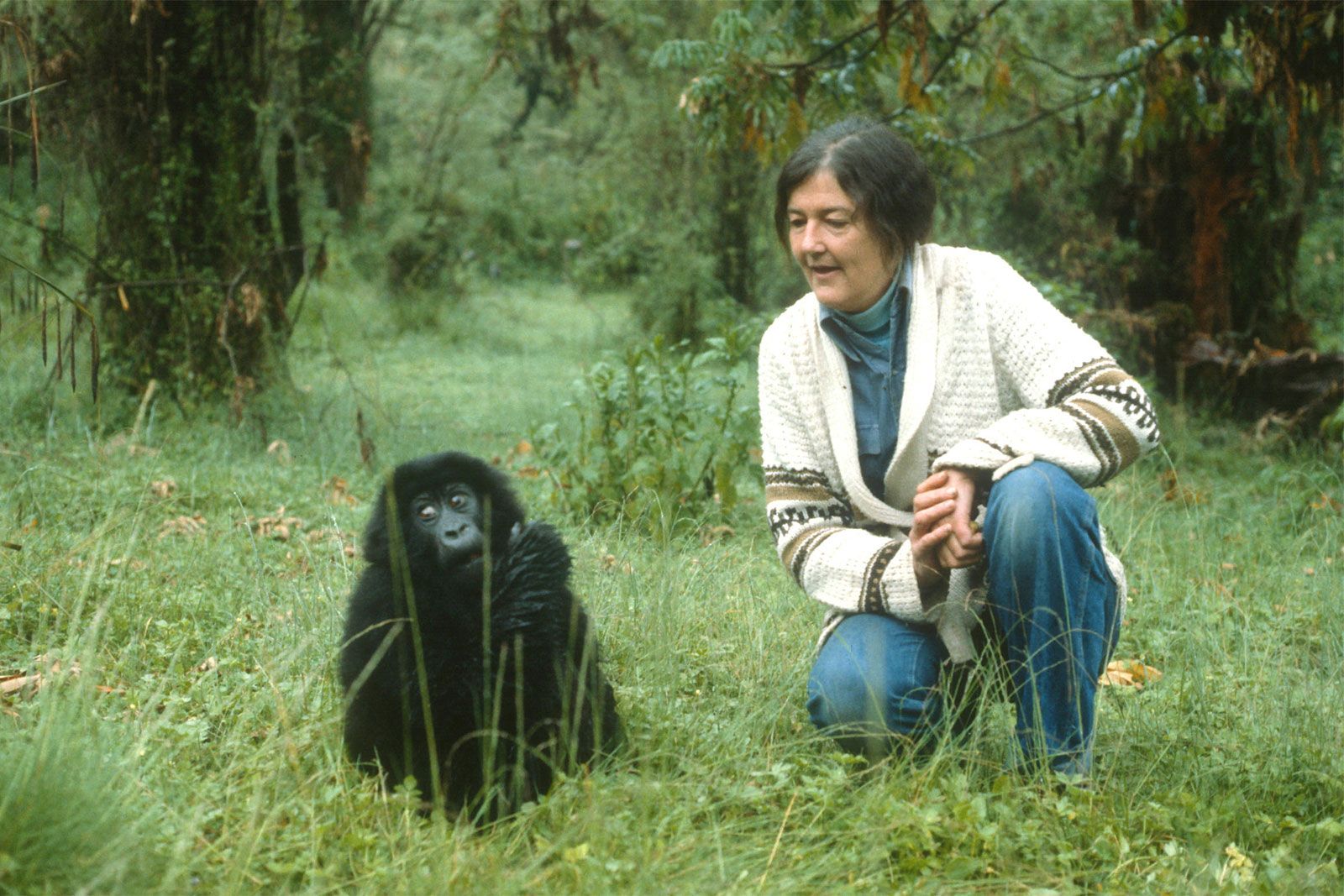
Fossey earned the trust of the gorillas, allowing her to study them at close quarters.
“These huge apes are gentle giants with individual personalities and rich social lives,” she wrote in National Geographic in 1970, after over 2,000 hours of observation.
Her work revealed the pivotal role of silverback males in family units and sparked human-gorilla bonds that fascinated the world.
Inspired by a 1963 African safari, Fossey met Louis Leakey, the famed paleoanthropologist who had launched Jane Goodall’s chimpanzee studies.

Ian Redmond (pictured) worked closely with Fossey while studying the mountain gorillas in Rwanda.
In 1967, Leakey tasked her with gorilla research in the Democratic Republic of Congo, but civil unrest forced a relocation to Rwanda’s Karisoke Research Center—a cluster of cabins perched in the volcanic highlands.
Home to one of just two global populations of mountain gorillas (the other in Uganda), the Virungas sheltered about 475 individuals in the 1960s. By the early 1980s, poaching and habitat loss had slashed that to 254.
Fossey’s breakthrough came swiftly. “Gorillas are as fascinated by us as we are by them,” recalls Ian Redmond, a conservationist who collaborated with her for over three years.

Fossey would frequently lead groups on anti-poaching patrols.
He describes gorillas inspecting humans’ teeth and lips, drawn to our shared traits. Her 1970 National Geographic cover story humanized the species, debunking aggression myths: in thousands of hours, she witnessed mere minutes of it.
Films and named individuals—like the silverback Digit, with his crooked finger—fueled public empathy, paving the way for ecotourism and conservation funding.
Yet Fossey’s triumphs masked a turbulent personal life. Colleagues paint her as charismatic yet volatile.
“She demanded complete loyalty, but you never knew if she’d love or hate you that day,” says Kelly Stewart, a former student who joined in 1973.
Emphysema curtailed her fieldwork, but not her control over Karisoke. Isolated in the creaking night forest, she withdrew into handwritten notes and solitude, her smoking and drinking intensifying.
Her war on threats escalated dramatically.

Alphonse Nemeye and Ian Redmond with Digit’s headless body.
Farmers’ cattle grazed gorilla turf; poachers set snares for bushmeat or trophies. Fossey led patrols, shot livestock, and confronted intruders with theatrics—donning masks to feign witchcraft, earning the moniker “witch of the Virungas.”
Anecdotes of interrogations and torture surface in her letters: one poacher was “spread-eagled and lashed with nettle stalks.”
In a heated raid, she briefly held a poacher’s child hostage during a gun search, later fined for the lapse.
Redmond calls it a “foolish dramatic moment,” not a repeated tactic.
The 1977 New Year’s Eve killing of Digit shattered her.
The young silverback, Fossey’s “outsider” favorite, defended his group but was decapitated and de-handed for $20 trinkets.

Many of the gorillas killed by poachers were buried on the grounds of Fossey’s camp.
Redmond discovered the “mangled” corpse; Fossey buried it at camp. “The saddest event in all my years,” she lamented.
Six months later, an organized assault claimed two more adults and infant Kweli, who succumbed to wounds and grief. Fossey blamed corrupt officials, suspecting staged killings for sympathy funds.
Digit’s death spotlighted the crisis, boosting awareness—but funds flowed to education and habitat protection, not her preferred anti-poaching crackdowns.
This fueled her isolation.

Fossey was buried in the same cemetery where she had put the remains of so many of the gorillas she had been fighting for including Digit.
She scorned the 1979 Mountain Gorilla Project, which engaged locals to shift attitudes, dubbing it “comic book conservation.”
“She shut out Rwandans entirely, dismissing them as insincere,” says Amy Vedder, who arrived in 1978. Fossey couldn’t envision former poachers as allies, deepening her mistrust of authorities and peers.
On December 26, 1985, Fossey was hacked to death with a machete in her Karisoke cabin.
Bloodstained carpets and ransacked drawers suggested a search for evidence—perhaps of gold smuggling routes near unstable borders with Congo and Uganda. No valuables were taken.

Fossey’s life was undoubtedly controversial, but her legacy can still be seen in the rebounding fortunes of mountain gorillas today.
Poachers seem unlikely culprits, per Vedder: “They avoided confrontation.” Smugglers or vengeful locals remain prime suspects.
The botched investigation—trampled footprints, no forensic rigor—left it unsolved. Fossey, pistol by her bed, had long anticipated peril.
“Her behavior could be extreme,” Stewart notes. “She died like the warrior she was.”
Fossey’s grim prophecy—that gorillas would vanish in 15 years—proved false. A 1986 census showed stabilization; today, 1,063 roam the wild, up from 880 in 2012.
Downgraded from critically endangered, they thrive via ecotourism and the annual baby-naming ceremony, marking 400 births since 2005. The Rwandan genocide of the 1990s barely dented numbers, a testament to Karisoke’s endurance.
Flawed and fierce, Fossey put Rwanda’s gorillas on the map. “Without her National Geographic splash, Digit’s death wouldn’t have echoed,” Stewart says.
Buried beside him in the Virungas, her grave—adorned with thistle and celery by Vedder—overlooks a rebounding legacy. As Redmond reflects: “Her life was controversial, but the gorillas’ fortunes prove her impact.”
Discover more from AMERICA NEWS WORLD
Subscribe to get the latest posts sent to your email.



![Smoke rises after Israeli strikes in Beirut's southern suburbs, on March 2 [Mohamad Azakir/Reuters]](https://america112.com/wp-content/uploads/2026/03/hgh.webp)