By Suraj Karowa and Rebecca Cairns /ANW ,December 5, 2025

Published last month, “Tigers Between Empires” details the rise, fall, and rise again of the Amur tiger, also known as the Siberian tiger, in Russia’s freezing and formidable Far East.
In the snow-swept taiga of Russia’s Far East, where temperatures plunge to minus 40 degrees Celsius and ancient forests stretch endlessly toward the horizon, a drama unfolded that could rival any wildlife thriller.
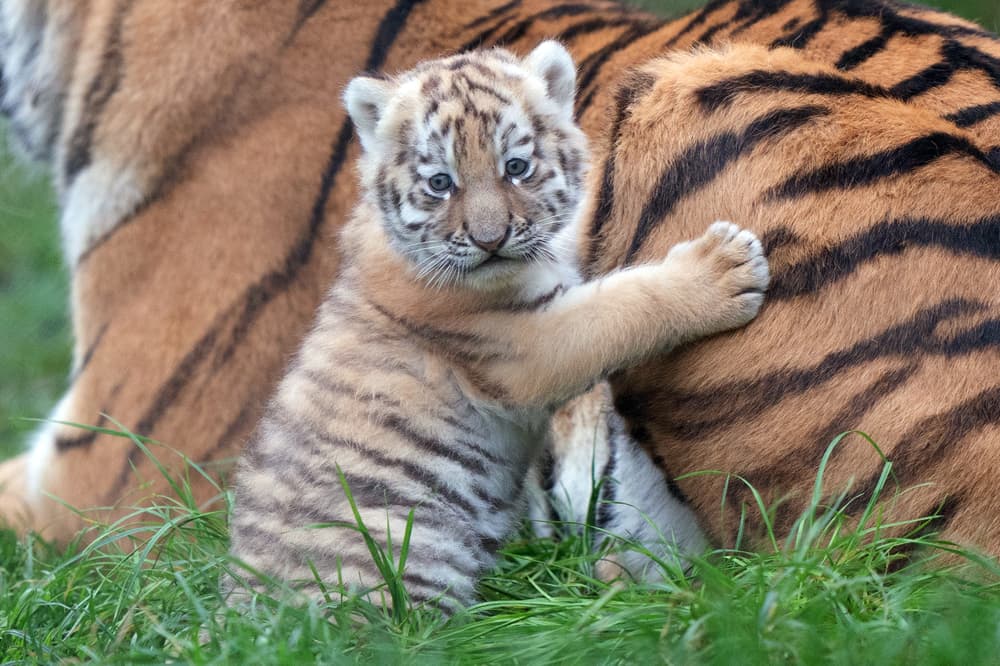
This is the story of the Amur tiger—known to most as the Siberian tiger—the world’s largest big cat, whose population teetered on the edge of oblivion in the 20th century.
From a robust 3,000 in the mid-1800s, their numbers had plummeted to a mere 30 by the 1930s, victims of relentless hunting and habitat loss.
Yet, against the backdrop of geopolitical upheaval, a ragtag team of American and Russian scientists launched a 30-year quest that not only saved the species but redefined global conservation.

Tigress Olga pictured during her second capture, when her collar was replaced. She was darted and partially sedated from a helicopter.
This saga, long whispered about in field camps and academic circles, has finally found its way into print with Jonathan Slaght’s riveting new book, “Tigers Between Empires,” published last month by the University of Chicago Press.
Slaght, a wildlife biologist and regional director for the Wildlife Conservation Society’s (WCS) temperate Asia program, didn’t set out to pen this epic.
Over 25 years of friendship, he’d heard his colleague Dale Miquelle— the grizzled, moose-turned-tiger expert who’d called Russia’s Primorsky Krai home for three decades—muse about writing it himself.
“One day I’m going to write a book about this,” Miquelle would say, his voice thick with the weight of untold adventures.

In 1992, Lena the tiger was poached just months after giving birth to four cubs. The Siberian Tiger Project found her collar in the snow, and rescued the orphaned cubs, who were hiding in the snow nearby waiting for their mother to return.
But life in the field—darting tigers from helicopters, trekking through blizzards, and negotiating with poachers—left little time for prose.
In 2021, Slaght, fresh off his acclaimed debut “Owls of the Eastern Ice,” made the offer: “What if I write it instead?”
The result is a 512-page tapestry blending history, folklore, and high-stakes science.
It’s the chronicle of the Siberian Tiger Project, the longest-running tiger research initiative on Earth, born in the chaotic aftermath of the Soviet Union’s 1991 collapse.
As Russia’s economy cratered, poaching surged—tigers skinned for their bones and pelts, their prey like sika deer hunted for bushmeat.
Enter Miquelle, a former Peace Corps volunteer turned WCS biologist, and his Russian counterpart, Zhenya Smirnov, a rodent specialist with an uncanny knack for the wild.

Jonathan C. Slaght, pictured, author of “Tigers Between Empires” and currently the the regional director of the Wildlife Conservation Society’s temperate Asia program.
Lacking resources, they forged an unlikely alliance with American scientists, who brought cutting-edge tech like radiotelemetry collars—devices commonplace in U.S. labs but forbidden under Soviet secrecy.
“Together, they filled the gaps,” Slaght told CNN in a recent interview. “Russians knew the land and the cats; Americans had the tools and funding.
It was a marriage of necessity that birthed breakthroughs.” Over three decades, the project collared 114 tigers, transforming anonymous predators into named stars of the story.
Take Olga, the inaugural collar-wearer in 1992. A young tigress darted from a chopper, she roamed for 13 years, her signal mapping a life of fierce independence—from juvenile shadow in her mother’s territory to matriarch passing down a 1,000-square-kilometer realm to her daughters.
Olga wasn’t just data; she was a local legend. A hunter once spotted her in the woods but held his fire, recognizing the collar’s glint.
“She became a fixture for the community,” Slaght notes, “a bridge between man and beast.”
The collars revealed secrets long buried in myth: tigers inherit ranges like family estates, females grooming cubs for succession in a matrilineal dynasty.
Feeding frenzies—devouring a deer in 20 minutes—kill rates (one every 7-10 days), and even “strange prey” like porcupines that left quills embedded in paws.
This intel spawned nearly 200 peer-reviewed papers, not just on tigers but on leopards and ungulates, reshaping ecology across Asia.
Non-lethal snaring techniques pioneered here spread to India and Sumatra, while population surveys doubled protected lands in the Russian Far East.
But triumph came laced with tragedy. Project data from the 1990s painted a grim picture: 75% of tiger deaths stemmed from poaching, their “short, violent lives” a far cry from the regal loungers in zoo enclosures.
In 1992, the team found Tigress Lena’s discarded collar in the snow, her body gone, four orphaned cubs huddled nearby, mewling for a mother who’d never return.
Rescued and rehabilitated, those cubs symbolized the project’s dual role: science and salvation.
Geopolitics added plot twists. By 2010, rising Russian nationalism cast foreign NGOs as interlopers.
Miquelle, who’d married a Russian and raised a family there, faced entry bans in 2013. The 2022 Ukraine invasion sealed the rift—WWF and Greenpeace expelled, WCS influence waning. Miquelle, after 30 years, relocated to the U.S. last year.
“It was heartbreaking,” he emailed CNN. “But Jon’s book revives those early days—the terror of our first capture, the joy of breakthroughs. It’s all there, raw and real.”
Today, Amur tigers number 500-600 in Russia (per IUCN’s 2022 estimate), stable but vulnerable.
President Vladimir Putin’s 2022 claim of 750 adults—up from 390 in 2010—has been met with skepticism over opaque censuses.
Slaght urges vigilance: “This isn’t solved. Poaching lingers, logging creeps in. But cross-border pacts, like the Land of the Leopard reserve straddling Russia and China, show promise.
They’re thinking big—treating tigers as a shared heritage.”
Slaght’s own tie to the tale runs deep. Posted to Terney village during Peace Corps service in the 1990s—the project’s nerve center—he’d join managers like John Goodrich on impromptu tiger hunts.
“Saturday morning, truck rolls up: ‘Helicopter darting today?'” he recalls with a grin.
Those escapades fueled his PhD on Blakiston’s fish owls and a lifelong love for the region.
“Tigers Between Empires” is his love letter to it—a clarion call amid climate threats and habitat fragmentation.
As Rolex’s Perpetual Planet Initiative spotlights such stories through CNN’s Call to Earth series, Slaght’s message resonates: Conservation thrives on collaboration, grit, and stories that stick.
In a world racing toward the sixth mass extinction, the Amur tiger’s comeback whispers hope.
But as Slaght warns, “These cats clawed back from the abyss. Complacency could send them tumbling again.”
With poachers still prowling and borders hardening, the empire between tigers endures—not as folklore, but as a fragile, fierce reality demanding our watch.
Discover more from AMERICA NEWS WORLD
Subscribe to get the latest posts sent to your email.