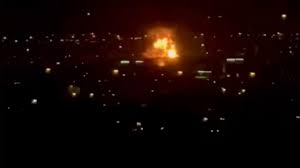
Dubai's skies turned ominous early Monday morning as Iranian drones struck a fuel tank near Dubai International Airport, triggering a massive fire and forcing authorities to suspend all flight operations. Dubai Civil Defence teams moved quickly to contain the blaze, and the Dubai Media Office confirmed the fire had been "successfully contained." Still, the incident shook the confidence of travelers and markets alike, as it marked the third attack targeting the world's most-traveled airport hub since the outbreak of the wider conflict.
The UAE's National Emergency Crisis and Disaster Management Authority (NCEMA) issued a stark alert to residents shortly after, confirming that air defence systems were actively "responding to a missile threat." Residents across Dubai were urged to shelter in place and monitor only official government channels for updates — a sign of just how fluid and dangerous the situation on the ground had become.
Emirates Airlines, the world's largest international carrier and the main operator out of Dubai, confirmed the temporary suspension of all flights in a direct post on X. The airline urged passengers to avoid traveling to the airport entirely, promising updates as the situation developed. Data tracked by Flightradar24 confirmed that several diverted Emirates flights had begun turning back toward their departure airports. Among them, Flight EK533, which had departed Kochi (Cochin International Airport) at 4:30 AM with 325 passengers on board, was directed mid-flight to return to India and touched down safely at 8:30 AM. Road closures on Airport Road and the Airport Tunnel were also put in place by Dubai Police, with drivers redirected to alternate routes.
As the physical battle raged above Dubai's runways, a diplomatic pressure campaign was simultaneously underway. According to a New York Times report citing unnamed White House officials, Saudi Crown Prince Mohammed bin Salman has been personally urging U.S. President Donald Trump to "keep hitting Iran hard." The report noted that Trump regularly holds conversations with Arab Gulf leaders. The Saudi Crown Prince and UAE President Sheikh Mohamed bin Zayed Al Nahyan also reportedly spoke by phone on Sunday, jointly condemning Iran's continued strikes as a "dangerous escalation threatening regional security and stability."
Since Iran launched its offensive on February 28 — following the U.S.–Israeli strikes that killed Supreme Leader Ali Khamenei — the UAE has absorbed the heaviest blow of any nation in the region. More than 1,800 Iranian missiles and drones have been aimed at the Emirates alone, the highest volume directed at any single country in this conflict. While the UAE's advanced air defence network has intercepted a vast majority of projectiles, several have slipped through. Just last Wednesday, two falling drones wounded four people near the airport. Iran also accused the United States of using "ports, docks, and hideouts" inside the UAE to conduct strikes on Kharg Island — Iran's main oil export terminal — though no evidence was presented. The UAE's diplomatic adviser Anwar Gargash firmly rejected the accusation, reaffirming the UAE's right to self-defence while insisting it "continues exercising restraint."
The crisis is also reverberating through civilian life. UAE authorities arrested 35 people — including 19 Indian nationals — for posting what officials described as "misleading and fabricated content" on social media during the conflict. UAE Attorney General Dr. Hamad Saif Al Shamsi ordered the arrests after electronic monitoring revealed that the defendants had published real footage, AI-fabricated clips, and propaganda glorifying hostile military actions. Penalties under UAE law include at least one year in prison and a fine of no less than AED 100,000. Meanwhile, Iran announced that at least 500 people inside the country have been arrested on charges of passing intelligence to "adversaries," with 18 of those accused of having connections to the Iran International news channel.
As the situation continues to evolve by the hour, the world watches one of the globe's most critical commercial crossroads hold its breath. Gulf Arab states have now collectively absorbed more than 2,000 missile and drone attacks since the war began — with civilian airports, hotels, ports, and oil facilities all in the crosshairs. The question facing Washington, Riyadh, Abu Dhabi, and Tehran is no longer whether the war will expand — but how far it will go.