By Suraj Karowa/ANW , Latin America
Santiago, Chile – November 17, 2025

In a stark reflection of Chile’s deepening political polarization, ultraconservative lawyer José Antonio Kast emerged as the frontrunner in the country’s presidential election after a bruising first-round vote on Sunday.
With over 70% of ballots tallied, Kast secured approximately 24% of the vote, positioning him for a high-stakes showdown against Communist Party candidate Jeannette Jara in the December 14 run-off.
Jara edged him out slightly with 26%, but the splintering of the right-wing vote—coupled with swift endorsements from eliminated rivals—has tilted the odds firmly in Kast’s favor.
The election, held amid soaring concerns over crime, immigration, and economic stagnation, underscores a broader conservative resurgence across South America.

Kast’s campaign, infused with Donald Trump-esque rhetoric, promised an “iron fist” against perceived threats, vowing to “put Chileans first” through draconian border controls and aggressive policing.
His ascent marks a potential rebuke to outgoing President Gabriel Boric’s progressive agenda, which has grappled with legislative gridlock and public disillusionment since 2022.
As polling stations closed under a balmy Santiago sunset, early results triggered a frenzy of endorsements that could prove decisive. Radical libertarian Johannes Kaiser, who garnered 14% of the vote with his anti-establishment firebrand style, wasted no time in throwing his weight behind Kast.
“The alternative is Mrs. Jara and Chile’s lefty impoverishers,” Kaiser declared to a roaring crowd of supporters, his voice echoing through the capital’s Plaza de Armas.
Moments later, conservative stalwart Evelyn Matthei—securing 13%—joined the chorus, lambasting the “absolutely uncontrolled arrival” of migrants and urging voters to back Kast for a “sharp change of direction.”
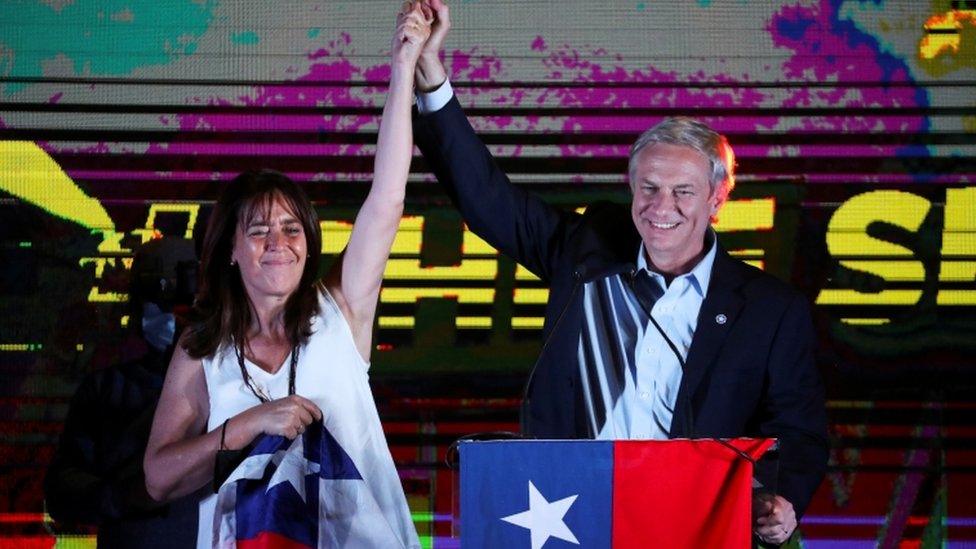
Matthei’s plea was visceral: “Please support Kast. It’s super important that this government does not remain in power. We have too many problems.” Her endorsement, delivered onstage beside the beaming frontrunner, symbolized the right’s tactical unity against Boric’s center-left coalition.
Together, right-leaning candidates captured nearly 30% of the vote, fragmenting the progressive bloc and amplifying Kast’s momentum.
Jara, a former labor minister under Boric known for her staunch advocacy of workers’ rights, addressed a sea of red-clad faithful in Santiago’s historic center.
“Chile is a great country—don’t let them tell you it’s gone to the dogs,” she implored, her words a direct riposte to Kast’s doomsday narrative. Flanked by union leaders and young activists, Jara framed the run-off as a battle for social justice, highlighting achievements like pension reforms and minimum wage hikes.
Yet her path to victory appears narrow; Boric’s lukewarm approval ratings—hovering around 30%—have sapped enthusiasm from the left.
Boric himself struck a conciliatory tone, congratulating both finalists after what he dubbed a “spectacular day of democracy.”
From the presidential palace in La Moneda, the 39-year-old leader emphasized Chile’s resilient institutions, even as polls suggest his legacy hangs in the balance. His administration’s push for constitutional reform faltered twice, fueling perceptions of chaos that Kast has ruthlessly exploited.
At 59, Kast is no stranger to the presidential fray—this is his third bid, following a narrow 2021 defeat to Boric. A scion of German immigrants whose father was a Waffen-SS officer during World War II, Kast has deftly rebranded his Republican Party as a bulwark against “woke” excesses.
His platform fuses economic liberalism with cultural conservatism, railing against gender ideology, abortion, and what he calls an “invasion” of migrants.
Central to his pitch is “Escudo Fronterizo” (Border Shield), a Trump-inspired blueprint for trenches, barriers, and walls along Chile’s porous northern frontier with Bolivia and Peru. Over the past decade, more than 500,000 Venezuelans have fled economic collapse to seek refuge in Chile, straining resources in cities like Iquique and Antofagasta.
“Chile has been invaded… but this is over,” Kast thundered in a viral campaign ad, footage of overflowing border camps spliced with images of U.S. deportations.
Kast’s admiration for strongman tactics extends to El Salvador’s Nayib Bukele, whose mass incarceration of 2% of the population has slashed homicide rates—and drawn human rights rebukes.
Chile’s crime wave, though modest by regional standards, has nonetheless spiked: assassinations up 20%, kidnappings surging in urban sprawls.
Official data shows Chile’s homicide rate at 6.7 per 100,000—far below Brazil’s 20—but public fear is palpable, with nightly carjackings and extortion rackets dominating headlines.
Kast’s October rally in Viña del Mar crystallized his vision. Citing U.S. figures, he crowed that 1.6 million migrants had “self-deported” post-Trump, aiming for a “four-to-one or five-to-one” ratio in Chile through hostile policies like benefit cuts and workplace raids. “We need an iron fist,” he bellowed, evoking Bukele’s iron grip while nodding to Trump’s border wall.
This Trumpian flair resonates in Washington, where figures like Secretary of State Marco Rubio toast a “conservative wave” cresting Latin America.
Bolivia’s recent pivot to center-right rule after two decades of socialism; looming right-wing triumphs in Colombia and Peru; even Brazil’s Luiz Inácio Lula da Silva staring down a resurgent Jair Bolsonaro despite the latter’s coup conviction—all signal a regional tide turning against the Pink Tide of the 2000s.
Critics decry Kast’s nostalgia for Pinochet’s dictatorship, which he has praised for its “order.” Human rights groups warn his immigration crackdown risks xenophobia, noting Chile’s own history as a haven for exiles.
Jara’s camp counters with a progressive manifesto: universal healthcare expansion, green energy investments, and Indigenous rights amplification.
As Chileans brace for the run-off, the stakes transcend borders. A Kast victory could embolden authoritarians from Buenos Aires to Brasília, reshaping trade pacts like the Pacific Alliance and straining ties with progressive neighbors.
For now, the ballot boxes are sealed, but the ideological trench warfare has only just begun. In a nation born from coups and constitutions, democracy’s next chapter hinges on who wields the shield—and who shatters it.
Discover more from AMERICA NEWS WORLD
Subscribe to get the latest posts sent to your email.