By Suraj Karowa and Katherine Latham/ ANW , December 11, 2025

In the shadowy depths of the Atlantic, where sunlight fades into eternal twilight, colossal underwater mountains rise like forgotten sentinels.
These seamounts—volcanic peaks piercing the seafloor at heights exceeding 1,000 meters (3,300 feet)—are alive with a frenzy of life.
Corals sway in invisible currents, sponges filter nutrient-rich waters, and schools of fish dart through craggy ridges.
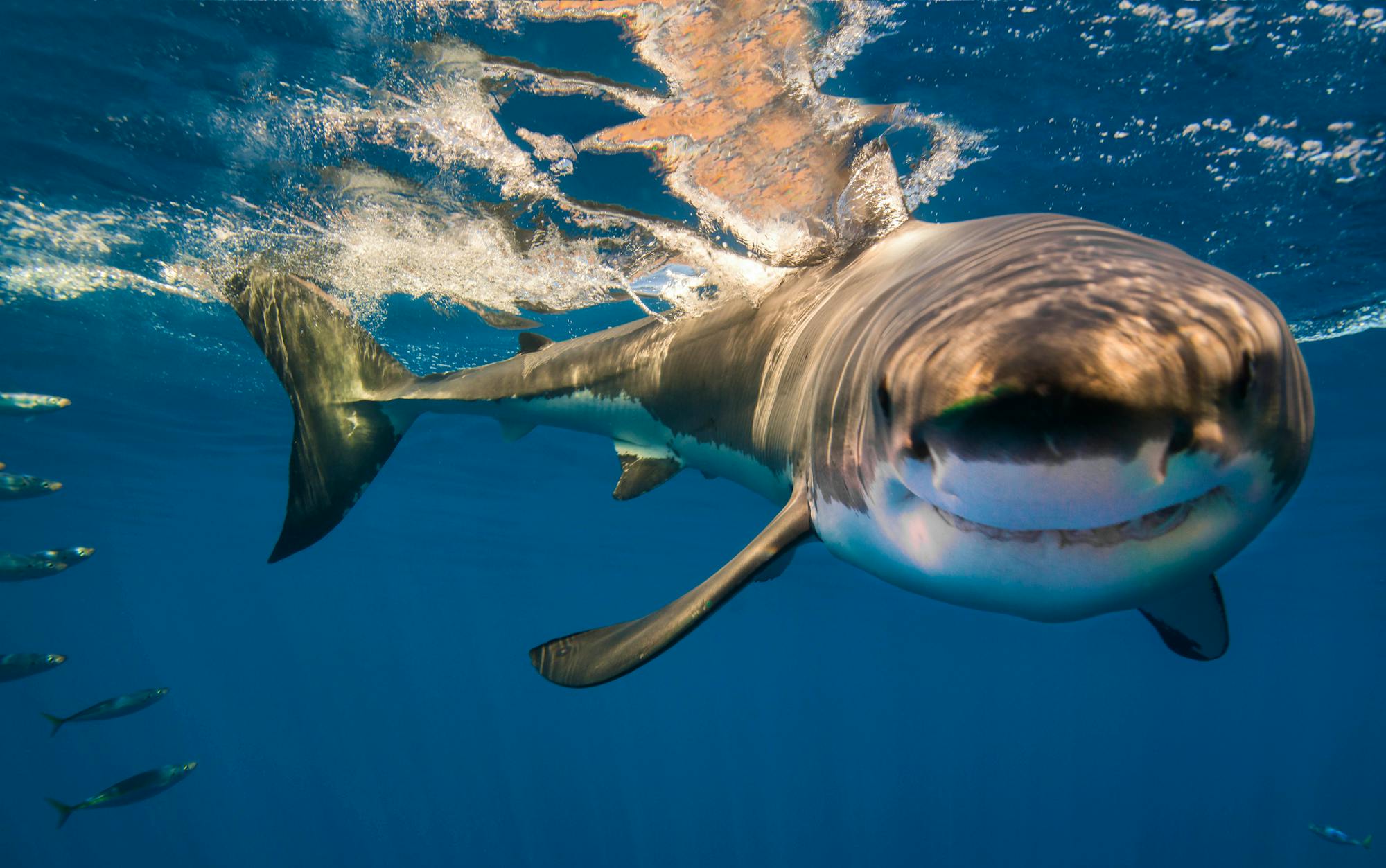
But it’s the sharks that reign supreme here, drawn to these oceanic oases in astonishing numbers.

Off the coast of Ascension Island, researchers haul a silky shark in for tagging.
Recent expeditions off Ascension Island, a remote British territory midway between Africa and Brazil, have unveiled a thriving predator paradise.
Scientists aboard the research vessel James Clark Ross documented shark biomass 41 times higher around the Southern Seamounts—Grattan and Young—than in the surrounding open ocean.
Diversity soared fivefold, with threatened species like silky sharks and Galapagos sharks mingling alongside commercial prizes such as yellowfin and bigeye tuna.
“It’s like a bustling village underwater,” says Sam Weber, a marine ecologist at the University of Exeter, who led the tagging efforts.

AIG Conservation Dept/ Univ of Exeter/ Univ of W Australia.
A shortfin mako shark investigates bait as it’s filmed by an underwater camera near Ascension Island seamount.
“Everyone knows their place in the food chain.”Seamounts aren’t just isolated bumps on the seafloor; they’re global hotspots.
Estimates peg their number at over 100,000, scattered from the icy North Atlantic to the sun-baked Pacific abyss.
Yet fewer than 0.1% have been explored, a testament to the ocean’s vast mysteries.
“We’ve uncovered an unprecedented wave of volcanic seamounts in recent decades,” notes Ali Mashayek, a climate dynamics expert at the University of Cambridge.
Advanced sonar and submersibles are accelerating discoveries, revealing ecosystems teeming with endemics—species found nowhere else.

There are thought to be more than 100,000 undersea mountains on Earth but fewer than 0.1% have been explored.
What lures these apex predators? Theories abound. Seamounts may serve as navigational beacons, their iron-laced rocks imprinting unique magnetic signatures that sharks and whales use like cosmic GPS.
“They’re stepping stones in migratory corridors,” Weber explains. Chains of these features stretch across oceans, spaced 100-200 kilometers apart, guiding travelers from foraging grounds to breeding sites.
Two competing ideas dominate: the “oasis” and “hub” hypotheses. In the oasis model, seamounts generate their own bounty.
Ocean currents crash against their slopes, creating turbulent upwellings that propel nutrient-laden deep waters to the sunlit surface.

Typically solitary, pregnant marbled electric rays gather on the Gorringe Seamount off the coast of Portugal.
This sparks phytoplankton blooms, the base of the marine food web. Pioneering oceanographer Walter Munk once called seamounts “stirring rods of the ocean,” and modern research backs it: they drive about a third of global ocean mixing, influencing everything from carbon storage to heat distribution.
“This turbulence reshapes deep circulation,” says Laura Cimoli, a physical oceanographer at Cambridge. Around Ascension, however, phytoplankton levels were unremarkable.
Instead, “trophic focusing” concentrated migrating mesopelagic fish—mid-level prey—trapping them like flies on flypaper, cascading energy upward to filter-feeders and, ultimately, sharks.

Each seamount is unique and teeming with life.
The hub theory paints seamounts as social hubs. Mobile hunters like silky sharks venture into the bluewater abyss at night, devouring prey up to 100 kilometers away, then return at dawn.
Acoustic tags revealed one silky shark tracing figure-eight loops, beelining back to the summit with uncanny precision.
Others vanished for a year, suggesting pit stops on epic migrations. “It’s the ‘service station’ hypothesis,” Weber quips.
Upwelling currents create thermal refuges, allowing energy-sipping sharks—obligate ram ventilators that must swim ceaselessly—to glide effortlessly, conserving stamina before the next hunt.

The habitats of the Gorringe Seamount span almost 5km (3 miles) of depth and include kelp forests, cold-water coral and deep-sea sponge beds .
Aggregations spike at these “energetically favorable” spots, hinting at mating or resting grounds.
This bounty extends beyond the peaks. A “halo effect” radiates enhanced biodiversity up to 6 kilometers (3.7 miles) outward—and in some studies, 40 kilometers (25 miles)—even plunging thousands of meters deep.
Tuna and sharks roamed hundreds of kilometers yet remained “site-attached,” commuting between Grattan and Young, 80 kilometers apart.
Diurnal rhythms amplified the halo: predators swelled at night, contracting by day. “These aren’t isolated refuges,” Weber warns. “They’re connected nodes in a vast network.”
For elasmobranchs—sharks, rays, and skates—seamounts are lifelines. With over 1,000 shark species, each carves a niche, from reef patrollers to deep-sea nomads.
But paradise teeters on a knife’s edge. Industrial fishing, especially bottom trawling, ravages these habitats.
Heavy nets scour the seafloor, pulverizing millennia-old corals and sponges into barren wastelands.
“It’s decimating the entire food web,” Koehler laments. Bycatch claims hundreds of millions of sharks annually, many discarded as collateral in pursuits of tuna.
Slow-growing seamount residents—some corals enduring 4,000 years—may never recover; regeneration spans human lifetimes.
Boom-bust fisheries exploit the abundance ruthlessly. “They arrive, see the loads of fish, scoop them up, and vanish,” Weber says.
Ascension’s response? In 2019, its Exclusive Economic Zone shuttered to commercial fishing, a model for protection. Globally, momentum builds.
Portugal’s 2025 marine reserve around Gorringe Seamount—Europe’s tallest underwater peak—safeguards kelp forests, cold-water corals, and undescribed species.
The UN’s 2021 Ocean Assessment flagged trawling as seamounts’ top threat, echoed by the IUCN’s October 2025 Motion 032, urging a worldwide ban by 2026’s end.
Yet Weber calls for more: total no-take zones, banning longlines alongside trawls. “Protect the ecosystem holistically.”
As exploration ramps up, so does urgency. Seamounts aren’t luxuries; they’re planetary arteries, pumping life through the blue. Shielding them safeguards sharks—and the oceans they anchor.
Discover more from AMERICA NEWS WORLD
Subscribe to get the latest posts sent to your email.