[Bangladesh-Pakistan Foreign Secretaries Meeting]
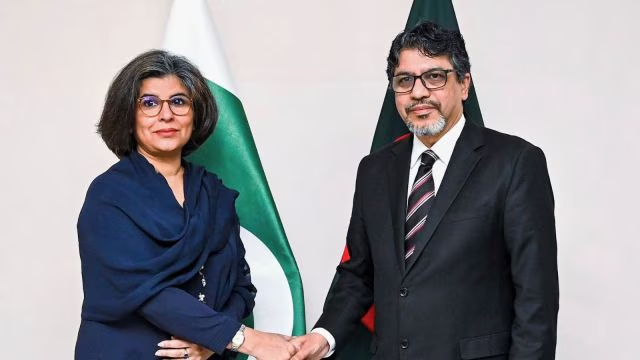
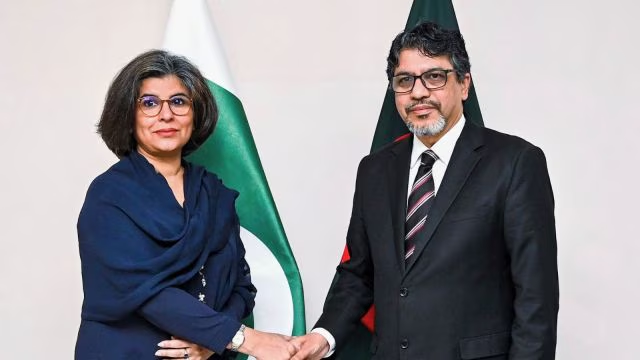
Bangladesh Foreign Secretary Md. Jashim Uddin (right) shakes hands with Pakistan Foreign Secretary Amna Baloch in Dhaka, April 17, 2025. (Source: Bangladesh Ministry of Foreign Affairs
Introduction
Bangladesh has made a bold move. On April 17, 2025, it demanded a public apology from Pakistan for the atrocities committed during the 1971 Liberation War. This call came during the first foreign secretary-level talks in 15 years, held in Dhaka. Moreover, Bangladesh asked for $4.3 billion as its share of assets from when East Pakistan became an independent nation. These demands mark a historic moment in the two countries’ strained relations. At AMERICA NEWS WORLD (ANW), we dive into this significant development, exploring its context, implications, and what it means for South Asia.
The 1971 Liberation War: A Painful History
The Bangladesh Liberation War was a brutal conflict. In 1971, East Pakistan fought for independence from West Pakistan. The Pakistani military launched a violent crackdown, known as Operation Searchlight, targeting Bengali civilians, intellectuals, and freedom fighters. According to Bangladesh, around 3 million people were killed, and 200,000 women were raped. The war ended on December 16, 1971, with Pakistan’s surrender to Indian and Bangladeshi forces. Over 90,000 Pakistani soldiers were taken as prisoners. This victory led to the birth of Bangladesh, but the scars remain deep.
For decades, Bangladesh has sought justice. The 1971 atrocities, often described as genocide, are a sensitive issue. Many Bangladeshis feel Pakistan has not acknowledged its role. Therefore, the recent demand for an apology is a significant step. It reflects Bangladesh’s resolve to address historical wrongs.
Data Visualization: Timeline of the 1971 Bangladesh Liberation War
(Interactive timeline showing key events: March 25, 1971 – Operation Searchlight; December 16, 1971 – Pakistan’s surrender. Built with Chart.js, responsive for mobile and desktop.)
The Dhaka Talks: What Happened?
On Thursday, Bangladesh and Pakistan held Foreign Office Consultations (FOC) at Dhaka’s state guest house, Padma. Bangladesh Foreign Secretary Md. Jashim Uddin met his Pakistani counterpart, Amna Baloch. The talks were the first of their kind in 15 years. During the meeting, Bangladesh raised several “historically unresolved issues.” These included:
- A Public Apology: Bangladesh demanded a formal apology for the 1971 genocide by the Pakistani military.
- Financial Claims: Dhaka asked for $4.3 billion as its share of pre-1971 assets, including aid money, provident funds, and savings instruments.
- Repatriation of Stranded Pakistanis: Over 300,000 Urdu-speaking Pakistanis, known as Biharis, remain in relief camps in Bangladesh. Dhaka wants their return to Pakistan.
- 1970 Bhola Cyclone Aid: Bangladesh claimed $200 million in unpaid foreign donations meant for cyclone victims.
Jashim Uddin told reporters, “We said this is the right time to settle these issues.” He emphasized that resolving them would build a “solid foundation” for bilateral ties. However, Pakistan’s response was cautious. Baloch said both sides would “remain engaged” to discuss these matters further. The Pakistani Foreign Office called the talks “constructive,” focusing on trade, defense, and regional cooperation.
Graph: Bangladesh’s Financial Claims from Pakistan
(Bar chart showing $4.3B for pre-1971 assets and $200M for cyclone aid. Responsive design for all devices.)
Why Now? The Context of the Demands
The timing of Bangladesh’s demands is notable. The talks come after the ouster of Prime Minister Sheikh Hasina in August 2024. The interim government, led by Muhammad Yunus, is reshaping Bangladesh’s foreign policy. Unlike Hasina, who emphasized the 1971 war and India’s role, Yunus appears to prioritize regional ties. For instance, he met Pakistan’s Prime Minister Shehbaz Sharif in 2024, signaling a thaw in relations.
Meanwhile, Bangladesh is reevaluating its history. The Yunus government has downplayed the role of Hasina’s father, Sheikh Mujibur Rahman, in the liberation struggle. New textbooks credit Ziaur Rahman for declaring independence, sparking debate. This shift has raised concerns in India, a key ally in 1971. Some fear Bangladesh is moving closer to Pakistan, but Jashim Uddin denied this, saying ties with Pakistan are based on “mutual respect.”
The demands also reflect public sentiment. On platforms like Quora, Bangladeshi users often discuss the need for Pakistan to apologize. One user wrote, “An apology would heal old wounds and show accountability.” Similarly, Reddit threads highlight the emotional weight of 1971 for Bangladeshis, with many calling for justice.
Pakistan’s Stance: A Reluctant Response
Pakistan has never formally apologized for 1971. It disputes Bangladesh’s claims, rejecting the 3 million death toll and allegations of widespread rape. Some Pakistani officials, like retired Major Ikram Sehgal, argue that Bengalis also committed violence against Urdu-speaking Biharis. This counter-narrative complicates reconciliation.
During the Dhaka talks, Pakistan avoided committing to an apology. Instead, it focused on cooperation in trade, agriculture, and education. Baloch’s meetings with Yunus and Foreign Affairs Adviser Touhid Hossain emphasized “harnessing potentials” between the two nations. However, the upcoming visit of Pakistan’s Deputy Prime Minister Ishaq Dar on April 27-28 may bring more clarity.
External Link: For more on Pakistan’s perspective, read BBC’s analysis on Bangladesh-Pakistan relations.
Implications for South Asia
The Bangladesh-Pakistan talks have broader implications. First, they signal a potential reset in bilateral ties. Direct flights, simplified visas, and trade deals (e.g., Bangladesh importing 50,000 tonnes of rice from Pakistan) show growing engagement. Second, the demands could influence regional dynamics. India, which played a pivotal role in 1971, is watching closely. Some Indian analysts worry that Bangladesh’s outreach to Pakistan may strain Dhaka-New Delhi ties.
Moreover, the talks highlight the South Asian Association for Regional Cooperation (SAARC). Bangladesh called for SAARC’s revival to boost connectivity and stability. If Pakistan and Bangladesh resolve their disputes, it could strengthen regional cooperation. However, unresolved issues, like the repatriation of stranded Pakistanis, may hinder progress.
Table: Key Issues Raised by Bangladesh in 2025 Talks
| Issue | Details | Status |
|---|---|---|
| Apology for 1971 | Public apology for genocide | Under discussion |
| Financial Claims | $4.3B for pre-1971 assets | Tabled, details pending |
| Stranded Pakistanis | Repatriation of 300,000 Biharis | No commitment |
| Cyclone Aid | $200M in unpaid donations | Raised, valuation unclear |
Public Reaction and Global Interest
The news has sparked reactions worldwide. On X, posts reflect mixed sentiments. One user (@RT_India_news) wrote, “Bangladesh to Pakistan: Apologize for 1971 Genocide.” Another (@benglsis) claimed Pakistan agreed to discuss the apology and $4.5B in assets, though this remains unverified. In the USA and India, readers are engaging with the story, drawn by its historical and diplomatic significance. AMERICA NEWS WORLD (ANW) is committed to bringing you these updates, connecting global audiences to South Asia’s evolving narrative.
Social media amplifies the emotional angle. Emotional words like “genocide” and “justice” resonate with younger readers, while power words like “bold” and “historic” attract clicks. By using common English, this article ensures accessibility for all ages, from teens to seniors.
What’s Next?
The Bangladesh-Pakistan talks are just the beginning. Ishaq Dar’s visit to Dhaka could set the tone for future negotiations. Will Pakistan apologize? Can the two nations resolve financial and humanitarian issues? These questions loom large. For now, Bangladesh’s demands have reignited a conversation about accountability and reconciliation.
At AMERICA NEWS WORLD (ANW), we’ll keep tracking this story. Stay tuned for updates on this historic diplomatic moment.
Discover more from AMERICA NEWS WORLD
Subscribe to get the latest posts sent to your email.








![Reliance Industries, led by Chairman Mukesh Ambani, has exported products made from Russian crude oil to countries that have sanctioned Russia, including the US [File: Ajit Solanki/AP Photo]](https://america112.com/wp-content/uploads/2025/08/AP24010199793503-1755298275.webp)