By Jacopo Prisco ,Suraj Karowa/ANW
November 28, 2025 – Houston, Texas

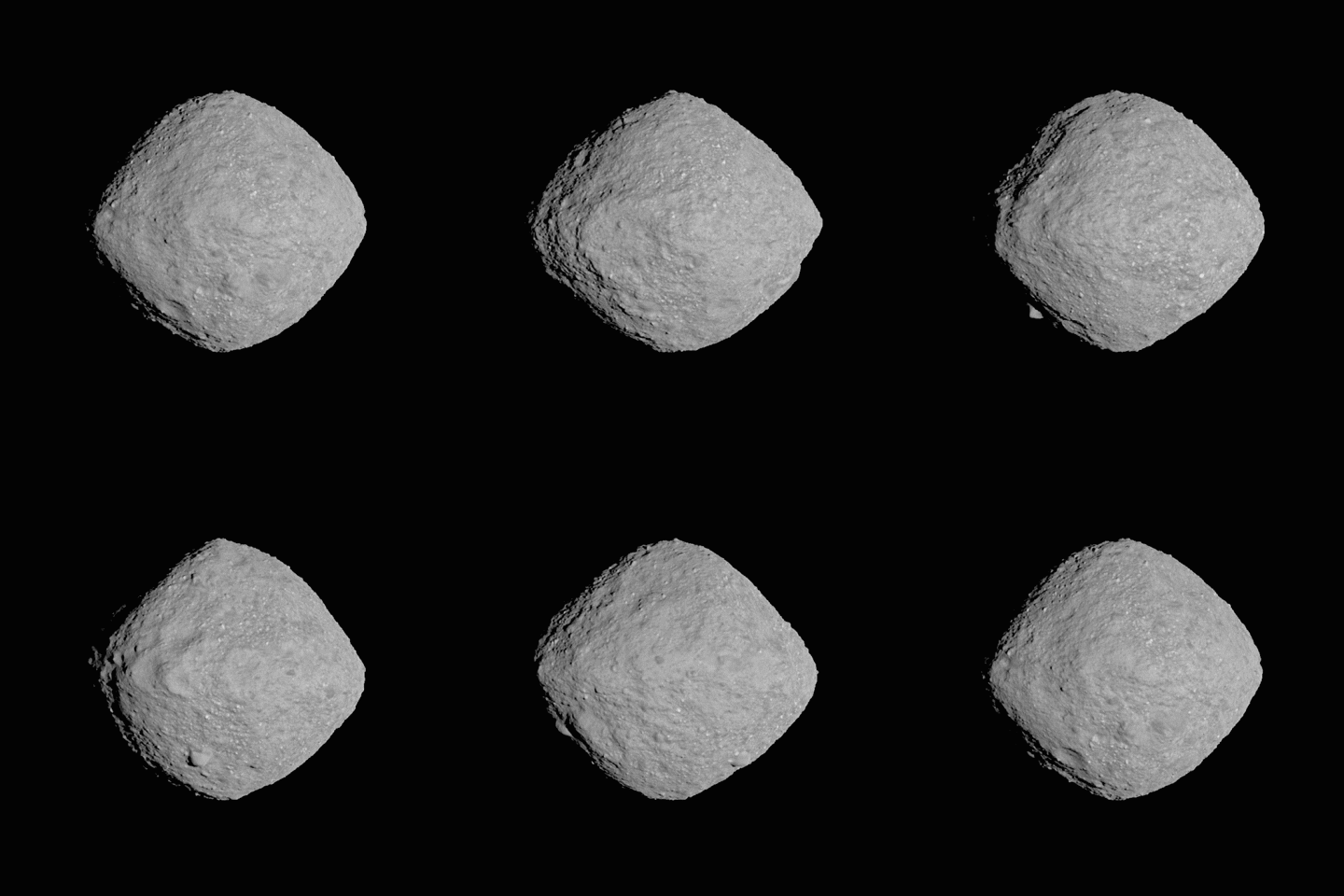
A mosaic of Bennu created from observations made by NASA’s OSIRIS-REx spacecraft, which was in close proximity to the asteroid for over two years
In a discovery that could rewrite the story of life’s origins, scientists have unearthed tryptophan—the elusive amino acid linked to everything from protein synthesis to that post-Thanksgiving drowsiness—in samples from the asteroid Bennu.
This finding, drawn from NASA’s groundbreaking OSIRIS-REx mission, pushes the count of life-essential amino acids detected in extraterrestrial material to 15 out of 20, bolstering theories that asteroids served as cosmic couriers delivering the building blocks of biology to early Earth.

A vial that contains part of the sample from asteroid Bennu is held up by Jason Dworkin, the NASA’s OSIRIS-REx mission’s project scientist, in 2023.
The revelation comes from a meticulous analysis of just 50 milligrams of pristine regolith returned to our planet in 2023 after a seven-year odyssey.
NASA’s OSIRIS-REx spacecraft touched down on Bennu in 2020, scooping up 121.6 grams of the asteroid’s rubble before parachuting the capsule back to the Utah desert.
Since then, tiny aliquots have been dispatched to labs worldwide, where researchers probe them for clues about the solar system’s infancy.
Jigsaw pieces
Tryptophan, one of the 20 amino acids that form the backbone of Earth’s proteins, stands out for its complexity.
Unlike simpler counterparts, it’s “essential” for humans—we can’t synthesize it and must obtain it through diet, often from turkey, eggs, or cheese.

A container holding rocks and dust from asteroid Bennu.
Its detection in Bennu, published Monday in the Proceedings of the National Academy of Sciences (PNAS), marks the first time this molecule has appeared in any meteorite or space sample.
“Finding tryptophan in the Bennu asteroid is a big deal,” said José Aponte, an astrochemist at NASA’s Goddard Space Flight Center and coauthor of the study.
In an email to xAI News, Aponte emphasized the implications: “Seeing it form naturally in space tells us that these ingredients were already being made out in the early Solar System. That would have made it easier for life to get started.”

These images, taken by the OSIRIS-REx spacecraft’s PolyCam camera in 2018, show four views of asteroid Bennu along with a global mosaic.
Bennu, a rubble-pile asteroid roughly 1,600 feet across—about the size of the Empire State Building laid on its side—orbits the sun in a path that brings it perilously close to Earth every six years.
Named after an ancient Egyptian bird deity symbolizing creation and rebirth, it’s a relic from 4.5 billion years ago, forged in the asteroid belt between Mars and Jupiter.
A chunk likely calved from a larger body between 2 billion and 700 million years ago, Bennu has endured supernovae blasts, radiative onslaughts, and aqueous chemistry on its parent world.
Prior scans of Bennu samples had already revealed 14 proteinogenic amino acids, all five nucleobases (adenine, guanine, cytosine, thymine, and uracil), and even ammonia—key for amino acid formation.
Add tryptophan, and the tally inches toward completeness. “They’re like jigsaw pieces that are not yet assembled,” explained lead author Angel Mojarro, a postdoctoral organic geochemist at Goddard.
Molecular ‘fossils’

The United Launch Alliance Atlas V rocket that took the OSIRIS-REx spacecraft into space, at Cape Canaveral Air Force Station in Florida on September 8, 2016.
“What this is telling us is that many of the building blocks of life can be produced naturally within asteroids or comets.”
This isn’t Bennu’s first brush with astrobiological fame. Echoing findings from Japan’s Hayabusa 2 mission on Ryugu in 2019 and countless meteorites, the evidence mounts that space rocks seeded Earth with organics during the Late Heavy Bombardment, some 4 billion years ago.
But tryptophan’s absence in prior samples puzzled experts; its fragility might explain why it evades detection in atmosphere-scorched meteorites.
The OSIRIS-REx haul changes that. By bypassing fiery reentry, the mission preserved delicate salts, minerals, and organics that would otherwise degrade.
“Because OSIRIS-REx returned these samples pristine, we’re finally seeing the fragile salts, minerals, and organics that meteorites lose on entry,” said Dante Lauretta, principal investigator for the mission and a cosmochemist at the University of Arizona.
Lauretta, a coauthor, described Bennu’s parent as a “rich geologic world with multiple liquid systems,” hinting at hydrothermal vents that could brew prebiotic soups.
Skeptics might wonder about contamination—could Earth microbes have hitched a ride? Unlikely, say the researchers.
The samples’ isolation protocols were ironclad, and the molecule’s isotopic signature screams extraterrestrial.
“I believe these molecules are legitimately derived from the Bennu asteroid,” affirmed George Cody, a Carnegie Institution geochemist who analyzed unrelated Bennu bits but reviewed the new work.
The find resonates with Harold Morowitz’s “molecular fossils” hypothesis: that life’s core chemistry echoes the solar nebula’s alchemy.
“If the natural chemistry that occurred at the dawn of our solar system produces the same molecules that life currently uses, then there must be a connection between them,” Cody noted.
Beyond origins-of-life intrigue, Bennu poses a double-edged sword. For 1.75 million years, it’s grazed Earth’s orbit, and projections flag 2182 as a potential collision date—with a 1-in-2,700 odds of unleashing a “global winter” via dust-shrouded skies.
NASA’s tracking continues, but the sample’s bounty underscores why studying these wanderers matters: knowledge for deflection, plus windows into habitability.
“Asteroids were the early Earth’s grocery delivery service, having provided a wealth of molecules to our prebiotic world,” reflected Kate Freeman, a Penn State geochemist unaffiliated with the study.
Her words capture the poetry: from stellar forges to planetary pantries, tryptophan’s trace in Bennu suggests life’s menu was drafted among the stars.
Yet confirmation beckons.
More tests on larger samples could seal tryptophan’s cosmic credentials. Sara Russell, a planetary scientist at London’s Natural History Museum, called the result “surprising” and stressed sample-return missions’ primacy.
“We don’t see this in meteorites, perhaps because it does not survive the fall through the Earth’s atmosphere.”
As OSIRIS-REx’s sibling, OSIRIS-APEX, hurtles toward Apophis for another rendezvous in 2029, the tryptophan tale fuels optimism.
Life’s ingredients aren’t Earth-exclusive; they’re etched in the void. Whether sparking biology here or elsewhere, Bennu’s whisper reminds us: creation’s recipe simmers in the dark, waiting for the right spark.
Discover more from AMERICA NEWS WORLD
Subscribe to get the latest posts sent to your email.








![Smoke rises after Israeli strikes in Beirut's southern suburbs, on March 2 [Mohamad Azakir/Reuters]](https://america112.com/wp-content/uploads/2026/03/hgh.webp)