By Suraj Karowa / ANW Maharashtra January 29, 2026

Ajit Pawar died in a plane crash on Wednesday
The sudden death of Ajit Pawar, Maharashtra’s deputy chief minister, in a plane crash has plunged India’s economic powerhouse into political uncertainty.
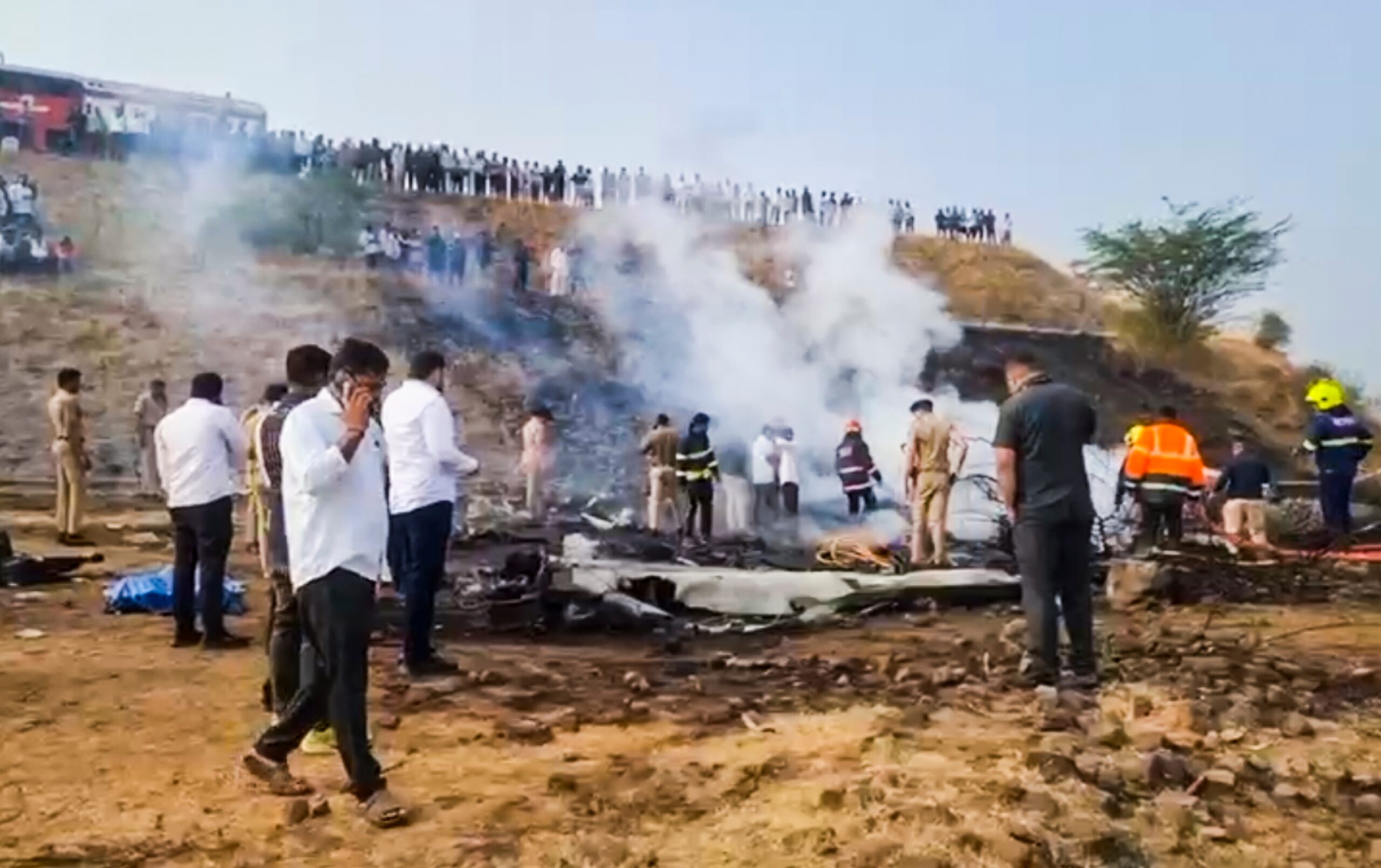
Pawar, 66, perished alongside four others when his private jet plummeted into a hilly terrain near Pune on Wednesday evening, marking a devastating blow to the state’s fractious alliance government.
The crash occurred around 6:45 PM as Pawar’s Beechcraft King Air, en route from Mumbai to Baramati, encountered severe weather.
Eyewitnesses reported thick fog and turbulence before the aircraft issued a mayday call.
Rescue teams recovered the charred remains from the wreckage scattered across rugged farmland.
Preliminary investigations point to mechanical failure compounded by poor visibility, though aviation authorities have launched a full probe.

Ajit Pawar (left) with his uncle Sharad Pawar, founder of NCP
Among the deceased were Pawar’s aide, the pilot, co-pilot, and two security personnel.
Maharashtra Chief Minister Devendra Fadnavis expressed profound grief, calling Pawar “a towering figure whose pragmatism shaped our state’s progress.”
Prime Minister Narendra Modi echoed the sentiment, hailing Pawar’s contributions to irrigation, cooperatives, and infrastructure.
Yet, Pawar’s demise exposes the fragility of Maharashtra’s ruling Mahayuti coalition—comprising the BJP, Eknath Shinde’s Shiv Sena, and Pawar’s NCP faction—which clinched a landslide in the 2024 assembly polls.
Born in 1959 in rural Baramati, Ajit Pawar was groomed by his uncle, Sharad Pawar, the NCP founder and veteran strategist.
Baramati, a sugar-rich belt in western Maharashtra, became his fiefdom. Elected MLA in 1991, he rose to guardian minister, spearheading projects like the ambitious irrigation schemes that earned him the moniker “Aba Saheb.”
Under his watch, Baramati transformed from agrarian backwater to a hub of education and industry, with institutions like Vidya Pratishthan underscoring his development focus.

Ajit Pawar (right) with Maharashtra Chief Minister Devendra Fadnavis (left) and Shiv Sena leader Eknath Shinde (centre) at a joint press conference after their victory in the 2024 Maharashtra state assembly elections
Pawar’s style contrasted sharply with Sharad’s calculated diplomacy. Blunt and action-oriented, he prioritized local networks over ideology, controlling cooperatives that wielded economic clout.
Critics accused him of cronyism, pointing to scams like the Maharashtra irrigation controversy in 2012, where he briefly resigned amid allegations of ₹70,000 crore graft—charges later dropped.
Family tensions defined his later years. Long overshadowed by Sharad, Ajit rebelled in 2019, briefly allying with the BJP to become deputy CM in a short-lived coup.
The gambit failed, but it foreshadowed the 2023 schism. Ajit split the NCP, aligning with Mahayuti and securing the party’s name and bicycle symbol via Election Commission ruling.
This left Sharad’s faction, led by daughter Supriya Sule, as NCP (Sharadchandra Pawar), splintering the Pawar dynasty.
The rift fueled Maharashtra’s volatile politics, where alliances shift like monsoon winds. Pawar’s faction holds 41 MLAs, pivotal to the coalition’s 235-seat majority.
His death raises urgent questions: Will his 40-odd loyalists defect to Sharad’s camp? Could Supriya Sule, a vocal critic, consolidate power? Or will Pawar’s wife Sunetra or son Parth emerge as heirs?Political analysts predict turbulence.
“Ajit was the glue holding Mahayuti’s diverse partners,” says Prakash Akolkar, a Pune-based commentator.
Recent civic poll wins in Pune and Mumbai had sparked reconciliation rumors, with whispers of a unified NCP under Ajit.
Now, those evaporate. The opposition Maha Vikas Aghadi (Congress-NCP-SP) smells opportunity, eyeing by-elections.
Economically, Maharashtra—contributing 13% to India’s GDP—faces headwinds.
Pawar championed urban projects and farmer welfare, including the ₹6,000 crore farm loan waiver.
His absence could stall initiatives amid farmer unrest and Mumbai’s infrastructure crunch.Tributes poured in from across the spectrum.
Uddhav Thackeray, Shinde’s rival, mourned the “seasoned administrator.” Rahul Gandhi lauded his “ground-level governance.”
In Baramati, thousands gathered for Pawar’s funeral Thursday, blending grief with chants of his legacy.
As investigations continue and power brokers maneuver, Pawar’s death underscores Maharashtra’s intricate web of ambition, loyalty, and betrayal.
Once a symbol of Pawar parivar unity, he leaves a fractured inheritance—reminding India that in politics, personal voids can reshape entire landscapes.
Discover more from AMERICA NEWS WORLD
Subscribe to get the latest posts sent to your email.